
[論文レビュー] A collider test of nano-Hertz gravitational waves from pulsar timing arrays
本論文は、パulsarタイムイングアレイ(PTA)が検出したナノヘルツスケールの重力波(GW)背景が、標準模型(SM)とヒッグスポータルを通じて結合するMeVスケールの隠れたセクターにおける一次相転移(FOPT)に起因する可能性を提案している。また、観測されたGW信号を生成するために必要な大きなポータル結合が、LHCおよび将来のレプトン衝突加速器(CEPC、ILC、FCC-ee)におけるヒッグスの非可視崩壊を通じて探査可能であることを示しており、このGW背景の起源に対する直接的な衝突加速器実験的検証が可能である。
A cosmic first-order phase transition (FOPT) occurring at MeV-scale provides an attractive explanation for the nano-Hertz gravitational wave (GW) background indicated by the recent pulsar timing array data from the NANOGrav, CPTA, EPTA and PPTA collaborations. We propose this explanation can be further tested at the colliders if the hidden sector couples to the Standard Model sector via Higgs portal. Through a careful analysis of the thermal history of the hidden sector, we demonstrate that in order to successfully explain the observed GW signal, the portal coupling must be sizable that it can be probed through Higgs invisible decay at the LHC or future lepton colliders such as CEPC, ILC, and FCC-ee. Our research offers a promising avenue to uncover the physical origin of the nano-Hertz GWs through particle physics experiments.
研究の動機と目的
- パulsarタイムイングアレイ(PTA)が観測したナノヘルツスケールの重力波(GW)背景が、MeVスケールの隠れたセクターにおける一次相転移(FOPT)によって説明可能かどうかを調査すること。
- このようなFOPTが素粒子実験、特に衝突加速器探索に与える影響を特定すること。
- GW信号の振幅と隠れたセクターへのヒッグスポータル結合の強さとの間の関係を確立すること。
- HL-LHC、CEPC、ILC、FCC-eeなどの現在および将来の加速器の感度が、PTAデータを説明するために必要なポータル結合のパラメータ空間をどの程度カバーできるかを評価すること。
提案手法
- ゲージ化されたU(1)Xダークセクターを有する最小モデルを採用し、そのセクターにはスカラーおよびダークゲージボソンが含まれ、これらはヒッグスポータルを通じて標準模型(SM)と結合する。
- 有限温度におけるダークスカラーの有効ポテンシャルを計算し、1ループ量子補正および熱的効果を反映するデイジー再帰挙動を含める。
- 初期の弱いポータル結合による分離を考慮した上で、隠れたセクターの温度がSMセクターに対してどの程度であるかを、熱的歴史を分析することで特定する。
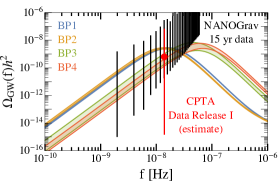
- バブル衝突および音響波の寄与に基づく標準的な確率的GW背景生成フレームワークを用いて、重力波スペクトルを計算する。
- ポータル結合の関数としてヒッグス非可視崩壊幅を導出し、直接的な衝突加速器感度推定を可能にする。
- ベンチマーク点を数値的に解析し、GW生成に必要なポータル結合とHL-LHCおよび将来のレプトン加速器の探査能力を比較する。
実験結果
リサーチクエスチョン
- RQ1PTAが観測したナノヘルツスケールの重力波背景は、MeVスケールの隠れたセクターにおける一次相転移によって説明可能か?
- RQ2観測されたGW振幅を生成するためにはどの程度のヒッグスポータル結合の強さが必要であり、それが加速器で探査可能か?
- RQ3隠れたセクターの初期の熱的分離は、GW信号および必要なポータル結合にどのような影響を与えるか?
- RQ4HL-LHCおよび将来的なレプトン加速器(CEPC、ILC、FCC-ee)は、PTAのGW信号を説明するために必要なパラメータ空間をどの程度カバーできるか?
- RQ5確率的GW背景とヒッグスポータル結合によるヒッグスの非可視崩壊との間には、直接的な関連性があるか?
主な発見
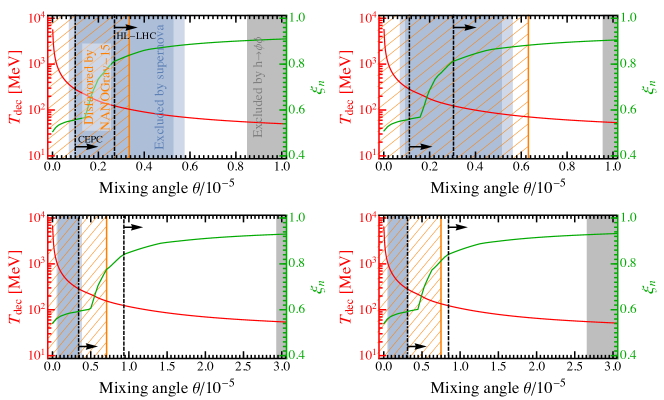
- 観測されたナノヘルツスケールのGW背景を生成するには、大きなヒッグスポータル結合が必要であり、それより小さい結合では相転移時のエネルギー放出が不十分になる。
- 必要なポータル結合はヒッグスボソンの非可視ブランチング比を顕著に増大させ、HL-LHCにおけるヒッグス非可視崩壊を通じて検出可能である。
- HL-LHCは、PTAのGW信号と整合するパラメータ空間の大部分を探査可能であると予想される。
- 将来的なレプトン加速器(CEPC、ILC、FCC-ee)は、GW背景を説明するために必要なパラメータ空間のほぼ全域をカバーできる。
- 本研究は、天体的観測による確率的GW背景と、特定の素粒子物理学的過程(ヒッグス非可視崩壊)との間の直接的かつ検証可能な関係を確立した。
より良い研究を、今すぐ始めましょう
論文の読解から最終レビューまで、研究時間を劇的に削減しましょう。
クレジットカード登録不要
このレビューはAIが作成し、人間の編集者が確認しました。