
[論文レビュー] A comprehensive review of 3D convolutional neural network-based classification techniques of diseased and defective crops using non-UAV-based hyperspectral images
本論文は、ドローン非搭載の高スペクトル画像(HSI)を用いた作物の病害虫・欠陥の分類に、3次元畳み込みニューラルネットワーク(3D-CNN)技術をレビューし、空間的およびスペクトル的特徴を同時に抽出できる能力に注目し、分類精度の向上を図っている。データ不足や計算コストの高さといった課題を強調し、転移学習、アクティブラーニング、スペクトル帯選択などの解決策を提示することで、限られたHSIデータセットにおけるモデルの効率性と性能を向上させている。
Hyperspectral imaging (HSI) is a non-destructive and contactless technology that provides valuable information about the structure and composition of an object. It can capture detailed information about the chemical and physical properties of agricultural crops. Due to its wide spectral range, compared with multispectral- or RGB-based imaging methods, HSI can be a more effective tool for monitoring crop health and productivity. With the advent of this imaging tool in agrotechnology, researchers can more accurately address issues related to the detection of diseased and defective crops in the agriculture industry. This allows to implement the most suitable and accurate farming solutions, such as irrigation and fertilization before crops enter a damaged and difficult-to-recover phase of growth in the field. While HSI provides valuable insights into the object under investigation, the limited number of HSI datasets for crop evaluation presently poses a bottleneck. Dealing with the curse of dimensionality presents another challenge due to the abundance of spectral and spatial information in each hyperspectral cube. State-of-the-art methods based on 1D- and 2D-CNNs struggle to efficiently extract spectral and spatial information. On the other hand, 3D-CNN-based models have shown significant promise in achieving better classification and detection results by leveraging spectral and spatial features simultaneously. Despite the apparent benefits of 3D-CNN-based models, their usage for classification purposes in this area of research has remained limited. This paper seeks to address this gap by reviewing 3D-CNN-based architectures and the typical deep learning pipeline, including preprocessing and visualization of results, for the classification of hyperspectral images of diseased and defective crops. Furthermore, we discuss open research areas and challenges when utilizing 3D-CNNs with HSI data.
研究の動機と目的
- 3D-CNNの特徴抽出能力に優れているにもかかわらず、高スペクトル画像(HSI)分類における3D-CNNの実用化が限定的であるという問題に取り組む。
- データ不足、次元の高さ、計算コストといった、HSIを用いた作物分類における主な課題を特定する。
- 非ドローン型HSI応用に特化した3D-CNN向けに、前処理、モデルアーキテクチャ、可視化を含むディープラーニングパイプラインをレビューする。
- データ制限を克服し、モデル効率を向上させるために、転移学習、アクティブラーニング、有用なスペクトル帯選択などの戦略を検討する。
- 軽量モデルとMLaaS統合を提言し、農業現場でのリアルタイムでコスト効率の良い展開を可能にする。
提案手法
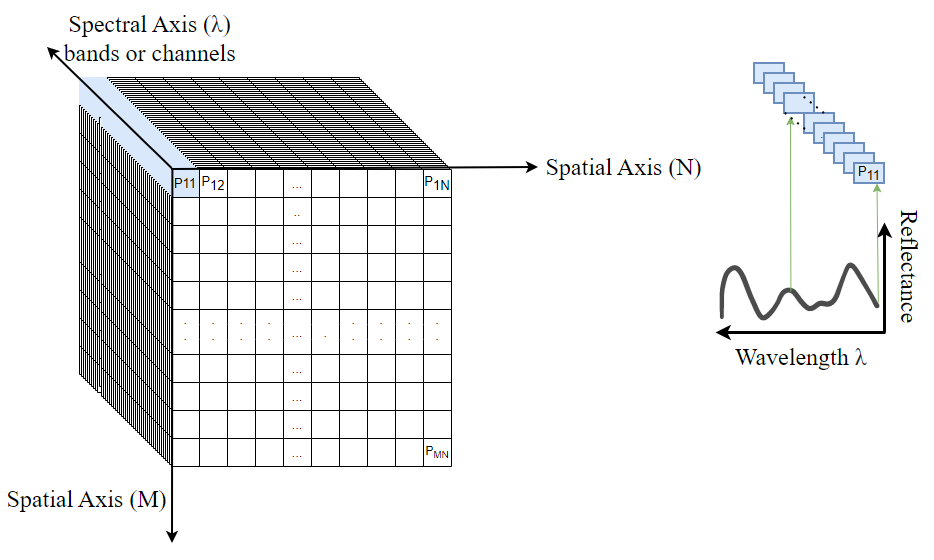
- 3次元テンソル(M×N×λ)として高スペクトルキューブを処理する3D-CNNアーキテクチャを用い、空間的およびスペクトル的特徴を統合的に捉える。
- 大規模データセットで事前学習されたモデルを小規模なHSI作物データセットに適応させる転移学習を適用し、データが限られた状況でも性能を向上させる。
- ラベル付けに最も有用なサンプルを反復的に選択することで、アノテーション負荷を軽減し、モデル精度を向上させるアクティブラーニングを採用する。
- NDVI や GCI などのスペクトルインデックスを分析し、特徴表現の強化とモデルの解釈性向上を支援する。
- バンドの削減やインデックスへのグループ化を検討し、モデルの複雑さ、トレーニング時間、メモリ使用量を低減する。
- 機械学習としてのサービス(MLaaS)プラットフォームを活用することで、インfra構築の負担を軽減し、非専門家ユーザーのためのモデル開発を加速する。
実験結果
リサーチクエスチョン
- RQ1ドローン非搭載の高スペクトル画像から、3D-CNNが作物病害虫・欠陥分類に効果的に空間的およびスペクトル的特徴を抽出する方法は何か?
- RQ2特にデータ不足と計算コストの観点から、3D-CNNを高スペクトル作物画像に適用する際の主な課題は何か?
- RQ3転移学習とアクティブラーニングは、限られたHSIデータセットで学習された3D-CNNモデルの性能をどの程度向上させ得るか?
- RQ4作物病害虫・欠陥の検出に最も有用なスペクトル帯は何か?また、それらを効率的な軽量モデルを構築するためにどのように選択すべきか?
- RQ5MLaaSプラットフォームとモデル最適化技術を活用することで、精密農業におけるリアルタイムで現地に展開可能な3D-CNNシステムをどのように実現できるか?
主な発見
- 3D-CNNは、空間的およびスペクトル的特徴を統合的にモデル化できるため、1Dおよび2D-CNNを上回る分類精度を実現する。
- 転移学習により、事前学習済み重みを活用することで、小規模なHSIデータセットでもモデル性能が著しく向上し、過学習のリスクとトレーニング時間の両方を低減できる。
- アクティブラーニングにより、最も情報価値の高いサンプルを選択することで、ラベル付きデータの必要数を削減し、学習の効率性が向上する。
- スペクトル帯の選択とインデックスへのグループ化により、モデルの複雑さを低減し、トレーニング時間を短縮しながら、分類精度を維持または向上できる。
- MLaaSプラットフォームにより、事前構築済みの3D-CNNモデルとスケーラブルな計算インfraへのアクセスが可能となり、農業実務者にとっての参入障壁が低下する。
- 有望な技術であるにもかかわらず、データ不足と計算コストの高さのため、3D-CNNはHSIベースの作物分類でまだ十分に活用されていない。今後の研究とツール開発の必要性が示唆される。
より良い研究を、今すぐ始めましょう
論文の読解から最終レビューまで、研究時間を劇的に削減しましょう。
クレジットカード登録不要
このレビューはAIが作成し、人間の編集者が確認しました。