
[論文レビュー] A Comprehensive Survey on Automatic Knowledge Graph Construction
自動的な知識グラフ構築の網羅的な調査で、取得、洗練、進化のプロセス、さらにリソース、ツール、将来の方向性を詳述します。
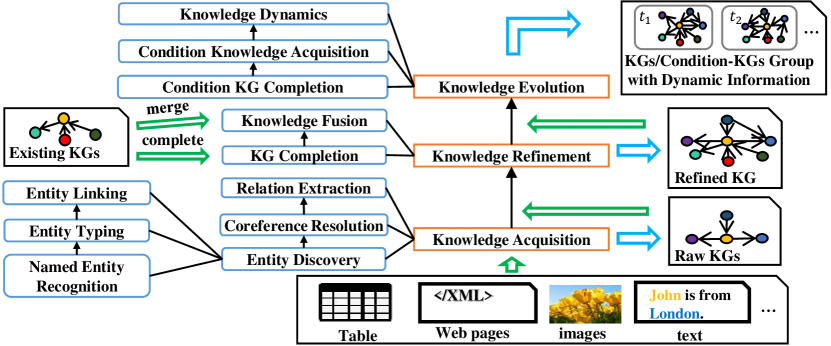
Automatic knowledge graph construction aims to manufacture structured human knowledge. To this end, much effort has historically been spent extracting informative fact patterns from different data sources. However, more recently, research interest has shifted to acquiring conceptualized structured knowledge beyond informative data. In addition, researchers have also been exploring new ways of handling sophisticated construction tasks in diversified scenarios. Thus, there is a demand for a systematic review of paradigms to organize knowledge structures beyond data-level mentions. To meet this demand, we comprehensively survey more than 300 methods to summarize the latest developments in knowledge graph construction. A knowledge graph is built in three steps: knowledge acquisition, knowledge refinement, and knowledge evolution. The processes of knowledge acquisition are reviewed in detail, including obtaining entities with fine-grained types and their conceptual linkages to knowledge graphs; resolving coreferences; and extracting entity relationships in complex scenarios. The survey covers models for knowledge refinement, including knowledge graph completion, and knowledge fusion. Methods to handle knowledge evolution are also systematically presented, including condition knowledge acquisition, condition knowledge graph completion, and knowledge dynamic. We present the paradigms to compare the distinction among these methods along the axis of the data environment, motivation, and architecture. Additionally, we also provide briefs on accessible resources that can help readers to develop practical knowledge graph systems. The survey concludes with discussions on the challenges and possible directions for future exploration.
研究の動機と目的
- 知識グラフとその構築の formal な基礎と分類を定義する。
- さまざまなデータ環境に跨る知識獲得、洗練、進化の方法を体系的にレビューする。
- 知識グラフ構築を支える実践的なリソース、データセット、ツールを要約する。
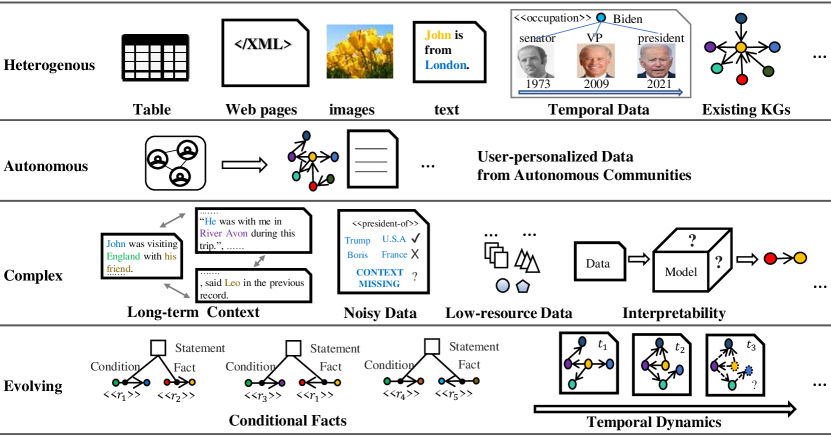
- HACE 大規模データ環境における課題を分析し、知識グラフの解釈性と進化を論じる。
- 知識グラフ構築の将来の方向性と未解決の課題を強調する。
提案手法
- formal 定義と背景知識を用いて知識グラフと構築プロセスを分類する。
- 取得、洗練、進化の各段階にまたがる300 超の方法を調査し、パラダイムを比較する。
- データ環境、動機、アーキテクチャの観点で議論を整理する。
- 実践的な知識グラフプロジェクト、データセット、構築ツールの概要を提供する。
- ノイズデータ、低リソース環境、モデルの解釈可能性へのアプローチを検討する。
- 今後の知識グラフ構築研究の方向性を示す。
実験結果
リサーチクエスチョン
- RQ1知識グラフとその構築プロセスの formal definitions と構成要素は何か。
- RQ2データ環境やタスクごとに、知識獲得、洗練、進化の方法はどのように異なるか。
- RQ3自動的な知識グラフ構築を支える実用的なリソース(データセット、ツール、プロジェクト)は何か、その特性は何か。
- RQ4HACE 大規模データ環境における知識グラフ構築の主な課題は何か、どう対処できるか。
- RQ5自動的な知識グラフ構築における将来の方向性と未解決の問題は何か。
主な発見
- 本調査は300件を超える方法を網羅し、知識グラフ構築を取得、洗練、進化の三段階プロセスとして描く。
- データ環境、動機、アーキテクチャに沿ってパラダイムをマッピングし、アプローチを比較する。
- 百科事典、言語学、常識、企業、領域特有、連合知識グラフなどの実践的な知識グラフプロジェクト、データセット、ツールの在庫を提供する。
- ノイズが多いデータ、文書レベル、低リソースデータ、解釈性、条件/時相知識グラフに関する議論を含む。
- データ、モデル、アーキテクチャの観点から、知識グラフ構築の課題と将来の方向性を概説する。
より良い研究を、今すぐ始めましょう
論文設計から論文執筆まで、研究時間を劇的に削減しましょう。
クレジットカード登録不要
このレビューはAIが作成し、人間の編集者が確認しました。