
[論文レビュー] A fast-rotator post-starburst galaxy quenched by supermassive black-hole feedback at z=3
この JWST 研究は z=3.064 における巨大な静止星背景をもつ銀河の NIRSpec IFU 観測を提示し、SMBH 主導の排出フィードバックと高速回転ディスクを示す。星形成ディスクを破壊せずに quenching を示唆する。
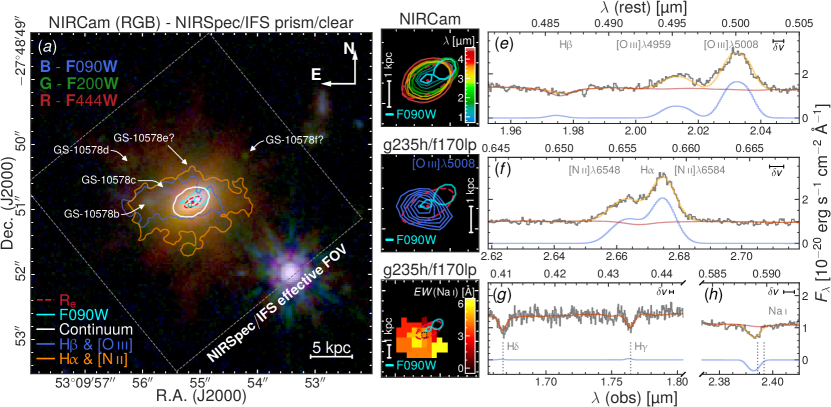
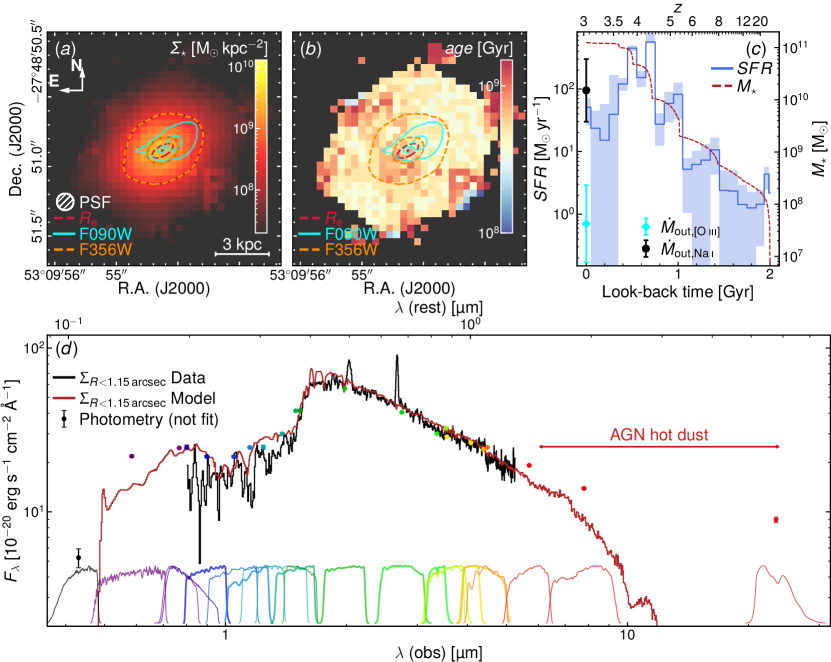
There is compelling evidence that the most massive galaxies in the Universe stopped forming stars due to the time-integrated feedback from their central super-massive black holes (SMBHs). However, the exact quenching mechanism is not yet understood, because local massive galaxies were quenched billions of years ago. We present JWST/NIRSpec integral-field spectroscopy observations of GS-10578, a massive, quiescent galaxy at redshift z=3.064. From the spectrum we infer that the galaxy has a stellar mass of $M_*=1.6\pm0.2 \times 10^{11}$ MSun and a dynamical mass $M_{\rm dyn}=2.0\pm0.5 \times 10^{11}$ MSun. Half of its stellar mass formed at z=3.7-4.6, and the system is now quiescent, with the current star-formation rate SFR<9 MSun/yr. We detect ionised- and neutral-gas outflows traced by [OIII] emission and NaI absorption. Outflow velocities reach $v_{\rm out}\approx$1,000 km/s, comparable to the galaxy escape velocity and too high to be explained by star formation alone. GS-10578 hosts an Active Galactic Nucleus (AGN), evidence that these outflows are due to SMBH feedback. The outflow rates are 0.14-2.9 and 30-300 MSun/yr for the ionised and neutral phases, respectively. The neutral outflow rate is ten times higher than the SFR, hence this is direct evidence for ejective SMBH feedback, with mass-loading capable of interrupting star formation by rapidly removing its fuel. Stellar kinematics show ordered rotation, with spin parameter $λ_{Re}=0.62\pm0.07$, meaning GS-10578 is rotation supported. This study shows direct evidence for ejective AGN feedback in a massive, recently quenched galaxy, thus clarifying how SMBHs quench their hosts. Quenching can occur without destroying the stellar disc.
研究の動機と目的
- 最も巨大な銀河がどのように quenched するか、AGN フィードバックによるガス除去が必須かを理解する動機づけ。
- z~3 の静止銀河における恒星質量・力学質量・星形成史・現在の星形成率を定量化する。
- ガスのアウトフロー(電離ガスおよび中性ガス)を検出・特徴づけし、AGN 活動との関連性を評価する。
- quenched な過程で銀河の回転支配と力学的状態を評価する。
提案手法
- 銀河全体の星とガスの性質を地図化するため、プリズム/クリアおよび高分解能 g235h/f170lp 構成で JWST/NIRSpec IFS データを取得する。
- spaxel ごとに全スペクトルエネルギー分布(SED)モデリングを実施し、表面星質量密度・星族年齢・星形成史を導出する。
- BPT 図を含む[発射線診断]を用いてAGN の光イオン化とアウトフローの兆候を同定; O III および Hα+nII から電離アウトフロー率を推定する。
- Na I 吸収を用いて中性ガスを検出・マッピングし、高速で大規模な中性アウトフローを追跡する;速度と質量負荷を推定する。
- 星の運動学を測定して回転(lambdar)を導出し、銀河が高速回転体かを評価する;力学質量と恒星質量を比較する。
実験結果
リサーチクエスチョン
- RQ1この巨大な z~3 銀河の quenching は星形成駆動の風ではなく SMBH フィードバックによって起こっているのか。
- RQ2ガスのアウトフロー(電離および中性)は将来の星形成を抑制するのに十分な質量と運動量を運んでいるのか。
- RQ3銀河は回転支援か(高速回転体)?これが z=0 までの進化経路に何を意味するか。
- RQ4恒星集団年齢と観測時点に対する主たる星形成エピソードのタイミングはどうか。
- RQ5AGN はこの系の ISM/CGM の形態と運動学にどのような影響を与えるか。
主な発見
- Stellar mass Mstar = 1.6 ± 0.2 × 10^11 solar masses and a dynamical mass Mdynvalue; main star-formation episode occurred at z = 3.7–4.6, with current SFR < 9 solar masses per year.
- Outflows detected in ionised (O III) and neutral (Na I) gas with velocities up to ~1000 km/s, comparable to the escape velocity and exceeding what star formation alone would drive.
- Ionised-gas outflow rate is 0.14–2.9 solar masses per year, while neutral-gas outflow rate is 30–300 solar masses per year, with neutral loading far exceeding the SFR, indicating ejective SMBH feedback capable of removing star-forming fuel.
- AGN evidence includes X-ray luminosity and mid-infrared SED excess; AGN bolometric luminosity L_AGN ≈ 2.6 ± 0.9 × 10^45 erg/s.
- Stellar kinematics show ordered rotation with spin parameter lambda_R(Re) = 0.62 ± 0.07, indicating the galaxy is rotation-supported (fast rotator) despite quenching and compactness.
- Galaxy is extremely compact and, in the local universe, would be a strong outlier on mass-size relations; comparison suggests significant dynamical and morphological evolution required between z ≈ 3 and present to grow in size and reduce angular momentum.
より良い研究を、今すぐ始めましょう
論文設計から論文執筆まで、研究時間を劇的に削減しましょう。
クレジットカード登録不要
このレビューはAIが作成し、人間の編集者が確認しました。