
[論文レビュー] A Full Dive into Realizing the Edge-enabled Metaverse: Visions, Enabling Technologies,and Challenges
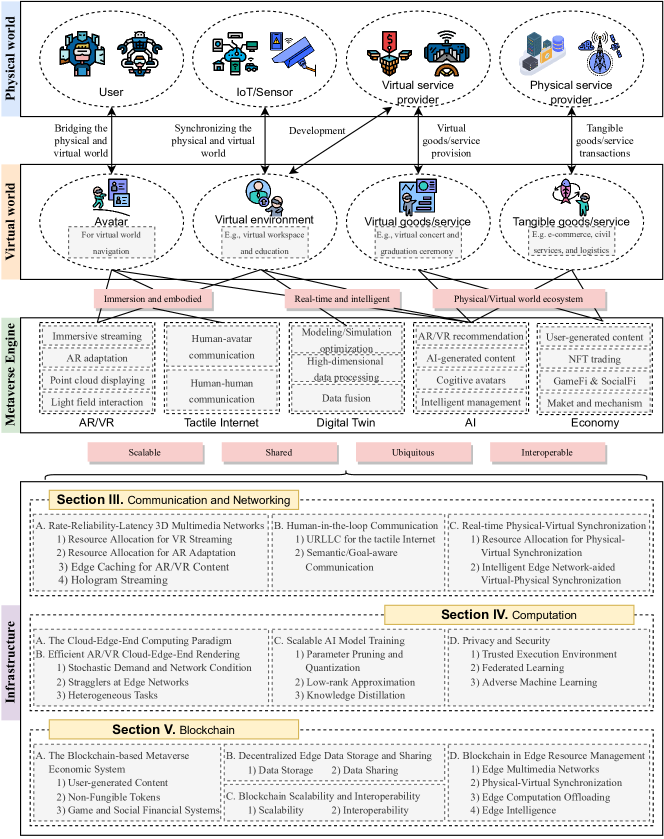
この論文はエッジ接続型メタバースを概観し、アーキテクチャ、エッジ対応の実現を支える技術(通信、計算、ブロックチェーン)、課題、モバイルエッジネットワーク上でスケーラブルで没入型かつ相互運用可能なメタバースを実現するための今後の研究方向を詳述します。
Dubbed "the successor to the mobile Internet", the concept of the Metaverse has grown in popularity. While there exist lite versions of the Metaverse today, they are still far from realizing the full vision of an immersive, embodied, and interoperable Metaverse. Without addressing the issues of implementation from the communication and networking, as well as computation perspectives, the Metaverse is difficult to succeed the Internet, especially in terms of its accessibility to billions of users today. In this survey, we focus on the edge-enabled Metaverse to realize its ultimate vision. We first provide readers with a succinct tutorial of the Metaverse, an introduction to the architecture, as well as current developments. To enable ubiquitous, seamless, and embodied access to the Metaverse, we discuss the communication and networking challenges and survey cutting-edge solutions and concepts that leverage next-generation communication systems for users to immerse as and interact with embodied avatars in the Metaverse. Moreover, given the high computation costs required, e.g., to render 3D virtual worlds and run data-hungry artificial intelligence-driven avatars, we discuss the computation challenges and cloud-edge-end computation framework-driven solutions to realize the Metaverse on resource-constrained edge devices. Next, we explore how blockchain technologies can aid in the interoperable development of the Metaverse, not just in terms of empowering the economic circulation of virtual user-generated content but also to manage physical edge resources in a decentralized, transparent, and immutable manner. Finally, we discuss the future research directions towards realizing the true vision of the edge-enabled Metaverse.
研究の動機と目的
- Motivate and define the Metaverse architecture and its edge-enabled realization.
- Identify core communication, networking, computation, and blockchain challenges at mobile edge networks.
- Survey current and emerging solutions and technologies to enable ubiquitous, immersive Metaverse access.
- Highlight interoperability, security, and resource management considerations for edge deployments.
- Outline future research directions toward a scalable, embodied Metaverse.
提案手法
- Provide a succinct tutorial on Metaverse architecture and current developments.
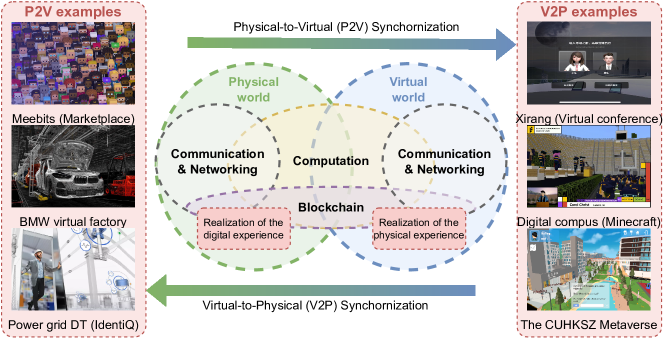
- Systematically review communication and networking challenges and survey next-generation solutions (e.g., semantic/goal-aware communication, real-time synchronization).
- Classify computation solutions into cloud-edge-end paradigms and AI-driven acceleration techniques for edge devices.
- Examine blockchain/DLT roles in interoperability, secure data sharing, resource management, and economy.
- Discuss future research directions and open issues across architecture, technologies, and deployment.
- Ground the discussion with examples and current developments (MMO games, smart cities, industry use cases).
実験結果
リサーチクエスチョン
- RQ1What are the architectural principles and current developments of the Metaverse, especially in edge-enabled contexts?
- RQ2What are the primary communication, networking, and synchronization challenges for edge-enabled Metaverse access, and what solutions exist?
- RQ3How can computation be effectively offloaded and accelerated across cloud, edge, and end devices to support Metaverse workloads?
- RQ4What roles can blockchain and distributed ledger technologies play in interoperability, data management, and economics within the edge Metaverse?
- RQ5What are the key future research directions and open challenges toward realizing a scalable, immersive, and ubiquitous edge-enabled Metaverse?
主な発見
- Provides a tutorial definition and architecture of the Metaverse emphasizing embodied, interoperable, immersive, and shared ecosystems.
- Identifies and discusses challenges in communication, networking, computation, and blockchain key to enabling edge-based Metaverse experiences.
- Reviews solutions including semantic/goal-aware communication, multi-layer computation offloading (cloud-edge-end), and AI-driven acceleration.
- Elaborates on how blockchain enables ownership (NFTs), data interoperability (cross-chain), and decentralized resource management for edge networks.
- Outlines future research directions and guidelines for achieving ubiquitous access, interoperability, and scalable Metaverse deployment at mobile edges.
より良い研究を、今すぐ始めましょう
論文設計から論文執筆まで、研究時間を劇的に削減しましょう。
クレジットカード登録不要
このレビューはAIが作成し、人間の編集者が確認しました。