
[論文レビュー] A guided light system for agile individual addressing of Ba$^+$ qubits with $10^{-4}$ level intensity crosstalk
本論文は、レーザーで加工された波導とファイバー結合型自己走査型光モジュレータ(AOM)を用いた、Ba⁺量子ビットのためのガイド光個別アドレス指定システム(GLIAS)を提案する。このシステムにより、16本のビームについて強度、周波数、位相の独立的かつ迅速な制御が可能となり、隣接するイオン間で10⁻⁴レベルの相対的強度クロストークを達成した。これは、スケーラブルな捕獲イオン量子コンピューティングにおけるクロストーク誘発誤りを顕著に低減するものである。
Trapped ions are one of the leading platforms for quantum information processing, exhibiting the highest gate and measurement fidelities of all contending hardware. In order to realize a universal quantum computer with trapped ions, independent and parallel control over the state of each qubit is necessary. The manipulation of individual qubit states in an ion chain via stimulated Raman transitions generally requires light focused on individual ions. In this manuscript, we present a novel, guided-light individual addressing system for hyperfine Ba$^+$ qubits. The system takes advantage of laser-written waveguide technology, enabled by the atomic structure of Ba$^+$, allowing the use of visible light to drive Raman transitions. Such waveguides define the spatial mode of light, suppressing aberrations that would have otherwise accumulated in a free-space optics set up. As a result, we demonstrate a nearest neighbour relative intensity crosstalk on the order of 10$^{-4}$, without any active aberration compensation. This is comparable to or better than other previous demonstrations of individual addressing. At the same time, our modular approach provides independent and agile control over the amplitude, frequency, and phase of each channel; combining the strengths of previous implementations.
研究の動機と目的
- 長鎖状のBa⁺イオンの個別アドレス指定を可能にするスケーラブルでモジュラーな光学システムの開発。
- ユニバーサル量子制御を実現するため、各アドレス指定ビームの強度、周波数、位相に対する独立的かつ迅速な制御の実現。
- 隣接イオン間の強度クロストークを10⁻⁴未満に低減し、故障耐性量子計算の閾値に近づける。
- レーザーで加工された波導およびファイバー光技術と互換性を持つ可視光波長のラーマン遷移を活用する。
- 493 nmでの状態検出と互換性を持つことで、中間回路測定および高精度な量子誤り訂正を可能にする。
提案手法
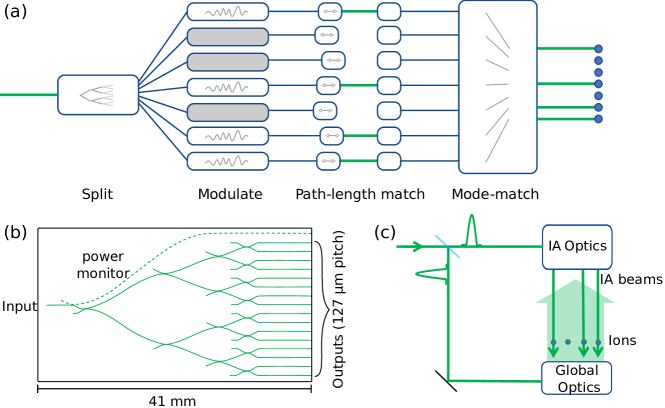
- フェムト秒レーザー直接加工(FLDW)技術を用いて、光の空間モードを定義するレーザーで加工された波導分岐器を製造し、歪みを抑制する。
- ファイバー結合型自己走査型光モジュレータ(AOM)を用いて、各ビームチャネルの振幅、周波数、位相を独立的かつ迅速に制御する。
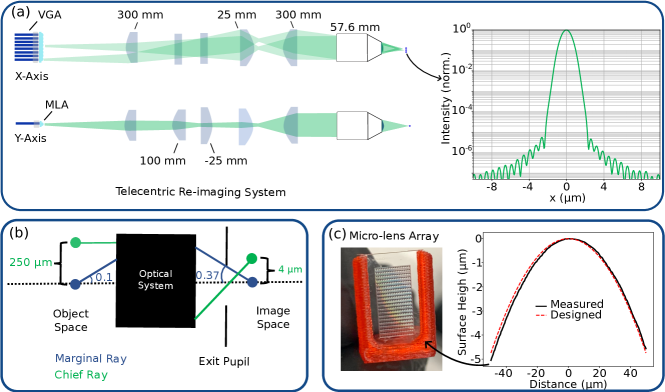
- 62.5×の縮小系により、ビームをイオン平面で0.9 µmのウェストに焦点化し、一般的なイオン鎖の間隔に一致させる。
- マイクロレンズアレイ(MLA)を用いて波導から目的レンズへの光の結合を実現するが、これによりクロストークに非対称性が生じる可能性がある。
- 強度クロストークは、1.12 µmピクセルを備えたRaspberry Pi Noir V2カメラを用いて、イオン平面でのビームプロファイルを撮影することで測定する。
- システムはモジュラー設計となっており、波導チップの交換が実装の再調整を伴わずに可能であり、将来の高対比統合波導とも互換性を持つ。
実験結果
リサーチクエスチョン
- RQ1レーザーで加工された波導を用いたガイド光システムは、Ba⁺量子ビットの個別アドレス指定において10⁻⁴未満の強度クロストークを達成できるか?
- RQ2ファイバー結合型AOMは、捕獲イオン系における複数のビームに対して、強度、周波数、位相を独立的かつ迅速に制御できるか?
- RQ3Ba⁺における可視光波長のラーマン遷移の使用は、UVベースのシステムと比較して、波導およびファイバー光技術との統合性を向上させるか?
- RQ4アクティブな歪み補償を用いなくても、クロストークレベルを10⁻⁴にまで低減でき、高精度な単一量子ビットゲートを保証できるか?
- RQ5493 nmでの状態検出と互換性を持つことで、中間回路測定および量子誤り訂正を実現できるか?
主な発見
- アクティブな歪み補償を用いなくても、隣接イオン間の相対的強度クロストークが約10⁻⁴に達した。
- 最初の3つのチャネルではクロストークが10⁻³のオーダー、残りのチャネルでは10⁻⁴のオーダーであり、MLAの製造上の不具合による非対称性が原因である可能性がある。
- ビームピークから4 µm離れた位置では、クロストークがわずかに10⁻⁴を超えており、イオン平面での測定結果と整合的である。
- クロストーク誘発Rabi周波数誤差は1%程度と推定され、最先端の性能と同等である。
- Ramanビームの両方に個別アドレス指定を適用することで、Rabi周波数のクロストーク誤差は0.01%にまで低減され、故障耐性量子誤り訂正の要件を満たす。
- モジュラー設計により、システムのアップグレードや波導チップの交換が再調整を伴わずに可能となり、より大きなイオン鎖へのスケーラビリティを実現する。
より良い研究を、今すぐ始めましょう
論文の読解から最終レビューまで、研究時間を劇的に削減しましょう。
クレジットカード登録不要
このレビューはAIが作成し、人間の編集者が確認しました。