
[論文レビュー] A JWST/NIRSpec First Census of Broad-Line AGNs at z=4-7: Detection of 10 Faint AGNs with M_BH~10^6-10^8 M_sun and Their Host Galaxy Properties
JWST/NIRSpec は z=4-7 の 10 個の微弱 broad-line AGN を低質量ブラックホール(約 10^6–10^8 Msun)とともに同定し、それらの宿主銀河、形態、および再電離への寄与を分析する。
We present a first statistical sample of faint type-1 AGNs at $z>4$ identified by JWST/NIRSpec deep spectroscopy. Among the 185 galaxies at $z_\mathrm{spec}=3.8-8.9$ confirmed with NIRSpec, our systematic search for broad-line emission reveals 10 type-1 AGNs at $z=4.015-6.936$ whose broad component is only seen in the permitted H$α$ line and not in the forbidden [OIII]$λ$5007 line that is detected with greater significance than H$α$. The broad H$α$ line widths of $\mathrm{FWHM}\simeq1000-6000\ \mathrm{km\ s^{-1}}$ suggest that the AGNs have low-mass black holes with $M_\mathrm{BH}\sim10^6-10^8\ M_\odot$, remarkably lower than those of low-luminosity quasars previously identified at $z>4$ with ground-based telescopes. JWST and HST high-resolution images reveal that the majority of them show extended morphologies indicating significant contribution to the total lights from their host galaxies, except for three compact objects two of which show red SEDs, probably in a transition phase from faint AGNs to low luminosity quasars. Careful AGN-host decomposition analyses show that their host's stellar masses are systematically lower than the local relation between the black hole mass and the stellar mass, implying a fast black hole growth consistent with predictions from theoretical simulations. A high fraction of the broad-line AGNs ($\sim5\%$), higher than $z\sim0$, indicates that a number density of such faint AGNs is higher than an extrapolation of the quasar luminosity function, implying a large population of AGNs including type 1 and type 2 in the early universe. Such faint AGNs contribute to cosmic reionization, while the total contribution is not large, up to $\sim50\%$ at $z\sim6$, because of their faint nature.
研究の動機と目的
- JWST/NIRSpec 光スペクトロスコピーによって同定された z>4 の微弱な broad-line (type-1) AGN の集団を調べる。
- これらの低質量 SMBH に対するブラックホール質量、ボリーメトリック光度、および Eddington 比を特徴づける。
- 恒星質量、形態、塵減衰を含む宿主銀河の性質を検討する。
- 宇宙再電離への微弱 AGN の寄与を評価し、局所および高-z の AGN 集団と比較する。
提案手法
- JWST/NIRSpec 光スペクトロスコピーによる 185 個の z-spec 3.8-8.9 銀河に対する広線放出の系統的探索(ERO GLASS、CEERS および関連プログラム)を実施。
- Hβ、[OIII]、Hα、[NII] を狭部と広部に分解して放出線をフィットし、広い Hα または Hβ が FWHM > 1000 km/s かつ SNR > 5 を満たす条件を適用。
- [OIII]、[NII] の狭部成分基準を適用して、AGN の広線シグネチャをアウトフローや合成系と区別。
- 広い Hα に基づく関係(z~0 での Greene & Ho 2005 の校正)を用いて M_BH を推定し、L_bol および Eddington 比を導出。
- 高分解能 JWST/HST イメージングを用いた宿主銀河特性の評価と AGN-宿主分解を実施。
- Balmer 減算および Calzetti 塵法を用いて AGN の E(B-V) や塵減衰を評価。
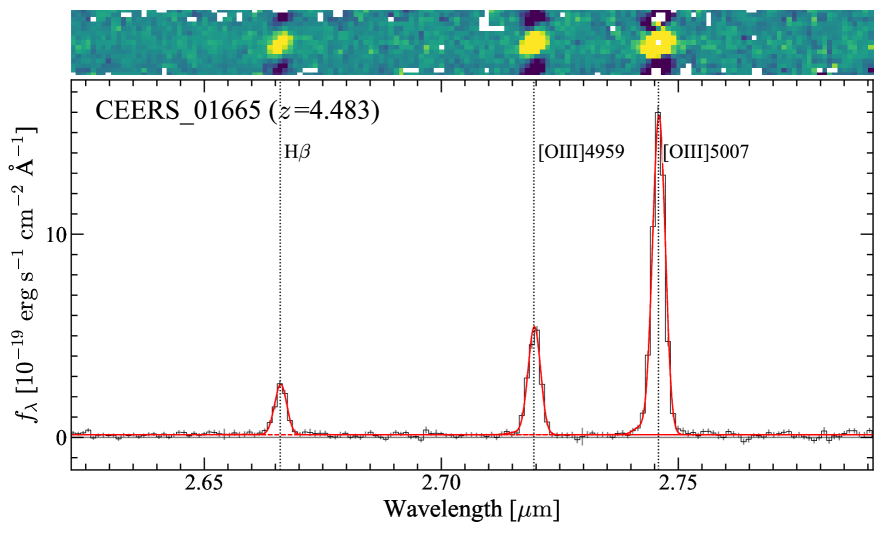
![Figure 1: NIRSpec spectra of CEERS_01244, GLASS_160133, GLASS_150029, and CEERS_00746. For each object, the left and middle panels show spectra around H $\beta$ +[ Oiii ] $\lambda\lambda$ 4959,5007 and H $\alpha$ +[ Nii ] $\lambda\lambda$ 6548,6584, respectively. The 2D and 1D spectra are shown in t](https://ar5iv.labs.arxiv.org/html/2303.11946/assets/x1.png)
実験結果
リサーチクエスチョン
- RQ1JWST/NIRSpec サンプルにおける z=4-7 での微弱な broad-line AGN の発生頻度と性質は何か?
- RQ2これらの低質量 SMBH のブラックホール質量、ボリメトリック光度、および Eddington 比はどうか。
- RQ3これらの AGN 宿主の恒星質量、形態、塵成分はどうなっているか。
- RQ4これらの微弱 AGN は局所で観測される M_BH–M_* 関係に位置づけられるか、それとも初期の SMBH 成長を示すか。
主な発見
| Name | R.A. | Decl. | z_spec | M_UV | 12+log(O/H) | E(B-V) | SNR_Halpha,broad | Delta_AIC |
|---|---|---|---|---|---|---|---|---|
| CEERS_01244 | 14:20:57.76 | +53:02:09.8 | 4.478 | -19.50^{+0.18}_{-0.18} | 7.67^{+0.20}_{-0.23} | 0.00 | 37.3 | 789.8 |
| GLASS_160133 | 00:14:19.27 | -30:25:27.8 | 4.015 | -18.94^{+0.08}_{-0.09} | 7.95^{+0.06}_{-0.05} | 0.16 | 32.5 | 2022.4 |
| GLASS_150029 | 00:14:18.52 | -30:25:21.3 | 4.583 | -19.20^{+0.10}_{-1.08} | 7.70^{+0.09}_{-0.08} | 0.17 | 18.1 | 431.1 |
| CEERS_00746 | 14:19:14.19 | +52:52:06.5 | 5.624 | -17.82^{+0.33}_{-0.61} | 8.29^{+0.24}_{-0.22} | 1.38 | 17.3 | 210.5 |
| CEERS_01665 | 14:20:42.77 | +53:03:33.7 | 4.483 | -21.66^{+0.07}_{-0.07} | 8.05^{+0.19}_{-0.19} | 0.42 | 11.6 | 132.0 |
| CEERS_00672 | 14:19:33.52 | +52:49:58.7 | 5.666 | -16.71^{+0.31}_{-1.16} | 8.57^{+0.30}_{-0.23} | 0.80 | 11.6 | 51.9 |
| CEERS_02782 | 14:19:17.63 | +52:49:49.0 | 5.241 | -19.50^{+0.12}_{-0.00} | 7.51^{+0.16}_{-0.16} | 0.28 | 11.2 | 78.6 |
| CEERS_00397 | 14:19:20.69 | +52:52:57.7 | 6.000 | -21.23^{+0.17}_{-0.24} | 7.87^{+0.14}_{-0.14} | 0.19 | 6.2 | 51.2 |
| CEERS_00717 | 14:20:19.54 | +52:58:19.9 | 6.936 | -21.49^{+0.12}_{-0.12} | 7.87^{+0.17}_{-0.18} | 0.00 | 6.1 | 23.9 |
| CEERS_01236 | 14:20:34.87 | +52:58:02.2 | 4.484 | -19.61^{+0.27}_{-0.23} | 7.55^{+0.29}_{-0.28} | 0.00 | 5.9 | 23.3 |
- z=4.015-6.936 の範囲で広い Hα 放出を持ち [OIII] に広い成分を認めない type-1 AGN を 10 個同定し、低質量ブラックホール M_BH ~ 10^6–10^8 M_sun を示唆。
- Broad Hα 線幅は FWHM ~ 1000–6000 km/s の範囲にあり、地上ベースで同定された高-z クエーサーと比較して相対的に低質量の SMBH を示唆。
- ほとんどの宿主は JWST/HST 画像で拡がって見え、宿主銀河の光が顕著であることを示唆;塵の多い赤色の SED を持つ3つのコンパクト天体は多様な宿主環境を示す。
- AGN-宿主分解は宿主の恒星質量が局所の M_BH–M_* 関係より体系的に小さいことを示し、宿主に比べてブラックホール成長が速いことを示唆。
- AGN は z=4-7 の銀河サンプルの約 5% を占め、-22 < M_UV < -17 の範囲で、z~0 の AGN 比率より高く、初期宇宙における微弱 AGN 集団が大きい可能性を示唆。
- Rest-UV 線診断の一部サブセットは複合的な特徴を示し、いくつかの天体は赤い連続体と顕著な塵減衰(E(B-V) up to ~1.4)を示し、 dusty AGN を示唆。
より良い研究を、今すぐ始めましょう
論文設計から論文執筆まで、研究時間を劇的に削減しましょう。
クレジットカード登録不要
このレビューはAIが作成し、人間の編集者が確認しました。