
[論文レビュー] A massive, neutral gas reservoir permeating a galaxy proto-cluster after the reionization era
本研究では、ビッグバン後10億年後のz ≈ 5.4の銀河プロトクラスタを貫く、巨大で空間的に一様な冷たい中性原子素性水素(H i)の貯留層の初回検出を報告する。JWST/NIRSpec分光法を用いた観測により、複数の背景銀河でH i吸収深さが最大10²³.⁵ cm⁻²に達することが判明し、これは現在の宇宙論的シミュレーションに挑戦する密度が高く大規模なガス過密度を示しており、宇宙再電離のトポロジーに大きな影響を及ぼす。
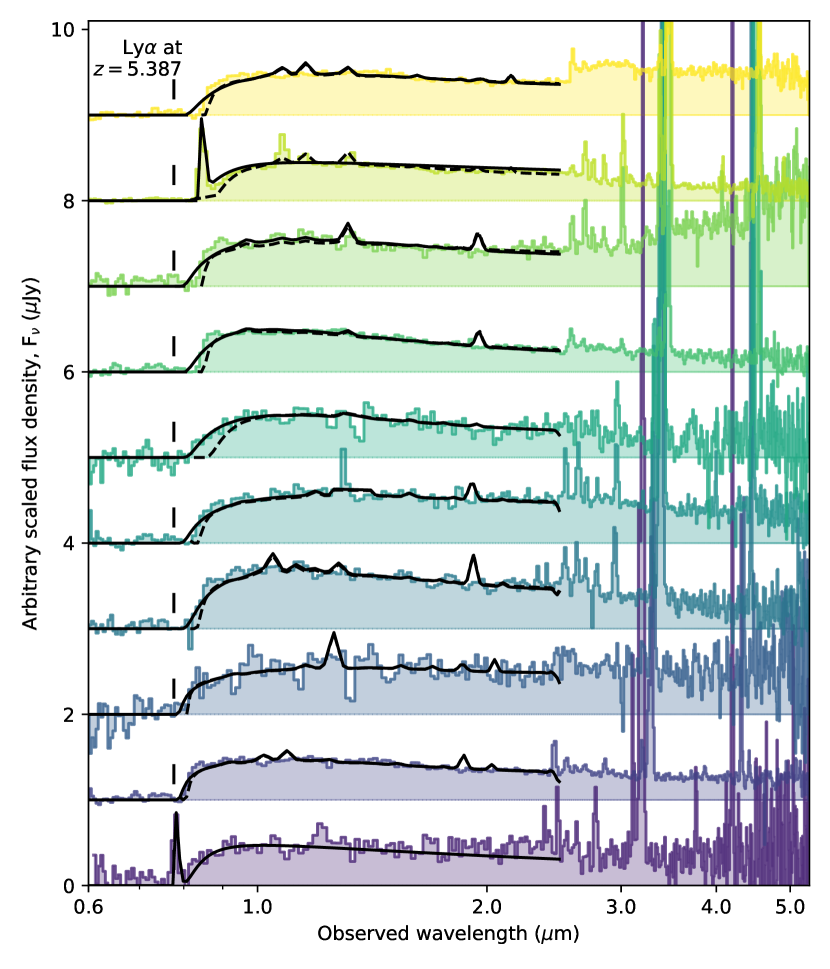
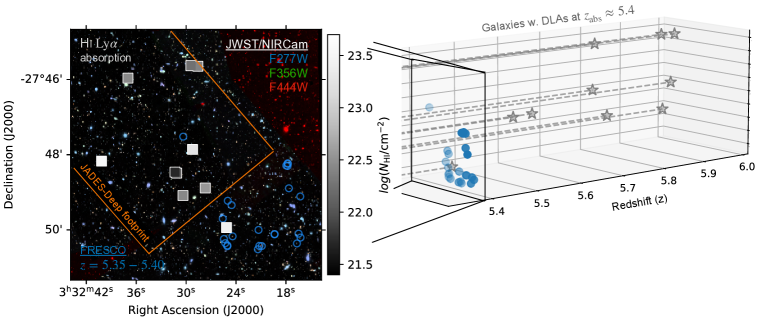
Galaxy clusters are the most massive, gravitationally-bound structures in the Universe, emerging through hierarchical structure formation of large-scale dark matter and baryon overdensities. Early galaxy ``proto-clusters'' are believed to be important physical drivers of the overall cosmic star-formation rate density and serve as ``hotspots'' for the reionization of the intergalactic medium. Our understanding of the formation of these structures at the earliest cosmic epochs is, however, limited to sparse observations of their galaxy members, or based on phenomenological models and cosmological simulations. Here we report the detection of a massive neutral, atomic hydrogen (HI) gas reservoir permeating a galaxy proto-cluster at redshift $z=5.4$, observed one billion years after the Big Bang. The presence of this cold gas is revealed by strong damped Lyman-$α$ absorption features observed in several background galaxy spectra taken with JWST/NIRSpec in close on-sky projection. While overall the sightlines probe a large range in HI column densities, $N_{ m HI} = 10^{21.7}-10^{23.5}$ cm$^{-2}$, they are similar across nearby sightlines, demonstrating that they probe the same dense, neutral gas. This observation of a massive, large-scale overdensity of cold neutral gas challenges current large-scale cosmological simulations and has strong implications for the reionization topology of the Universe.
研究の動機と目的
- z ≈ 5.4における希少で巨大な銀河プロトクラスタにおける、冷たい高密度中性ガスのバリオン的物質含量および分布を同定すること。
- 背景銀河で観測された強いダミング・ライマン・アルファ(DLA)吸収ラインが、共通の大規模H i貯留層由来であるのか、個々の主銀河由来であるのかを特定すること。
- このような巨大で一様なH i過密度が、初期宇宙における再電離のトポロジーに与える影響を評価すること。
- 現在の宇宙論的シミュレーションが、観測された極端なガス過密度および吸収深さ分布を再現できるかを検証すること。
- 統計的モデリングとシミュレーションを用いて、プロトクラスタ環境における高吸収深さH iガスの覆い範囲と空間的整合性を定量すること。
提案手法
- JWST/NIRSpecのプリズムモード分光法を用い、z = 5.4–6.0の10個の背景銀河で強いダミング・ライマン・アルファ(DLA)吸収特徴を検出。
- FRESCO調査からのJWST/NIRCamのスリットレス・グリズム観測と併用し、z ≈ 5.35–5.40のプロトクラスタメンバーを特定・赤方偏移測定。
- 光度測定の事前知識を適用し、Hαおよび[N II]線の検出が5σ以上に達する条件を満たすことで赤方偏移を確認し、銀河メンバーを同定。
- 赤方偏移および吸収深さの自由パラメータを用いてDLA吸収をモデリングし、大多数の視線方向で主銀河由来の可能性は3σ以上で除外。
- プロトクラスタ中心からの投影距離関数としてH i吸収深さの空間的分布をマッピングし、小スケールインパクトパラメータで類似した値を示すことを確認。
- z = 5.4における高解像度宇宙論的シミュレーション(Manhattan Suite)と観測結果を比較し、覆い範囲と過密度を分析。
実験結果
リサーチクエスチョン
- RQ1複数の背景銀河で観測された強いダミング・ライマン・アルファ(DLA)吸収は、共通の大規模H i貯留層由来か、個々の銀河寄与か?
- RQ2このプロトクラスタにおける中性ガスの空間的整合性および過密度はどの程度で、宇宙論的シミュレーションの予測と比較してどうなるか?
- RQ3現在のシミュレーションが、z ≈ 5.4における観測された吸収深さ分布およびH iの覆い範囲をどの程度再現できるか?
- RQ4このような巨大で冷たいH i貯留層の存在が、初期銀河過密度における再電離トポロジーおよび電離光子予算にどのように影響を与えるか?
- RQ5中性ガス貯留層の実効的物理的スケールおよび質量はどの程度であり、プロトクラスタのホール質量および星形成歴とどのように関係するか?
主な発見
- z ≈ 5.4の複数の背景銀河で、10²¹.⁷から10²³.⁵ cm⁻²の範囲のH i吸収深さを示す巨大で空間的に一様なH i貯留層が検出された。
- プロトクラスタ中心からの投影距離が100 kpc未塔の視線方向では、H i吸収深さが極めて類似しており、共通の高密度ガス構造の存在を示唆する。
- 観測されたH i過密度は、z ≈ 5.5における現在の宇宙論的シミュレーションの典型的値を大幅に上回る中性ガス分率f_HI(1+δ) ≈ 10³–10⁴を示唆している。
- シミュレーションではN_HI > 10²¹.⁷ cm⁻²のH iの覆い範囲は最大15%に達するが、このような極端で空間的に一様な過密度はManhattan Suiteシミュレーションでは再現されていない。
- プロトクラスタの全ホール質量はlog(M_halo/M☉) ≈ 12.6–12.8であり、z = 0における質量M₂₀₀,c ≈ 10¹⁵ M☉の巨大銀河クラスタの形成に一致する。
- 詳細な銀河形成物理学を含まないモデルでは、観測されたH i貯留層は説明できないため、初期構造形成における高密度中性ガスを捉えるための改良されたシミュレーションの必要性が強調された。
この論文を読む
Nubintのビューアで原文を開き、読みながら気になる箇所をすぐに質問できます。
Nubintでこの論文を読むこのレビューはAIが論文の原文をもとに作成しました。引用する前に原文をご確認ください。