
[論文レビュー] A massive quiescent galaxy at redshift 4.658
スペクトroscopic JWST による GS-9209 の z=4.658 における巨大な静止銀河としての確認と、質量が 3.8±0.2×10^10 M⊙、凍結は z≈6.5 まで完了しており、初期の迅速な形成と凍結を意味する。
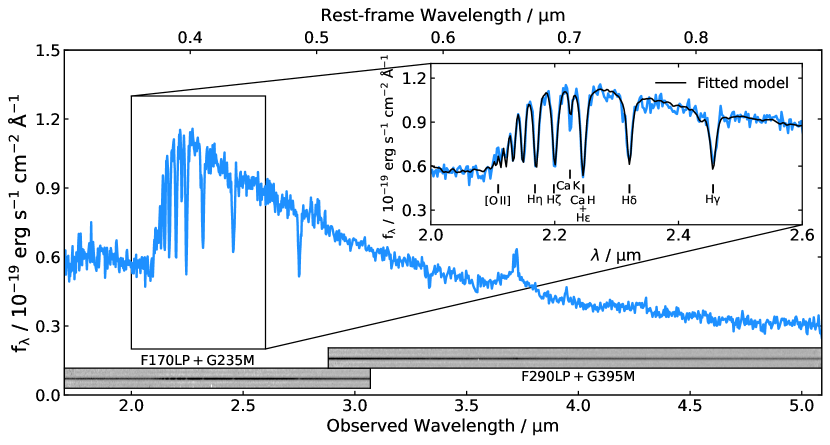
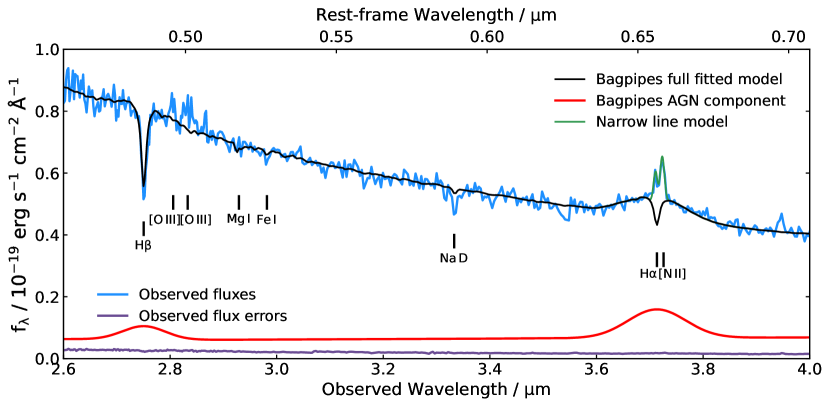
The extremely rapid assembly of the earliest galaxies during the first billion years of cosmic history is a major challenge for our understanding of galaxy formation physics. The advent of JWST has exacerbated this issue by confirming the existence of galaxies in significant numbers as early as the first few hundred million years. Perhaps even more surprisingly, in some galaxies, this initial highly efficient star formation rapidly shuts down, or quenches, giving rise to massive quiescent galaxies as little as 1.5 billion years after the Big Bang. However, due to their faintness and red colour, it has proven extremely challenging to learn about these extreme quiescent galaxies, or to confirm whether any exist at earlier times. Here we report the spectroscopic confirmation of a massive quiescent galaxy, GS-9209, at redshift $z=4.658$, just 1.25 billion years after the Big Bang, using JWST NIRSpec. From these data we infer a stellar mass of $M_* = 3.8\pm0.2 imes10^{10}\ M_\odot$, which formed over a $\simeq200$ Myr period before this galaxy quenched its star formation activity at $z=6.5^{+0.2}_{-0.5}$, when the Universe was $\simeq800$ million years old. Based on the presence of broad H$α$ in the spectrum and a high narrow-line [NII]/H$α$ ratio, we infer the presence of an accreting supermassive black hole, with a mass of $M_\bullet = 5\pm1 imes10^{8}\ M_\odot$. This large black hole mass relative to the stellar mass suggests that active galactic nucleus (AGN) feedback may have been responsible for quenching this galaxy. GS-9209 is also extremely compact, with an effective radius, $r_e=215\pm20$ parsecs. This galaxy is both a likely descendent of the highest-redshift submillimetre galaxies and quasars, and a likely progenitor for the dense, ancient cores of the most massive local galaxies.
研究の動機と目的
- JWST NIRSpecデータを用いて z>4 での巨大な静止銀河の存在を示す。
- 質量・星形成史・凍結時期を含む恒星集団特性を推定する。
- 観測スペクトルと銀河進化に対するAGNの存在と影響を評価する。
- GS-9209を初期の巨大系の文脈に位置づけるため、銀河サイズ・密度・力学質量を特徴付ける。
提案手法
- Balmer特性を検出するために、1.7–5.1 μm をカバーする G235M および G395M のグレーティングを用いた JWST NIRSpec 分光法(分解能 R≈1000)。
- スペクトロスコピーと多波長光度測定を組み合わせるため、Bagpipes コードによる完全なスペクトロフォトメトリックフィッティング。
- 22パラメータのモデルを用い、星形成、塵、星間物質、AGN成分を含む。BC03/MILES ライブラリに基づく事前分布と double-power-law SFH による情報を用いる。
- AGN由来の狭線をマスクしつつ、星形成の可能性を示す星間成分を適合。
- AGN連続体と広い Hα/Hβ 放射をモデル化して星成分と非星成分を分離。
- JWST NIRCam F210M 画像と PetroFit を用いたサイズ・構造解析で、星成分とAGN成分を分解。
実験結果
リサーチクエスチョン
- RQ1GS-9209 の赤方偏移とスペクトルによる確認状況はどうか?
- RQ2GS-9209 の質量と星形成史はどのようで、いつ形成され凍結したか?
- RQ3GS-9209 はAGNをホストしているのか、観測スペクトルと推定特性にどう影響するのか?
- RQ4GS-9209 の構造・動的特性(サイズ・密度・速度分散・力学質量)はどうで、他の高赤方偏移静止系とどう比較されるか?
主な発見
- GS-9209 は z = 4.6582 ± 0.0002 で、Balmer 主成分スペクトルを示し、SFR の急激な最近の低下を示唆する。
- Stellar mass は log10(M*/M⊙) = 10.58 ± 0.02、塵減衰はほとんどなく (AV = 0.02 ± 0.02)。
- 形成時期は zform = 6.9 ± 0.2 で、凍結は zquench = 6.5^{+0.2}_{-0.5}、凍結前に約200 Myr の星形成エピソード。
- 広い Hα 放出と [N II]/Hα 比が約 -0.01 ± 0.04、AGN 活動を示し、AGN は 5100 Å で約 7.5% のフ flux、広い Hα の FWHM は ≈ 10300 ± 700 km s⁻¹。
- 星成分の有効半径は re = 0.033 ± 0.003 arcsec、 z = 4.658 で 215 ± 20 pc に対応、Sérsic 指数 n = 2.3 ± 0.3、 stellar-mass 表面密度 log10(Σeff/M⊙ kpc⁻²) = 11.15 ± 0.08。
- 力学質量は log10(Mdyn/M⊙) = 10.3 ± 0.1、星質量よりわずかに小さい;Hα と速度分散の測定から SMBH の質量は約 (0.5–1)×10^9 M⊙ と推定される。
より良い研究を、今すぐ始めましょう
論文設計から論文執筆まで、研究時間を劇的に削減しましょう。
クレジットカード登録不要
このレビューはAIが作成し、人間の編集者が確認しました。