
[論文レビュー] A nebular origin for the persistent radio emission of fast radio bursts
本論文は、近距離の繰り返し発生するフレッシュ・ラジオ・バースト(FRB)20201124Aと関連する恒常的ラジオ源(PRS)の検出を報告している。このPRSは逆スペクトルを示し、回転測定値(RM)が低く(1000 rad/m²未塔)、発生源が星雲由来である可能性を支持している。PRSは、若い磁気星を取りまく磁場を有する電離星雲からのシンクロトロン放射と整合的であり、低放射度領域におけるRM–放射度関係を拡張し、多くのFRBが周囲の媒体が弱いために検出可能なPRSを持たない可能性を示唆している。
Fast radio bursts (FRBs) are millisecond-duration, bright ($\sim$Jy) extragalactic bursts, whose production mechanism is still unclear. Recently, two repeating FRBs were found to have a physically associated persistent radio source of non-thermal origin. These two FRBs have unusually large Faraday rotation measure values likely tracing a dense magneto-ionic medium, consistent with synchrotron radiation originating from a nebula surrounding the FRB source. Recent theoretical arguments predict that, if the observed Faraday rotation measure mostly arises from the persistent radio source region, there should be a simple relation between the luminosity of the latter and the first. We report here the detection of a third, less luminous persistent radio source associated with the repeating FRB source FRB20201124A at a distance of 413 Mpc, significantly expanding the predicted relation into the low luminosity - low Faraday rotation measure regime ($<$1000 rad m-2). At lower values of the Faraday rotation measure, the expected radio luminosity falls below the limit of detection threshold for present-day radio telescopes. These findings support the idea that the persistent radio sources observed so far are generated by a nebula in the FRB environment, and that FRBs with low Faraday rotation measure may not show a persistent radio source because of a weaker magneto-ionic medium. This is generally consistent with models invoking a young magnetar as the central engine of the FRB, where the surrounding ionized nebula - or the interacting shock in a binary system - powers the persistent radio source.
研究の動機と目的
- 繰り返し発生するFRBと関連する恒常的ラジオ放射(PRS)の物理的起源を、特に繰り返し発生源の文脈で調査すること。
- PRSがFRBの周囲に存在する星雲環境由来であるかどうかを、ラジオスペクトル特性と磁場診断に基づいて特定すること。
- 電離星雲からのシンクロトロン放射に関連する放射度と回転測定値(RM)の理論的予測を検証すること。
- なぜ一部のFRBにのみ検出可能なPRSが観測されるのかを評価し、環境密度および磁場強度の役割を検討すること。
- 多周波数ラジオデータとダスト放射の上限を分析することで、FRBの中核エンジンの性質を制約すること。
提案手法
- FRB 20201124Aの領域におけるコンパクトなラジオ源の検出を目的として、15 GHzおよび22 GHzでサブアーキセonds解像度の深紫外電波望遠鏡(VLA)観測を実施した。
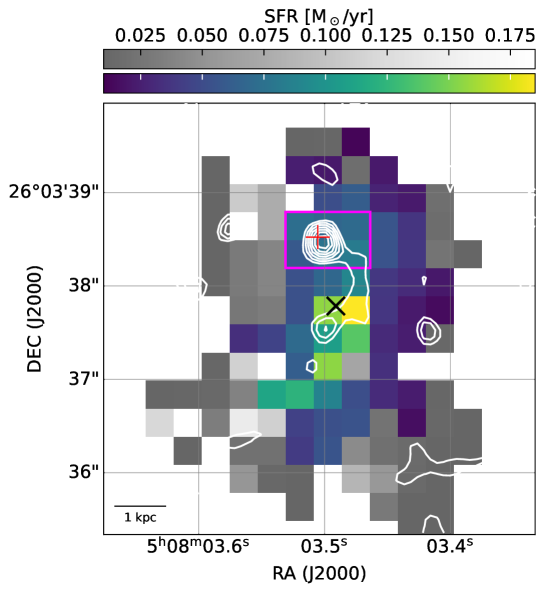
- 既存の6 GHz VLAデータを再分析し、宿主銀河内の拡散的星形成発光からコンパクトなPRSを分離した。
- 6–22 GHzの多周波数ラジオスペクトルを構築し、コンパクト源のスペクトル指数を決定した。その結果、$ F_{\nu} \propto \nu^{1} $ となり、逆スペクトルであることが判明した。
- 非常に長基線干渉計測定(VLBI)データを用いて、FRBの位置を413 Mpc(z = 0.098)で正確に局在化し、正確な源の関連付けを可能にした。
- 236 GHzおよび250 GHzでの深紫外電波望遠鏡(NOEMA)観測を実施し、冷たいダスト放射の上限を設定し、星形成およびダスト含有量を制約した。
- GTC/MEGARAの積分場ユニットデータを用いてバルマー減衰比(Hα/Hβ)分析を実施し、内在的ダスト減光を推定し、FRB近傍での星形成活動が顕著でないことを確認した。
![Figure 1: Top Panel: VLA image at 15 GHz of the host galaxy of FRB 20201124A from this work. Black contours indicate 3, 4, 5, 7, 9 $\times\sigma$ levels. The white contours are from the 6 GHz VLA image by [ 13 ] at similar resolution. The red contours are from the previous 22 GHz VLA image by [ 12 ]](https://ar5iv.labs.arxiv.org/html/2312.15296/assets/x1.png)
実験結果
リサーチクエスチョン
- RQ1FRB 20201124Aの恒常的ラジオ放射が、スペクトル的および磁場的特性から示唆されるように星雲由来であると整合的であるか?
- RQ2FRB 20201124AにおけるPRSの観測放射度と回転測定値(RM)は、シンクロトロン放射する星雲の予測されるRM–放射度関係に従っているか?
- RQ3なぜFRB 20201124AのPRSは、以前に検出されたPRSよりも放射度が低く、RMも低いのか?これは周囲の媒体にどのような含意をもたらすか?
- RQ4FRB環境での検出不能な星形成またはダスト放射が、PRSの星形成由来説を完全に除外できるか?
- RQ5逆スペクトルを示すPRSの検出は、中核エンジンおよび若年磁気星の存在にどのような含意をもたらすか?
主な発見
- 15 GHzで20.0 ± 3.5 μJyのflux密度を示すコンパクトで解像不能な恒常的ラジオ源(PRS)が検出され、FRB位置と整合的であり、3–4 kpcスケールの拡散的発光よりも顕著に明るいことが判明した。
- PRSは6–22 GHzの周波数範囲で逆スペクトル($ F_{\nu} \propto \nu^{1} $)を示し、熱的または星形成関連発光とは整合せず、非熱的起源を支持している。
- PRSの回転測定値(RM)は約100–200 rad/m²であり、低RM・低放射度領域に位置し、従来の未踏のパラメータ空間にまで拡張された観測されたRM–放射度関係を示している。
- NOEMAによる236 GHzおよび250 GHzでの上限(それぞれ≤130 μJyおよび≤160 μJy)は、顕著な冷たいダスト放射を排除し、FRB領域における星形成活動が最小限であることを示している。
- GTC/MEGARAデータは、低内在的E(B-V)減光および顕著なHα発光なしを示し、PRSの星形成由来説をさらに排除している。
- PRSは、その低フラックス密度(約10 μJy/beam)が、約10 μJy/beamのノイズ閾値未満であるため、以前のVLBI観測では検出されていなかった。これは、より深く高解像度の調査の必要性を強調している。
より良い研究を、今すぐ始めましょう
論文の読解から最終レビューまで、研究時間を劇的に削減しましょう。
クレジットカード登録不要
このレビューはAIが作成し、人間の編集者が確認しました。