
[論文レビュー] A new sociology of humans and machines
本論文は、複数の自律的かつ相互作用する人間と機械が共存する環境における集団的行動を研究するための新しい社会的枠組み—人間・機械社会システム—を提案する。Twitter、Reddit、Wikipedia、高頻度取引などのプラットフォームにおける競争、協力、そして顕在的ダイナミクスに関する学際的研究を統合することで、フラッシュクラッシュ や誤情報拡散といったシステム的リスクを特定し、社会的レジリエンスと安全性を確保するため、多様で適応的かつ倫理的に管理された人間・機械エコロジーの構築を提唱する。
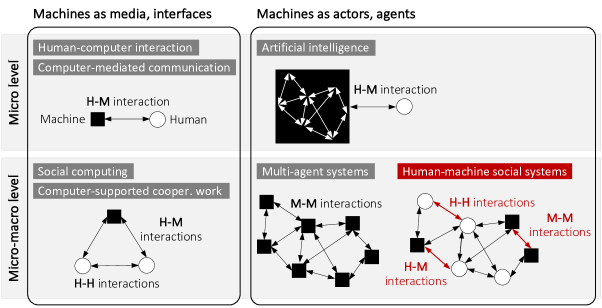
From fake social media accounts and generative artificial intelligence chatbots to trading algorithms and self-driving vehicles, robots, bots and algorithms are proliferating and permeating our communication channels, social interactions, economic transactions and transportation arteries. Networks of multiple interdependent and interacting humans and intelligent machines constitute complex social systems for which the collective outcomes cannot be deduced from either human or machine behaviour alone. Under this paradigm, we review recent research and identify general dynamics and patterns in situations of competition, coordination, cooperation, contagion and collective decision-making, with context-rich examples from high-frequency trading markets, a social media platform, an open collaboration community and a discussion forum. To ensure more robust and resilient human-machine communities, we require a new sociology of humans and machines. Researchers should study these communities using complex system methods; engineers should explicitly design artificial intelligence for human-machine and machine-machine interactions; and regulators should govern the ecological diversity and social co-development of humans and machines.
研究の動機と目的
- デジタルおよび物理的領域における、調整のとれていない相互依存的な人間・機械システムが引き起こす社会的リスクの増大に対処すること。
- 機械を受動的なツールや単一の実体として扱う既存の枠組みの限界を乗り越え、自律的かつ相互作用するエージェントとしての機械を扱うこと。
- 多様な文脈における人間・機械の集団的行動の顕在的メカニズムを理解するためのシステム的でメカニズム中心のアプローチを開発すること。
- 計算社会科学、人工知能、ロボット工学、経済学から得られる学際的知見を統合し、人間・機械間の相互作用における繰り返し現れるダイナミクスを同定すること。
- 多様性、適応性、共進化の重要性を強調することで、政策立案および設計に貢献し、システム的失敗を防ぐこと。
提案手法
- Google Scholar を用いて、膨大なキーワード検索(例:ボット + Twitter、アルゴリズム取引)を実施し、最新で公開可能な作業論文を網羅的に収集する統合的ナラティブレビューを実施する。
- 前後参照のチェーン(バックワード・フォワード・サイトセーチング)を用いて、基盤的かつ最新の文献を同定し、人間とボットを含む3つ以上の相互作用エージェントを含む研究に焦点を当てる。
- 文脈(例:金融市場、ソーシャルメディア、Wikipedia、Reddit)と相互作用タイプ(競争、調整、協力)ごとに研究を主題別にグループ化する。
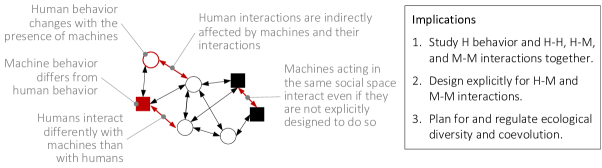
- システム的視点を用いて、人間同士、人間と機械、機械同士のレベルでの相互作用を分析し、顕在的集団的結果に注目する。
- ハイブリッド集合知フレームワークを用い、人間と自律的エージェントが共進化し、社会的結果を共に創出するマルチエージェントシステムを分析する。
- ロボット工学、ウェブサイエンス、複雑系科学、計算社会科学における実験的・理論的・観察的研究の知見を統合する。
実験結果
リサーチクエスチョン
- RQ1金融市場、ソーシャルメディア、共同作業プラットフォームなどの文脈において、人間・機械社会システムで顕在する一般的なダイナミクスとパターンは何か?
- RQ2複数の自律的機械と人間の間の相互作用は、個々の行動からは予測できない集団的行動をどのように生じさせるか?
- RQ3最適化目標、速度、情報源の類似性といった機械設計上の類似性は、フラッシュクラッシュ や誤情報の連鎖的拡散といったシステム的リスクをどのように拡大させるか?
- RQ4自律的エージェントと対話する際の人間行動はどのように変化し、その長期的影響は共感、社会的学習、文化的伝達にどのような意味を持つのか?
- RQ5多様性、レジリエンス、公平性を確保するため、人間・機械社会システムに必要なガバナンスおよび設計原則は何か?
主な発見
- 2010年のダウ・ジョーンズ急落のような金融市場におけるフラッシュクラッシュは、高頻度取引アルゴリズムが一括売買注文を共同で強化することで発生し、機械によるシステム的リスクを示している。
- Twitter や Reddit などのソーシャルメディアプラットフォームでは、ボットやアルゴリズムがスケール的に人間の行動を模倣することで、誤情報の拡散や公共の議論の操作が可能になる。
- Wikipedia などの共同作業システムでは、人間と機械の相互作用がコンテンツの質と効率を向上させることができるが、その条件はボットが多様でコミュニティの規範と整合している場合に限る。
- 高速かつ同質的な機械間の相互作用—特に同じ目的に最適化された場合—は、市場の不安定性や自律走行車両ネットワークにおける交通渋滞といった深刻な結果を引き起こす可能性がある。
- 機械の目的、速度、情報源の多様性はシステム的リスクを低減し、レジリエンスを高めることを示しており、政策は多様な機械エコロジーの構築を優先すべきである。
- 人間と機械の共進化は社会的ダイナミクスを変容させ、ロボットが感情的労働を代替することでケアの分野における共感の低下が生じる一方で、AI生成コンテンツや新しいゲーム戦略を通じて文化的伝達が変容する。
より良い研究を、今すぐ始めましょう
論文の読解から最終レビューまで、研究時間を劇的に削減しましょう。
クレジットカード登録不要
このレビューはAIが作成し、人間の編集者が確認しました。