
[論文レビュー] A physics and data co-driven surrogate modeling approach for temperature field prediction on irregular geometric domain
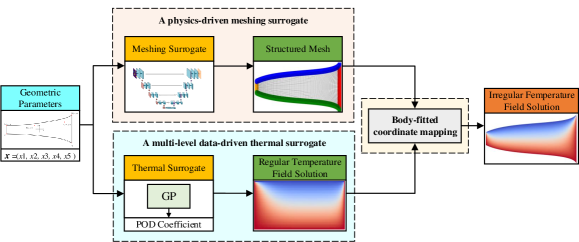
本稿では、不規則な幾何的領域における迅速かつ高精度な温度場予測を目的とした、物理学的要因とデータの両方を駆動要因とする代替モデルを提案する。不規則な幾何形状をボディフィットド座標を用いて正則な計算平面に写像し、物理的駆動のメッシュ生成代替モデルと、多層階の低次元化されたデータ駆動型熱代替モデルを組み合わせることで、標準的なU-Net や FNO などのCNNと比較して、小さなデータセットでも著しく短い訓練時間で高い精度を達成する。
In the whole aircraft structural optimization loop, thermal analysis plays a very important role. But it faces a severe computational burden when directly applying traditional numerical analysis tools, especially when each optimization involves repetitive parameter modification and thermal analysis followed. Recently, with the fast development of deep learning, several Convolutional Neural Network (CNN) surrogate models have been introduced to overcome this obstacle. However, for temperature field prediction on irregular geometric domains (TFP-IGD), CNN can hardly be competent since most of them stem from processing for regular images. To alleviate this difficulty, we propose a novel physics and data co-driven surrogate modeling method. First, after adapting the Bezier curve in geometric parameterization, a body-fitted coordinate mapping is introduced to generate coordinate transforms between the irregular physical plane and regular computational plane. Second, a physics-driven CNN surrogate with partial differential equation (PDE) residuals as a loss function is utilized for fast meshing (meshing surrogate); then, we present a data-driven surrogate model based on the multi-level reduced-order method, aiming to learn solutions of temperature field in the above regular computational plane (thermal surrogate). Finally, combining the grid position information provided by the meshing surrogate with the scalar temperature field information provided by the thermal surrogate (combined model), we reach an end-to-end surrogate model from geometric parameters to temperature field prediction on an irregular geometric domain. Numerical results demonstrate that our method can significantly improve accuracy prediction on a smaller dataset while reducing the training time when compared with other CNN methods.
研究の動機と目的
- 航空機構造最適化における熱的解析における従来のPDEソルバーの高い計算コストを低減すること。
- 標準的なCNNが規則的なグリッドに依存するため、不規則な幾何的領域を扱う際に生じる制限を克服すること。
- 物理的PDE制約とデータ駆動型学習を組み合わせた代替モデルを開発し、一般化性能と効率性を向上させること。
- 予測精度を維持したまま、複雑な幾何形状上での温度場予測に向けた訓練時間とデータ要件を削減すること。
提案手法
- 不規則な幾何形状をBézier曲線を用いてパrameter化し、一貫性のある幾何表現を可能にする。
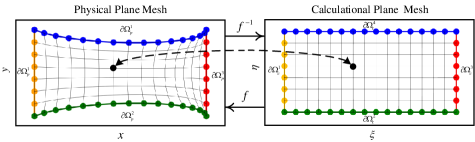
- ボディフィットド座標変換を適用して、不規則な物理的領域を正則な計算平面に変換する。
- PDE残差損失を用いて高品質なメッシュを生成する物理的駆動型畳み込みニューラルネットワーク(CNN)代替モデルを開発する。
- 固有直交分解(POD)に基づく多層階の低次元化モデル(ROM)を構築し、正則化された領域における温度場を予測する。
- メッシュ生成代替モデル(グリッド位置を提供)と熱的代替モデル(スカラー温度値を提供)を統合し、不規則領域に対するエンドツーエンド予測モデルを構築する。
- 物理法則とデータの両方を活用して一般化性能を向上させ、過学習を低減するため、小さなデータセットを用いて統合モデルを訓練する。
実験結果
リサーチクエスチョン
- RQ1標準的なCNNがグリッドの不規則性により失敗する不規則な幾何的領域において、共同駆動型代替モデルが温度場を効果的に予測できるか。
- RQ2PDEに基づく物理的制約とデータ駆動型学習を統合することで、限られた訓練データでも予測精度がどのように向上するか。
- RQ3多層階の低次元化モデリング戦略が、温度場予測における訓練の複雑さをどの程度低減し、一般化性能を向上させるか。
- RQ4小さなデータセットにおいて、提案手法がU-Net や FNO などの最先端のCNNベースの代替モデルと比較して、予測精度と訓練効率においてどの程度優れているか。
- RQ5提案されたフレームワークは、任意の境界条件を有する三次元またはより複雑な熱的問題へと拡張可能か。
主な発見
- 提案された多層階モデルは、平均絶対誤差(MAE)が0.0123、平均相対誤差(MRE)が0.0299を達成し、単一層モデル(MAE: 0.0185、MRE: 0.0448)を著しく上回る性能を示した。
- 多層階モデルは、小さなデータセットサイズでも低誤差と高い精度を維持し、データスケールの増加に伴う性能劣化が最小限に抑えられた。
- 提案モデルの訓練時間は約2分であり、U-Net や FNO モデル(約20分)と比較して約10倍速く収束に到達した。
- U-Net や FNO モデルはデータセットサイズに極めて敏感であり、小さなデータセットでは性能が著しく低下するが、提案モデルは安定的かつ高精度に保たれた。
- メッシュ生成代替モデルは低誤差の高品質なメッシュを生成し、物理的駆動型アプローチのメッシュ生成における有効性が裏付けられた。
- 統合モデルにより、幾何的パrameterから不規則領域上の温度場へのエンドツーエンド予測が可能となり、リアルタイム設計最適化への強い可能性を示した。
より良い研究を、今すぐ始めましょう
論文の読解から最終レビューまで、研究時間を劇的に削減しましょう。
クレジットカード登録不要
このレビューはAIが作成し、人間の編集者が確認しました。