
[論文レビュー] A physics-informed deep neural network for surrogate modeling in classical elasto-plasticity
本稿では、古典的弾塑性の基本的原則——加法的ひずみ分解や非線形増分的弾性——をネットワーク構造に直接埋め込むことで、物理に基づく深層ニューラルネットワーク、Elasto-Plastic Neural Network (EPNN) を提案する。EPNN は、砂の材料に対するひずみ制御荷重経路の未学習パスを予測する際、標準的な ANN よりも優れた汎化性能とデータ効率を達成する。
In this work, we present a deep neural network architecture that can efficiently approximate classical elasto-plastic constitutive relations. The network is enriched with crucial physics aspects of classical elasto-plasticity, including additive decomposition of strains into elastic and plastic parts, and nonlinear incremental elasticity. This leads to a Physics-Informed Neural Network (PINN) surrogate model named here as Elasto-Plastic Neural Network (EPNN). Detailed analyses show that embedding these physics into the architecture of the neural network facilitates a more efficient training of the network with less training data, while also enhancing the extrapolation capability for loading regimes outside the training data. The architecture of EPNN is model and material-independent, i.e. it can be adapted to a wide range of elasto-plastic material types, including geomaterials and metals; and experimental data can potentially be directly used in training the network. To demonstrate the robustness of the proposed architecture, we adapt its general framework to the elasto-plastic behavior of sands. We use synthetic data generated from material point simulations based on a relatively advanced dilatancy-based constitutive model for granular materials to train the neural network. The superiority of EPNN over regular neural network architectures is explored through predicting unseen strain-controlled loading paths for sands with different initial densities.
研究の動機と目的
- 弾塑性材料の代理構成モデルを構築し、コアな物理的原則をニューラルネットワークのアーキテクチャに直接統合すること。
- 訓練データを超える汎化および外挿能力を向上させ、特に訓練データに含まれない荷重経路に対しても有効であること。
- 異なる弾塑性材料、例えば地盤材料や金属に適用可能な、モデルおよび材料に依存しないフレームワークを構築すること。
- 物理的整合性と数値的安定性を維持しながら、実験データに直接学習できるようにすること。
- 増分的定式化により、標準的な有限要素コードへの統合を容易にすること。
提案手法
- EPNN のアーキテクチャは、全ひずみを弾性と塑性に分解する構造的制約を強制する。
- 物理に基づく応力更新則を用いて、ネットワークのフォワードパスに非線形増分的弾性を埋め込む。
- データ適合性と物理的一致性の両方の項を含む損失関数を用いてネットワークを学習させ、構成則への準拠を保証する。
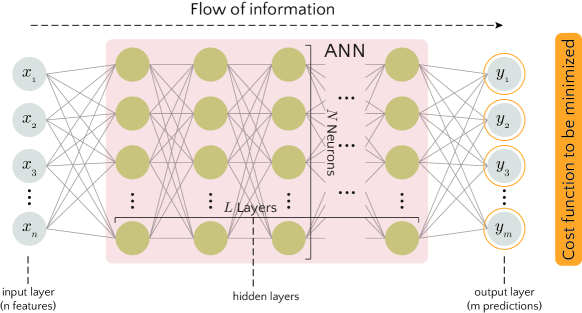
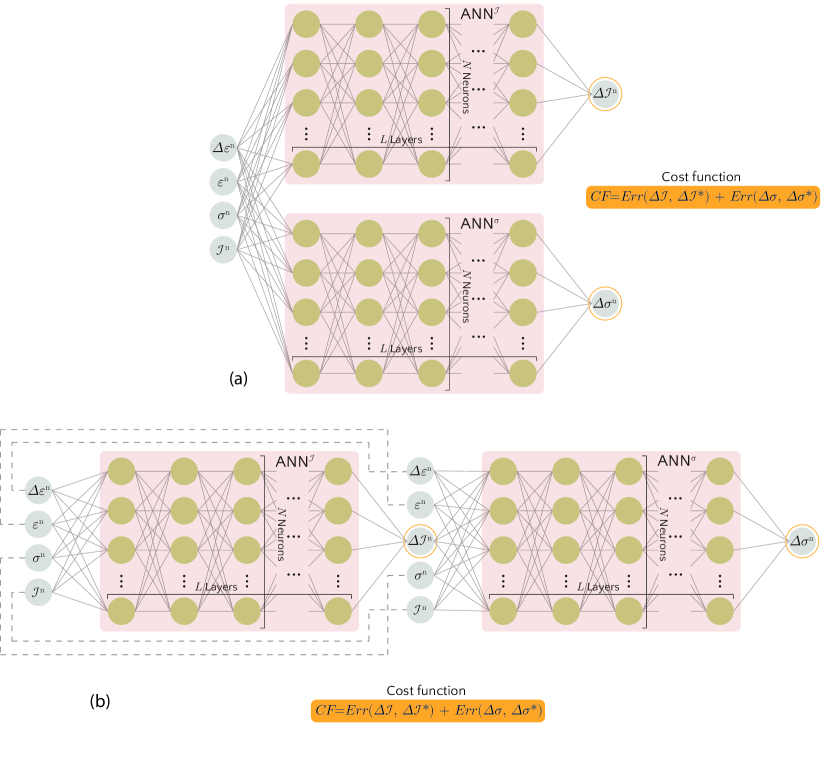
- 二本のサブネットワーク構造により、弾性および塑性ひずみ寄与を計算し、塑性ひずみ部は顕在的に降伏則および流れ則を満たすように学習される。
- 砂の材料に特化した体積変化に基づくモデルからの材料点シミュレーションで得た合成データを用い、さまざまなひずみ制御荷重経路でネットワークを学習させる。
- フレームワークは任意の単調な荷重経路をサポートでき、α比が変化する軸対称三軸経路を含むが、訓練データを超える汎化を可能にする。
実験結果
リサーチクエスチョン
- RQ1弾塑性のコアな物理法則を埋め込んだ深層ニューラルネットワークアーキテクチャは、少ない訓練データで標準的な ANN よりも優れた汎化性能を達成できるか?
- RQ2増分的弾性およびひずみ分解をネットワークアーキテクチャに統合することで、未学習の荷重経路に対する予測精度と外挿能力にどのような影響を与えるか?
- RQ3EPNN アーキテクチャは、再学習やアーキテクチャの再設計なしに、さまざまな弾塑性材料に一般化できる程度はどの程度か?
- RQ4EPNN は実験データに直接学習させつつ、物理的一致性と数値的安定性を維持できるか?
- RQ5増分的プローブによるデータ増強が、EPNN の予測能力にどのような影響を与えるか?
主な発見
- EPNN は、α = -1000, -2.5, -1.75 の軸対称三軸経路を含む、多様なひずみ制御荷重経路において、数値積分による真値と一致する高精度な応力予測を達成する。
- EPNN は、訓練データに含まれない荷重経路に対しても、標準的な並列および直列型 ANN アーキテクチャに比べて優れた外挿能力を示す。
- 埋め込まれた物理的制約のおかげで、収束が早く、安定性を維持するための訓練データ量が著しく少ない。
- 増分的定式化と一貫性のある応力更新メカニズムのおかげで、EPNN は標準的な有限要素コードと完全に互換性がある。
- 訓練データの品質が高くなるほどネットワークの性能が向上し、特にテンソル応答領域を探索するための増分的プローブデータによるデータ増強が有効である。
- 将来、塑性ポテンシャルや明示的な流れ則を塑性ひずみサブネットワークに組み込むことで、さらなる性能向上が期待できる。
より良い研究を、今すぐ始めましょう
論文の読解から最終レビューまで、研究時間を劇的に削減しましょう。
クレジットカード登録不要
このレビューはAIが作成し、人間の編集者が確認しました。