
[論文レビュー] A Quantum Algorithm for Model-Independent Searches for New Physics
本稿では、空間的に相関する相互作用を持つイジングスピン格子にデータ残差をマッピングすることにより、モデルに依存しないバンディッドコライダー・データにおける新物理探索のための量子に由来する適合度統計量 ${\mathcal{H}}_{\text{min}}$ を提案する。この手法は、物理的信号に特徴的な相関を活用することで、統計的ノイズに存在しないものとし、ローカル効果の影響を低減する。2次元グリッドにおいて、受信者操作特性曲線(ROC)分析では、$\chi^2$ テストに比べ最大51.3%の重複領域削減を達成する。
We propose a novel quantum technique to search for unmodeled anomalies in multidimensional binned collider data. We propose associating an Ising lattice spin site with each bin, with the Ising Hamiltonian suitably constructed from the observed data and a corresponding theoretical expectation. In order to capture spatially correlated anomalies in the data, we introduce spin-spin interactions between neighboring sites, as well as self-interactions. The ground state energy of the resulting Ising Hamiltonian can be used as a new test statistic, which can be computed either classically or via adiabatic quantum optimization. We demonstrate that our test statistic outperforms some of the most commonly used goodness-of-fit tests. The new approach greatly reduces the look-elsewhere effect by exploiting the typical differences between statistical noise and genuine new physics signals.
研究の動機と目的
- 多変数のバンディッドコライダー・データにおけるモデルに依存しない適合度検定を構築し、特定の新物理信号を仮定せずに、モデル化されていない異常を検出すること。
- 空間的に相関する信号と相関のない統計的フラクチュエーションを区別することで、ローカル効果の影響を低減すること。
- データ残差から構築したイジングハミルトニアンの基底状態エネルギーから導出される、新しい適合度統計量 ${\mathcal{H}}_{\text{min}}$ を導入すること。
- 基底状態におけるスピン配置の分析により、異常検出と解釈を両立させること。
- ハイエナージェリー物理における大規模応用に向けた断続的量子最適化の可能性を検討すること。
提案手法
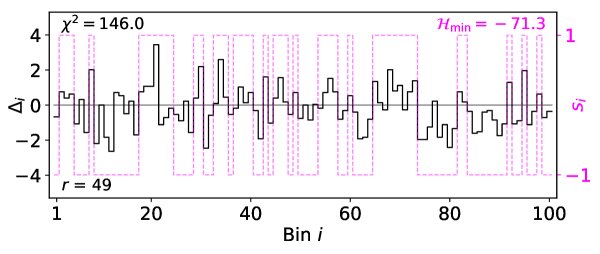
- 各データバインを、スピン状態 $s_i = \pm 1$ を持つイジング格子上のスピンサイトに対応させ、スピン配置は期待されるバックグラウンドからの逸脱を表す。
- 正規化された残差 $\Delta_i = (o_i - e_i)/\sqrt{e_i}$ を用いて、最近接スピン間の相互作用および自己相互作用を含むイジングハミルトニアン ${\mathcal{H}}$ を定義する。
- ハミルトニアンを ${\mathcal{H}} = -\sum_i \frac{|\Delta_i|\Delta_i}{2} \cdot \frac{s_i}{2} - \frac{\lambda}{2} \sum_{i,j} w_{ij} \frac{(\Delta_i + \Delta_j)^2}{4} \cdot \frac{1 + s_i s_j}{2}$ として構築する。ここで $\lambda$ は相互作用強度を制御するパラメータである。
- 基底状態エネルギー ${\mathcal{H}}_{\text{min}}$ を適合度統計量として用いる。値が低いほどバックグラウンド仮説への適合度が悪いことを示す。
- ${\mathcal{H}}_{\text{min}}$ の計算には、小規模な $N$ に対してはシミュレーテッド・アニーリングなどの古典的手法を、大規模な $N$ に対しては断続的量子最適化を用いる。
- 基底状態におけるスピン配置の分析により、異常を解釈し、スピンが一様に整列した大規模な領域を特定することで、相関する逸脱を特定する。
実験結果
リサーチクエスチョン
- RQ1空間的相関を捉えることのできるモデルに依存しない適合度統計量を、コライダー物理学における異常検出の性能向上を目的として構築できるか。
- RQ2提案された ${\mathcal{H}}_{\text{min}}$ 統計量は、$\chi^2$ テストのような従来の適合度検定と比較して、統計的パワーおよびローカル効果の影響低減の観点でどのように優れているか。
- RQ3データ残差から構築したイジングハミルトニアンの基底状態が、新物理信号を示す解釈可能な構造をどれだけ明らかにできるか。
- RQ4断続的量子最適化は、高次元かつ多数のバインを含むデータセットにおける ${\mathcal{H}}_{\text{min}}$ の計算に対してスケーラブルな解決策を提供できるか。
- RQ5ネイビューパラメータ $\vec{\theta}$ を用いてシステムティックな不確実性をモデル化した場合、統計量のロバストネスにどのような影響を与えるか。
主な発見
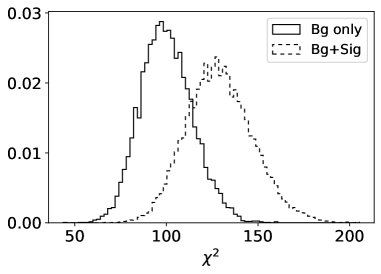
- 16バインの1次元例では、$\chi^2$ テストの帰無仮説と信号分布の重複領域は51.3%であったが、${\mathcal{H}}_{\text{min}}$ では41.4%にまで低下し、分離性能の向上が示された。
- $10\times10$ の2次元グリッドでは、$\chi^2$ の重複領域は40.7%であったが、${\mathcal{H}}_{\text{min}}$ では20.1%にまで減少し、顕著な性能向上が確認された。
- 図8の受信者操作特性曲線では、${\mathcal{H}}_{\text{min}}$ が2次元例において常に $\chi^2$ テストおよび「領域」検定を上回ることが示された。
- ${\mathcal{H}}$ の基底状態におけるスピン配置は、信号に類似した逸脱に対して、明確に整列したスピンの大きな領域を示しており、異常を解釈可能な形で局在化できる。
- 大規模な $N$ では、${\mathcal{H}}_{\text{min}}$ の正確な計算は非現実的になるが、断続的量子最適化はスケーラブルな代替手段として有望である。
- 古典的手法のシミュレーテッド・アニーリングは、現在の断続的量子最適化エンジンと同等の性能を示し、近い将来の応用において実用的である。
より良い研究を、今すぐ始めましょう
論文の読解から最終レビューまで、研究時間を劇的に削減しましょう。
クレジットカード登録不要
このレビューはAIが作成し、人間の編集者が確認しました。