
[論文レビュー] A rich hydrocarbon chemistry and high C to O ratio in the inner disk around a very low-mass star
JWST/MIRIを用いて、非常に低質量星の原始惑星円盤の内側0.1 auで、高C/O比を示す豊富な炭化水素化学が検出された。強いケイ酸塩および水の特徴が欠落していること、およびC₂H₂/CO₂およびC₂H₂/H₂Oの柱密度比が非常に高いことから、酸素が水のアイラインを超えて氷上固体に閉じ込められていることが示され、形成中の系外惑星の揮発性成分に顕著な影響を与えている。
Carbon is an essential element for life but how much can be delivered to young planets is still an open question. The chemical characterization of planet-forming disks is a crucial step in our understanding of the diversity and habitability of exoplanets. Very low-mass stars ($<0.2~M_{\odot}$) are interesting targets because they host a rich population of terrestrial planets. Here we present the JWST detection of abundant hydrocarbons in the disk of a very low-mass star obtained as part of the MIRI mid-INfrared Disk Survey (MINDS). In addition to very strong and broad emission from C$_2$H$_2$ and its $^{13}$C$^{12}$CH$_2$ isotopologue, C$_4$H$_2$, benzene, and possibly CH$_4$ are identified, but water, PAH and silicate features are weak or absent. The lack of small silicate grains implies that we can look deep down into this disk. These detections testify to an active warm hydrocarbon chemistry with a high C/O ratio in the inner 0.1 au of this disk, perhaps due to destruction of carbonaceous grains. The exceptionally high C$_2$H$_2$/CO$_2$ and C$_2$H$_2$/H$_2$O column density ratios suggest that oxygen is locked up in icy pebbles and planetesimals outside the water iceline. This, in turn, will have significant consequences for the composition of forming exoplanets.
研究の動機と目的
- 非常に低質量星の内側円盤の化学的組成を調査し、形成中の岩石惑星への揮発性成分の供給を理解すること。
- 低質量星の円盤における炭化水素および酸素を含む分子の存在割合を特定し、地球型系外惑星を多く持つ環境を特徴づけること。
- ガス相におけるC/O元素比を特定し、惑星形成および生命可能性に与える影響を評価すること。
- 円盤の中赤外スペクトルにおいて強力なケイ酸塩および水の特徴が観測されない理由を説明すること。
- 柱密度比に基づいて、氷上ペブルおよび惑星仔が酸素をどのように閉じ込めるかを評価すること。
提案手法
- MINDS調査の一環として、非常に低質量星の原始惑星円盤をJWST/MIRIを用いて中赤外分光測定した。
- 連続分光を差し引いて、高感度・高分解能スペクトルを抽出し、分子発光特徴を分離した。
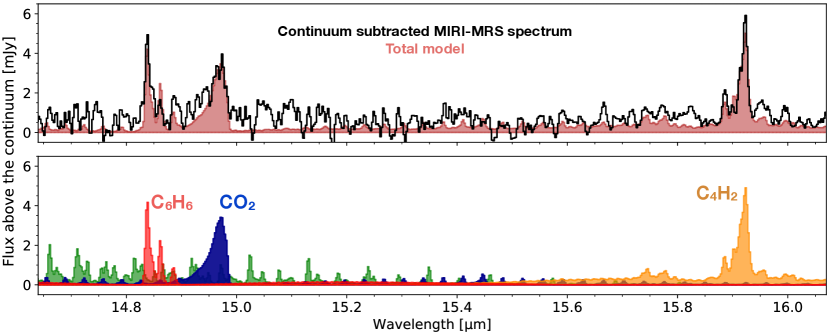
- HITRANおよびその他のデータベースからのラボラトリーおよび理論的ラインリストを用いて、C₂H₂、C₄H₂、ベンゼン、CH₄、CO₂、H₂Oなどの分子種を同定した。
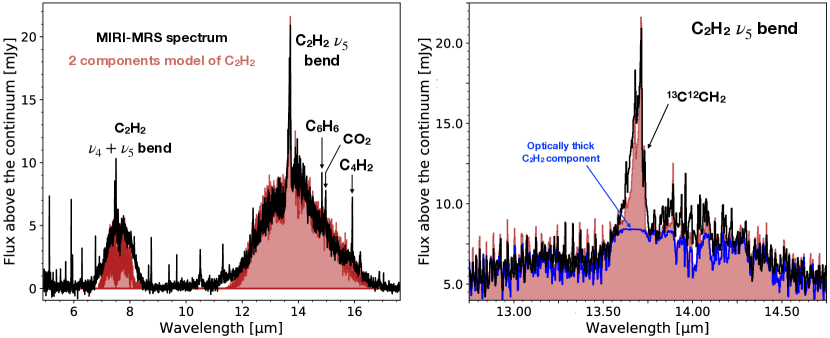
- スラブモデルを適用し、柱密度および励起温度を導出し、発光成分を光学的に厚い(成分I)および薄い(成分II)領域に分離した。
- 太陽のC/O比を仮定した円盤モデルの予測と比較して、観測された柱密度比(例:C₂H₂/CO₂、C₂H₂/H₂O)を評価した。
- 公開済みのスラブスペックコードを用いて合成スペクトルを生成し、モデルフィットの妥当性を検証し、観測された発光特徴を解釈した。
実験結果
リサーチクエスチョン
- RQ1非常に低質量星の内側円盤(0.1 au以内)の化学的組成は何か。特に炭化水素および酸素を含む分子に関しては?
- RQ2内側円盤におけるガス相のC/O元素比は何か。太陽値と比較するとどうなるか?
- RQ3円盤のスペクトルに中赤外域でケイ酸塩および水の特徴が弱いか、欠落しているのはなぜか?
- RQ4酸素は円盤内でどのように分布しているのか。水のアイラインを超えて、氷上ペブルおよび惑星仔が酸素をどのように閉じ込めるのか?
- RQ5高C/O比およびガス相における酸素欠乏が、形成中の系外惑星の揮発性インventryに与える影響は何か?
主な発見
- JWST/MIRIは、アセチレンの高い濃度を示すC₂H₂およびその¹³C¹²CH₂同位体体の強力で広い発光特徴を検出。
- C₄H₂、ベンゼン、およびおそらくCH₄の追加検出により、温かい内側円盤領域に豊富な炭化水素化学が確認された。
- CO₂の発光は主に光学的に厚い成分Iに起因し、小分子炭化水素は光学的に薄い成分IIに関連している。
- H₂O/C₂H₂の柱密度比は≤1×10⁻²、CO₂/C₂H₂比は8×10⁻³であり、太陽C/Oモデルの予測より顕著に低い。
- C₂H₂/CO₂およびC₂H₂/H₂Oの柱密度比が極めて高いことから、酸素が水のアイラインを超えて氷上固体にほとんど閉じ込められていることが示唆される。
- 強力なケイ酸塩特徴が欠落していることから、微小なダスト粒子がほとんどないことが示され、円盤への深部への浸透が可能となり、温かいガス相分子の検出が可能になった。
より良い研究を、今すぐ始めましょう
論文の読解から最終レビューまで、研究時間を劇的に削減しましょう。
クレジットカード登録不要
このレビューはAIが作成し、人間の編集者が確認しました。