
[論文レビュー] A Robust Study of High-Redshift Galaxies: Unsupervised Machine Learning for Characterising morphology with JWST up to z ~ 8
本研究は、JWST/NIRCam画像を用いた変分自己符号化器(VAE)を用いた教師なし機械学習フレームワークを導入し、赤方偏移 z > 2 の高赤方偏移銀河6,869個から、固有の形態的特徴を抽出した。11の明確で物理的に意味のある形態的クラスを同定した。この手法は観測バイアスを除去し、赤方偏移が増加するにつれて球状銀河の割合が減少することを明らかにした。また、従来の視覚的分類法が初期宇宙の形態の複雑さを捉えられていないことを示し、洗練されたデータ駆動型分類システムの必要性を提唱した。
Galaxy morphologies provide valuable insights into their formation processes, tracing the spatial distribution of ongoing star formation and encoding signatures of dynamical interactions. While such information has been extensively investigated at low redshift, it is crucial to develop a robust system for characterising galaxy morphologies at earlier cosmic epochs. Relying solely on the nomenclature established for low-redshift galaxies risks introducing biases that hinder our understanding of this new regime. In this paper, we employ variational auto-encoders to perform feature extraction on galaxies at z $>$ 2 using JWST/NIRCam data. Our sample comprises 6869 galaxies at z $>$ 2, including 255 galaxies z $>$ 5, which have been detected in both the CANDELS/HST fields and CEERS/JWST, ensuring reliable measurements of redshift, mass, and star formation rates. To address potential biases, we eliminate galaxy orientation and background sources prior to encoding the galaxy features, thereby constructing a physically meaningful feature space. We identify 11 distinct morphological classes that exhibit clear separation in various structural parameters, such as CAS-$M_{20}$, Sérsic indices, specific star formation rates, and axis ratios. We observe a decline in the presence of spheroidal-type galaxies with increasing redshift, indicating a dominance of disk-like galaxies in the early universe. We demonstrate that conventional visual classification systems are inadequate for high-redshift morphology classification and advocate the need for a more detailed and refined classification scheme. Leveraging machine-extracted features, we propose a solution to this challenge and illustrate how our extracted clusters align with measured parameters, offering greater physical relevance compared to traditional methods.
研究の動機と目的
- 赤方偏移 z > 2 の高赤方偏移銀河における、従来の視覚的分類法が、かたまりだらけで不規則かつ乱れた形態的特徴ゆえに失敗する状況において、バイアスのない、強固な銀河形態分類システムを開発すること。
- 銀河の姿勢、背景源、画像ノイズからのバイアスを克服するため、特徴抽出の前に入力データを標準化すること。
- 星形成率、構造的パラメータ、Sersic指数などの物理的性質を反映する、教師なし学習を用いた固有の形態的クラスを同定すること。
- JWSTからのデータ量の増加に伴い、従来の命名法に代わる、スケーラブルで物理的に意味のある代替分類システムを提供すること。
- 宇宙時間にわたる形態的タイプと物理的パラメータの関連を確立することで、銀河進化の今後の研究を可能にすること。
提案手法
- CEERSおよびCANDELS領域の高赤方偏移銀河のrest-frame光学画像から、低次元で分離された特徴を抽出するために、変分自己符号化器(VAE)を用いる。
- 画像の姿勢、背景源、ノイズを除去することで前処理を行い、学習された特徴が観測アーチファクトではなく、固有の形態的構造を反映していることを保証する。
- VAE埋め込み特徴に階層的クラスタリングを適用し、事前のラベルなしに11の明確で自己同様の形態的クラスを同定する。
- CAS-M20、Sersic指数、軸比、および特異的星形成率(sSFR)といった構造的パラメータを用いて、クラスタの妥当性と解釈性を検証する。
- 従来の視覚的分類と比較することで、クラスタの物理的関連性と分離度を評価する。
- UV形態によるバイアスを避けるために、JWST/NIRCamのrest-frame光学画像を用いることで、赤方偏移にわたる一貫性を確保する。
実験結果
リサーチクエスチョン
- RQ1教師なし機械学習は、事前に定義された視覚的カテゴリーに依存せずに、高赤方偏移銀河から物理的に意味のある形態的クラスを抽出できるか?
- RQ2特に球状銀河と円盤型銀河の形態的分布は、宇宙時間とともにどのように変化するか?
- RQ3従来の視覚的分類システムは、かたまりだらけや乱れた円盤型のような複雑な高赤方偏移形態をどれほど正確に区別できないか?
- RQ4不規則な形態的クラスを特徴付けるために、どの構造的および物理的パラメータが最も適しているか?
- RQ5抽出された形態的特徴は、星形成率やSersic指数といった物理的性質と信頼性を持って関連づけることができるか?
主な発見
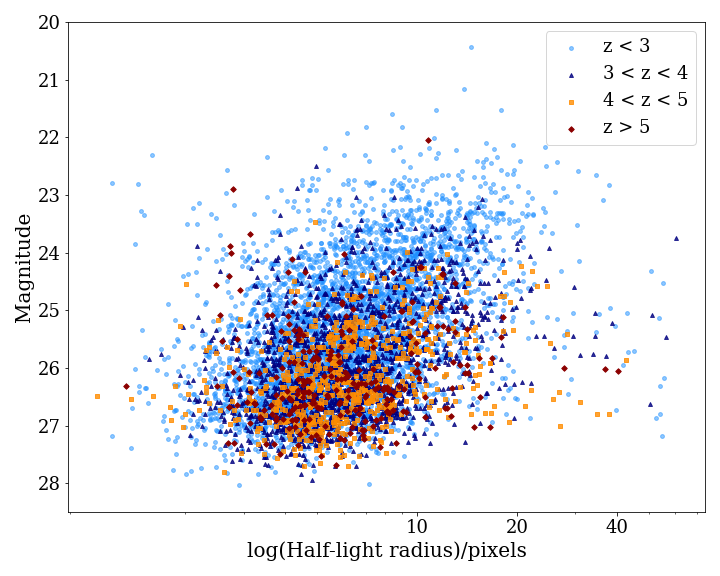
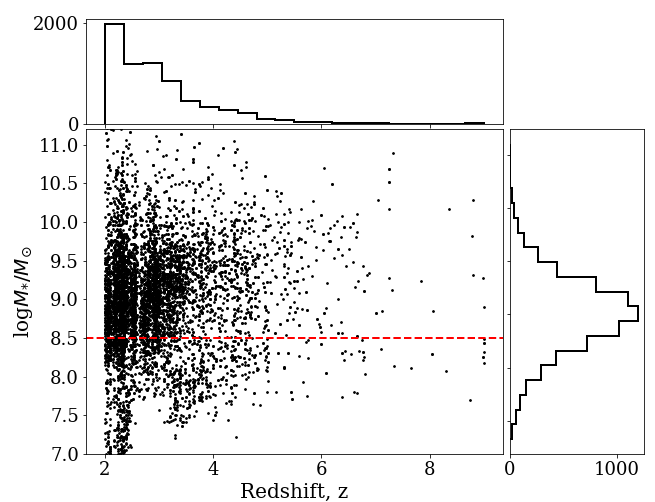
- 本研究は、JWST/NIRCamデータを用いた教師なし学習により、6,869個の高赤方偏移銀河(z > 2)から、255個の銀河が z > 5 に位置する中で、11の明確な形態的クラスを同定した。
- 形態的クラスは、CAS-M20、Sersic指数、軸比、sSFRといった物理的パrameter空間で良好に分離されており、強い物理的整合性を示している。
- 赤方偏移が増加するにつれて、球状銀河の割合が明確に減少しており、以前の研究結果を確認するとともに、初期宇宙において円盤型、かたまりだらけ、および乱れた形態が支配的であることを裏付けた。
- 従来の視覚的分類システムは、非球状タイプ、特に円盤型と奇妙銀河をうまく分離できていない。これは、より詳細でデータ駆動型の分類スキームの必要性を示している。
- 従来の研究がしばしば数百もの曖昧なクラスを生み出すのに対し、本研究の教師なし手法は、少ない数の、より明確に分離され、物理的に解釈可能なクラスタを生成した。
- 特徴空間は物理的に意味のあるものであり、姿勢や背景干渉を除外することで、モデルが固有の形態的構造に集中できるようになった。
より良い研究を、今すぐ始めましょう
論文の読解から最終レビューまで、研究時間を劇的に削減しましょう。
クレジットカード登録不要
このレビューはAIが作成し、人間の編集者が確認しました。