
[論文レビュー] A room-temperature moiré interlayer exciton laser
本研究は、シリコン上部トポロジカルナノキャビティと統合されたMoS₂/WSe₂ヘテロビレイヤーにおいて、モアレ相互作用を介した間接励起子による室温発光を初めて実証した。モアレポテンシャルは励起子の寿命を延長し、広い発光周波数可変性を可能にするとともに、通信Oバンドにおける超低しきい値発光と0.1 nm未満のスペクトル線幅を実現した。
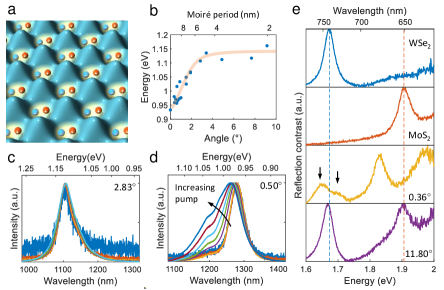
Moiré superlattices in van der Waals heterostructures offer highly tunable quantum systems with emergent electronic and excitonic properties such as superconductivity, topological edge states, and moiré-trapped excitons. Theoretical calculations predicted the existence of the moiré potential at elevated temperatures; however, its impact on the optical properties of interlayer excitons (IXs) at room temperature is lacking, and the benefits of the moiré effects for lasing applications remain unexplored. We report that the moiré potential in a molybdenum disulfide/tungsten diselenide (MoS2/WSe2) heterobilayer system can significantly enhance light emission, elongate the IX lifetime, and modulate the IX emission energy at room temperature. By integrating a moiré superlattice with a silicon topological nanocavity, we achieve ultra-low-threshold lasing at the technologically important telecommunication O-band thanks to the significant moiré modulation. Moreover, the high-quality topological nanocavities facilitate the highest spectral coherence of < 0.1 nm linewidth among all reported two-dimensional material-based laser systems. Our findings not only open a new avenue for studying correlated states at elevated temperatures, but also enable novel architectures for integrated on-chip photonics and optoelectronics.
研究の動機と目的
- モアレスーパーラティスを有する2次元ヘテロ構造で室温下における間接励起子発光を実証すること。
- 室温下におけるモアレポテンシャルが励起子の寿命と発光周波数可変性をどのように向上させるかを調査すること。
- 高Q値のトポロジカル光子ナノキャビティとモアレ間接励起子を統合し、低しきい値発光を実現すること。
- 2次元材料ベースのレーザーシステムにおいて高いスペクトル整合性と側モード抑圧を達成すること。
- モアレ励起子が常温下でオンチップ統合光通信および光エレクトロニクスの応用に適している可能性を検討すること。
提案手法
- 室温下でのモアレポテンシャル効果を特定するため、ねじれ角度依存の発光分光(PL)および反射対比分光法を用いた。
- 励起子再結合ダイナミクスと放射効率を評価するため、励起パワー依存のPLおよび時間分解PL測定を実施した。
- 高品質因子(Q > 10⁴)の光学的閉じ込めを実現するため、シリコンベースのトポロジカル光子結晶ナノキャビティとヘテロ構造を統合した。
- 発光モードの高分解能スペクトル検出のため、高溝密度グレーティング(600–1200 grooves/mm)を備えたCzerny-Turner分光計を用いた。
- ヘテロ構造のねじれ角度を特定するため、偏光分解第二高調波生成(SHG)測定を実施した。
- 有限差分時間領域(FDTD)法を用いてトポロジカルナノキャビティのシミュレーションを行い、共鳴波長とモードプロファイルの最適化を実施した。
実験結果
リサーチクエスチョン
- RQ1MoS₂/WSe₂におけるモアレ間接励起子は、室温下でも強い光学的活性と長寿命な励起子状態を維持できるか?
- RQ2常温下における2次元ヘテロ構造において、モアレポテンシャルが励起子の寿命をどの程度向上させ、発光エネルギーをどのように制御するか?
- RQ3高Q値のトポロジカルナノキャビティと結合したモアレ励起子は、低しきい値発光を実現できるか?
- RQ4このような系における発光のスペクトル整合性および側モード抑圧比は、他の2次元材料ベースのレーザーと比較していかなるものか?
- RQ5モアレポテンシャルとトポロジカルナノキャビティの組み合わせにより、技術的関心の高いOバンド(1260–1360 nm)で室温下での発光が可能になるか?
主な発見
- MoS₂/WSe₂ヘテロビレイヤーにおけるモアレポテンシャルは、間接励起子(IX)の寿命を顕著に延長し、室温下で超広帯域の発光周波数可変性を実現した。
- 室温下の間接励起子は、非放射的再結合が抑制され、発光量子収率が向上した。
- 強いモアレ調制と高Q値のトポロジカルナノキャビティによる閉じ込めのおかげで、Oバンド(1260–1360 nm)で超低しきい値発光が達成された。
- レーザーのスペクトル線幅は0.1 nm未満であり、2次元材料ベースのレーザーにおいて報告された中で最も狭い。
- 側モード抑圧比(SMSR)が30 dBを超えた。これは高いスペクトル純度とシングルモード動作を示している。
- コherence時間はナノ秒オーダーと推定され、高いスペクトル整合性と安定した発光動作を示している。

より良い研究を、今すぐ始めましょう
論文の読解から最終レビューまで、研究時間を劇的に削減しましょう。
クレジットカード登録不要
このレビューはAIが作成し、人間の編集者が確認しました。