
[論文レビュー] A Survey on Explainability of Graph Neural Networks
このサーレビューは、グラフニューラルネットワーク(GNN)の説明可能性手法の包括的な分類を提供し、事実ベースと反事実ベースのアプローチの両方を扱い、評価指標とデータセットについて議論する。
Graph neural networks (GNNs) are powerful graph-based deep-learning models that have gained significant attention and demonstrated remarkable performance in various domains, including natural language processing, drug discovery, and recommendation systems. However, combining feature information and combinatorial graph structures has led to complex non-linear GNN models. Consequently, this has increased the challenges of understanding the workings of GNNs and the underlying reasons behind their predictions. To address this, numerous explainability methods have been proposed to shed light on the inner mechanism of the GNNs. Explainable GNNs improve their security and enhance trust in their recommendations. This survey aims to provide a comprehensive overview of the existing explainability techniques for GNNs. We create a novel taxonomy and hierarchy to categorize these methods based on their objective and methodology. We also discuss the strengths, limitations, and application scenarios of each category. Furthermore, we highlight the key evaluation metrics and datasets commonly used to assess the explainability of GNNs. This survey aims to assist researchers and practitioners in understanding the existing landscape of explainability methods, identifying gaps, and fostering further advancements in interpretable graph-based machine learning.
研究の動機と目的
- 複雑な非線形構造を持つため、GNNs における説明可能性の必要性を動機づける。
- 目的と方法論によって説明可能性手法を分類する新しい分類を提供する。
- 各カテゴリの長所、制限、および適用シナリオを要約する。
- GNN の説明可能性を評価するために使用される評価指標と一般的に用いられるデータセットを強調する。
- 事実的または反事実的手法のいずれかに焦点を当てる先行サーベイが残すギャップを埋める。
提案手法
- GNN explainability の新しい分類を提案し、事実ベースと反事実ベースの手法に分割する。
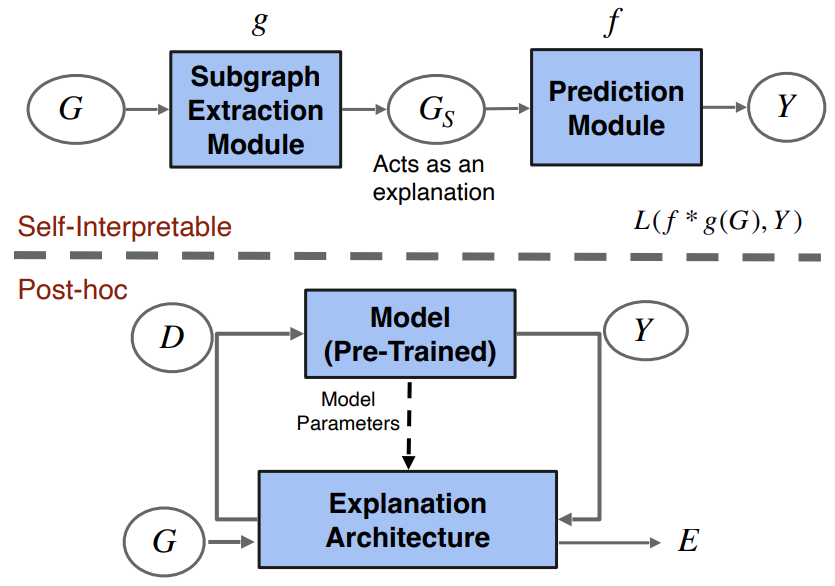
- 事実ベースの手法を自己解釈可能(self-interpretable)と後処理(post-hoc)に分類し、さらに post-hoc を分解ベース、勾配ベース、代理( surrogate)、摂動ベース、生成ベースのカテゴリに細分する。
- 情報的制約または構造的制約に基づく自己解釈可能な手法をレビューし、Y を予測する目的で部分グラフ抽出を説明する。
- GNN の説明可能性を評価するために用いられる評価戦略とデータセットについて論じる。
- グラフの説明に特有の課題、例えば組み合わせ的な部分構造探索やノード特徴とグラフトポロジの両方を考慮する必要性について論じる。
![Figure 1 : Overview of the Schema. (1) Factual. Information constraints: GIB [ 118 ] , VGIB [ 116 ] , GSAT [ 69 ] , LRI [ 70 ] ; Structural Constraints: DIR [ 107 ] , ProtGNN [ 125 ] , SEGNN [ 12 ] , KER-GNN [ 21 ] ; Decomposition: CAM [ 77 ] , Excitation-BP [ 77 ] , DEGREE [ 22 ] , GNN-LRP [ 84 ] ;](https://ar5iv.labs.arxiv.org/html/2306.01958/assets/Schema_V12.png)
実験結果
リサーチクエスチョン
- RQ1GNN の既存の説明可能性手法は何であり、それらを体系的にどのように分類できるか?
- RQ2GNN 説明可能性手法の各カテゴリの長所、制限、および適切な適用シナリオは何か?
- RQ3GNN の説明可能性を評価する際によく用いられるデータセットと評価指標は何か?
- RQ4GNN の説明における事実ベースと反事実ベースのアプローチはどのように比較されるか?
主な発見
- 説明可能性手法を事実ベースと反事実ベースに整理した包括的な分類を導入し、詳細なサブカテゴリを示す。
- 後処理法は white-box または black-box になり得ること、そして自己解釈可能な手法は説明をモデルアーキテクチャに統合することを指摘する。
- 分解ベース、勾配ベース、代理、摂動ベース、生成ベースの post-hoc 手法を要約し、それらの典型的な入力、出力、制約を示す。
- 自己解釈可能な手法は、統合された制約のため解釈性と予測精度のトレードオフになる可能性があることを強調する。
- GNN の予測を説明する際には、ノード属性とグラフ構造の両方を考慮する必要性を強調する。
- GNN の説明可能性で一般的に用いられるデータセットと評価指標をレビューする(論文のセクション7および8)。
より良い研究を、今すぐ始めましょう
論文設計から論文執筆まで、研究時間を劇的に削減しましょう。
クレジットカード登録不要
このレビューはAIが作成し、人間の編集者が確認しました。