
[論文レビュー] A Unified Learning Model for Estimating Fiber Orientation Distribution Functions on Heterogeneous Multi-shell Diffusion-weighted MRI
本論文は、異種のマルチシェル拡散画像法(DW-MRI)からの繊維方位分布関数(fODF)の統合的でエンドツーエンドの推定を目的とした、1段階の球面畳み込みニューラルネットワーク(SCNN)と動的ヘッドを提案する。q空間と径方向のb値情報の両方を統合的にモデル化することで、複数段階の学習アプローチに比べ、さまざまなシェル構成においてfODFの精度とスキャン・リピートの一貫性が向上し、HCP若年成人データにおいて最先端の性能を達成した。
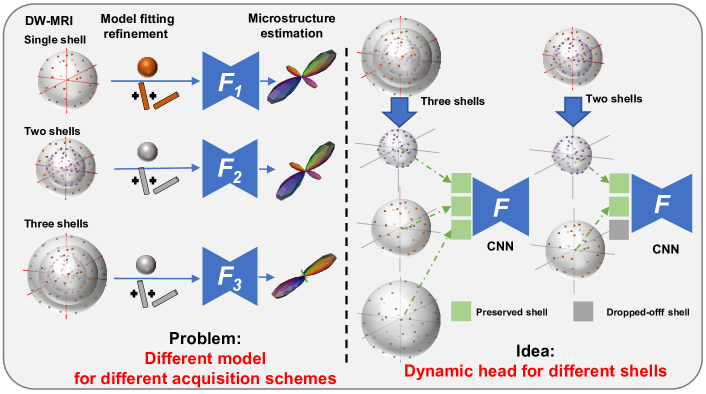
Diffusion-weighted (DW) MRI measures the direction and scale of the local diffusion process in every voxel through its spectrum in q-space, typically acquired in one or more shells. Recent developments in micro-structure imaging and multi-tissue decomposition have sparked renewed attention to the radial b-value dependence of the signal. Applications in tissue classification and micro-architecture estimation, therefore, require a signal representation that extends over the radial as well as angular domain. Multiple approaches have been proposed that can model the non-linear relationship between the DW-MRI signal and biological microstructure. In the past few years, many deep learning-based methods have been developed towards faster inference speed and higher inter-scan consistency compared with traditional model-based methods (e.g., multi-shell multi-tissue constrained spherical deconvolution). However, a multi-stage learning strategy is typically required since the learning process relies on various middle representations, such as simple harmonic oscillator reconstruction (SHORE) representation. In this work, we present a unified dynamic network with a single-stage spherical convolutional neural network, which allows efficient fiber orientation distribution function (fODF) estimation through heterogeneous multi-shell diffusion MRI sequences. We study the Human Connectome Project (HCP) young adults with test-retest scans. From the experimental results, the proposed single-stage method outperforms prior multi-stage approaches in repeated fODF estimation with shell dropoff and single-shell DW-MRI sequences.
研究の動機と目的
- マルチシェル拡散MRIにおいて、中間表現(例:SHORE)に依存する複数段階の深層学習パイプラインの限界を解消すること。
- 再トレーニングを必要とせず、任意のb値組み合わせを処理できる1つの統合モデルの開発。
- 異種マルチシェル画像収集におけるfODF推定の相互スキャン一貫性と精度の向上。
- 異なるシェル構成に応じてネットワークヘッドを動的に適応させることで、マイクロ構造特性の即時推定を可能にする。
- fODF予測および組織体積分率推定において、モデルベース(例:MSMT-CSD)およびデータ駆動型のベンチマークを上回ること。
提案手法
- マルチシェルDW-MRIデータに対して、原始的なq空間信号からfODF表現へ直接マッピングするエンドツーエンドで学習された1段階の球面畳み込みニューラルネットワーク(SCNN)を採用。
- 入力のシェル構成に応じて最終部の全結合層を動的に調整する機構を導入し、異なるb値組み合わせへの一般化を可能にした。
- 中間表現(例:SHOREや球面調和関数)を避けるために、空間的(球面)および径方向(b値)の信号次元を併用。
- 組織体積分率予測には平均二乗誤差(MSE)損失、fODF類似度評価には角度相関係数(ACC)を用いて学習。
- 再現性と一般化性能の評価のため、HCPデータ(テスト・リテストスキャンを含む)を用いてアーキテクチャを評価。
- 個々のシェル構成ごとの独立モデルおよびベースラインの深層学習・モデルベース手法(例:MSMT-CSD)と比較。
実験結果
リサーチクエスチョン
- RQ1再トレーニングを必要とせず、多様なマルチシェル拡散MRI構成に一般化可能な1つの深層学習モデルは構築可能か?
- RQ2q空間と径方向b値の統合的モデリングによるエンドツーエンド学習は、複数段階のアプローチに比べてfODF推定精度を向上させるか?
- RQ3本手法は、fODFおよび組織体積分率推定において、スキャン・リピートの一貫性にどの程度寄与するか?
- RQ4動的ヘッド機構は、異なるb値組み合わせに適応しつつも、高い性能を維持できるか?
- RQ5統合モデルは、モデルベース(MSMT-CSD)およびデータ駆動型ベンチマークを上回るfODF予測および組織分率回復性能を示すか?
主な発見
- 提案手法の1段階アプローチは、全シェル構成で平均角度相関係数(ACC)0.824を達成し、最良のベースライン(0.815)および銀標準(MSMT-CSD)を上回った。
- 球面畳み込みと動的ヘッドを備えた統合モデルは、3シェル構成(C1,2,3)で最高のACC 0.837を記録し、独立にトレーニングされたモデルでさえも上回った。
- スキャン・リピートの一貫性が顕著に向上し、全マルチシェルデータにおいて統合モデルの一致性スコアは0.865に達し、MSMT-CSD銀標準(0.856)を上回った。
- 全マルチシェルケースにおける組織体積分率予測MSEは5.92×10⁻⁴にまで低下し、全手法中最も低く、優れたマイクロ構造推定を示した。
- 動的ヘッド設計により、1つのモデルが全シェル構成に一般化可能となり、再トレーニングや構成ごとの別モデルの必要性が不要になった。
- シェル欠落シナリオにおいても、本手法は高い精度と一貫性を維持したが、複数段階の手法では失敗した。

より良い研究を、今すぐ始めましょう
論文の読解から最終レビューまで、研究時間を劇的に削減しましょう。
クレジットカード登録不要
このレビューはAIが作成し、人間の編集者が確認しました。