
[論文レビュー] A unified realization of electrical quantities from the quantum International System of Units
本論文は、1つの冷凍器内に統合された量子アノマラスホール抵抗素子とプログラマブルなジョセフソン電圧標準を用い、ゼロ磁場で動作する量子電流センサ(QCS)を提案する。252 nAにおける相対合成不確かさは3.91 × 10⁻⁶ A/Aに達し、83.9 nA近辺で1.46 × 10⁻⁶ A/Aの一致を示すオームの法則による検証により、正確性が裏付けられた。
In the revised International System of Units (SI), the ohm and the volt are realized from the von Klitzing constant and the Josephson constant, and a practical realization of the ampere is possible by applying Ohm's law directly to the quantum Hall and Josephson effects. As a result, it is possible to create an instrument capable of realizing all three primary electrical units, but the development of such a system remains challenging. Here we report a unified realization of the volt, ohm, and ampere by integrating a quantum anomalous Hall resistor (QAHR) and a programmable Josephson voltage standard (PJVS) in a single cryostat. Our system has a quantum voltage output that ranges from 0.24 mV to 6.5 mV with combined relative uncertainties down to 3 $μ$V/V. The QAHR provides a realization of the ohm at zero magnetic field with uncertainties near 1 $μΩ$/$Ω$. We use the QAHR to convert a longitudinal current to a quantized Hall voltage and then directly compare that against the PJVS to realize the ampere. We determine currents in the range of 9.33 nA to 252 nA, and our lowest uncertainty is 4.3 $μ$A/A at 83.9 nA. For other current values, a systematic error that ranges from -10 $μ$A/A to -30 $μ$A/A is present due to the imperfect isolation of the PJVS microwave bias.
研究の動機と目的
- 既存の量子基準における空白である9.33 nAから252 nAの範囲で、実用的かつトレーサブルなアンペアの実現を可能にすること。
- 長時間にわたるキャリブレーションチェーンに起因する高い不確かさを抱える従来のオームの法則に基づく電流基準の限界を克服すること。
- 量子アノマラスホール(QAH)抵抗素子を用いて、ゼロ磁場で量子化されたホール抵抗を実現することで、電流測定に外部磁場を不要にする。
- プログラマブルなジョセフソン電圧標準(PJVS)とQAH抵抗素子を1つの冷凍器内に統合し、システムの複雑さを低減するとともに安定性を向上させること。
- 従来のオームの法則に基づく測定と比較することで、QCSの正確性を検証し、基本定数へのトレーサビリティを確立すること。
提案手法
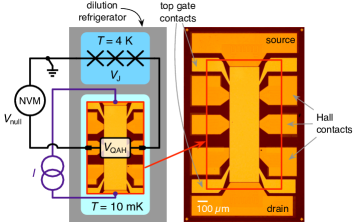
- ゼロ磁場下で量子化されたホール抵抗(Ryx = h/e²)を示す量子アノマラスホール(QAH)抵抗素子を、1つの冷凍器内に統合されたプログラマブルなジョセフソン電圧標準(PJVS)に直接接続する。
- PJVSを用いてQAHデバイスに正確に既知の電圧を印加し、オームの法則(I = V / R)を直接適用して電流を測定する。
- QAHデバイスの抵抗を、校正済みの100 Ω標準抵抗素子と比較することで高精度に測定するため、低温電流コンパレータ(CCC)を実装する。
- CCCブリッジ内のノルム電圧差を検出するために、超伝導量子干渉計(SQUID)を用い、ノイズとドリフトを最小限に抑える。
- 時間経過に伴うノルム電圧測定の安定性を評価するために、重ね合わせ型アラン分散分析を適用し、1/fノイズやホワイトノイズなどの主なノイズ源を特定する。
- 直接モード測定中にPJVSからの差動モードノイズを抑制するために、シャントコンデンサを備えたカスタムインターポーザを採用し、QAH量子化時における超伝導結合を維持する。
実験結果
リサーチクエスチョン
- RQ1QAH抵抗素子とPJVSを1つの冷凍器内に統合した状態で、ゼロ磁場下に量子電流センサを実現できるか?
- RQ2本統合量子手法を用いた場合、9.33 nAから252 nAの範囲における電流測定の達成可能な不確かさはどの程度か?
- RQ3QCSの正確性は、二次基準を用いた従来のオームの法則に基づく測定と比較して、どのように評価できるか?
- RQ4測定チェーンにおける主な不確かさ要因は何か、そしてそれらをどのように特定・最小化できるか?
- RQ5ノルム電圧測定の安定性をどのように特徴づけ、長期にわたり信頼性があり再現性のある電流測定を保証できるか?
主な発見
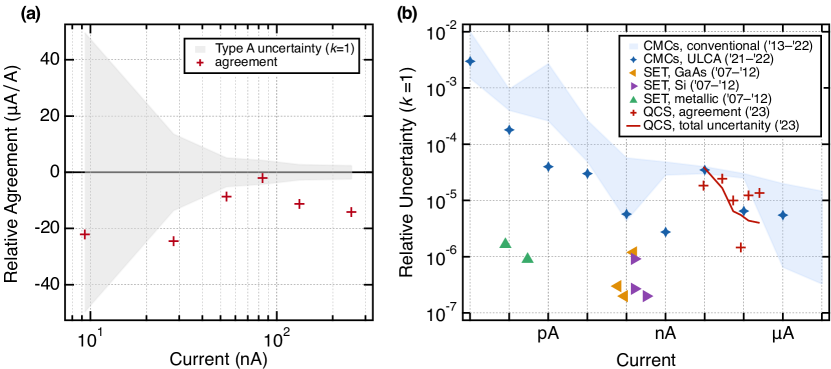
- QCSは252 nAにおいて相対合成不確かさ3.91 × 10⁻⁶ A/Aを達成し、タイプA不確かさは2.30 × 10⁻⁶ A/Aにとどまる。これは従来のnA電流基準に比べ顕著な改善である。
- 最小電流である9.33 nAでは、総合相対不確かさが41.2 × 10⁻⁶ A/Aに上昇するが、依然としてサブnA範囲における量子的実現の有効な道筋を示している。
- 83.9 nAで最も多くの測定がなされたが、QCSと従来のオームの法則に基づく測定との間で、1.46 ± 4.28 × 10⁻⁶ A/Aの最高一致を示した。
- 不確かさ予算では、標準抵抗(3 nΩ/Ω、k=1)、CCC巻線比誤差(10⁻¹⁰の数パラメータ)、SQUID整流ノイズが主な寄与要因であると特定された。
- アラン分散分析により測定の安定性が確認され、ノイズ挙動はホワイトノイズおよび1/fノイズと整合的であり、重ね合わせ型アラン分散法により統計的信頼性が向上した。
- シャントコンデンサを備えたカスタムインターポーザの使用により、直接モード測定中のPJVSからの差動ノイズが効果的に抑制され、安定動作が可能になった。
より良い研究を、今すぐ始めましょう
論文の読解から最終レビューまで、研究時間を劇的に削減しましょう。
クレジットカード登録不要
このレビューはAIが作成し、人間の編集者が確認しました。