
[論文レビュー] Accurate deep learning sub-grid scale models for large eddy simulations
2つの深層学習サブグリッドスケール SGS モデル系がLESのために開発された:完全な不変性を持つテンソル基底ニューラルネットワーク(Tensor Basis Neural Network)とよりシンプルなGalilean不変ネットワーク。後者のモデルはSGS応力の学習をより効果的に行い、どちらもチャネル流れの再現性の前向き検証(a priori)と事後検証(a posteriori)で良好に機能する。Reτ ≈ 395 および 590において。
We present two families of sub-grid scale (SGS) turbulence models developed for large-eddy simulation (LES) purposes. Their development required the formulation of physics-informed robust and efficient Deep Learning (DL) algorithms which, unlike state-of-the-art analytical modeling techniques can produce high-order complex non-linear relations between inputs and outputs. Explicit filtering of data from direct simulations of the canonical channel flow at two friction Reynolds numbers $Re_τ\approx 395$ and 590 provided accurate data for training and testing. The two sets of models use different network architectures. One of the architectures uses tensor basis neural networks (TBNN) and embeds the simplified analytical model form of the general effective-viscosity hypothesis, thus incorporating the Galilean, rotational and reflectional invariances. The other architecture is that of a relatively simple network, that is able to incorporate the Galilean invariance only. However, this simpler architecture has better feature extraction capacity owing to its ability to establish relations between and extract information from cross-components of the integrity basis tensors and the SGS stresses. Both sets of models are used to predict the SGS stresses for feature datasets generated with different filter widths, and at different Reynolds numbers. It is shown that due to the simpler model's better feature learning capabilities, it outperforms the invariance embedded model in statistical performance metrics. In a priori tests, both sets of models provide similar levels of dissipation and backscatter. Based on the test results, both sets of models should be usable in a posteriori actual LESs.
研究の動機と目的
- 壁に拘束された乱流に対するDLベース SGS モデリングに物理的不変性(Galilean、回転、反射)を組み込む。
- DLフレームワーク内で解析的 SGS 応力展開を活用して頑健性と一貫性を向上させる。
- テンソル基底ニューラルネットワーク(A1)を不変性埋め込み展開とし、Galilean 不変性のみに焦点を合わせたよりシンプルなネットワーク(A2)を比較する。
- さまざまなフィルタ幅とレイノルズ数でDNS由来データを用いてモデル性能を評価し、信頼性の高い LES 閉包を実現する。
提案手法
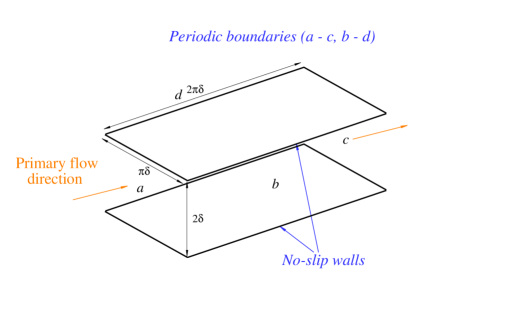
- Reτ ≈ 395 および 590のチャネル流れの明示的にフィルタリングされた DNS データを用いて、2つの DL/SNS モデル系を学習させた。
- アーキテクチャ A1: テンソル基底ニューラルネットワーク(TBNN)を用いて Pope–Lund–Novikov SGS 展開形を埋め込み、Galilean、回転、および反射不変性を強制。
- アーキテクチャ A2: 整合体基底テンソルと不変入力を用いるが、Galilean 不変性のみに焦点を合わせたよりシンプルなネットワーク。
- 解像速度勾配の対称成分Sと反対称成分R、およびそれらからの不変スカラーに由来する入力特徴量。
- SGS 予測における Galilean 不変性を保つため、明示的フィルタリングにはスペクトル的に鋭いカットオフフィルタを使用。
- さまざまなフィルタ幅とレイノルズ数で、予測された SGS 応力の前適合性(a priori)と後適合性(a posteriori)を評価する。
実験結果
リサーチクエスチョン
- RQ1DNS由来の明示的にフィルタリングされたデータで訓練した場合、DLベースの SGS モデルは壁に拘束された乱流の SGS 応力を正確に再現できるか。
- RQ2DL アーキテクチャに埋め込まれた不変性特性(Galilean、回転、反射)は壁に拘束された流れの SGS 予測のモデル性能を向上させるか。
- RQ32つのアーキテクチャ(A1は TBNN による全不変性、A2 は Galilean 不変性のみ)は、異なるフィルタ幅と Reynolds 数で前適合および後適合の評価でどのように比較されるか。
- RQ4学習された SGS モデルは、異なる DNS由来の訓練/テストデータセットと格子解像度に対して頑健か。
主な発見
- 両方のモデル系は、前適合テストで同様のレベルの耗散とバックキャタリングを示す。
- より良い特徴学習能力を持つ単純なアーキテクチャ(A2)は、不変性埋め込みモデル(A1)より統計的指標で優れている。
- アーキテクチャが異なっても、両方のモデルはテスト結果に基づき後適合LES応用で利用可能とみなされる。
- 不変性埋め込みアプローチ(A1)は解析的 SGS 展開形を埋め込むことで恩恵を受け、A2 は基底テンソルのクロス成分からの特徴抽出がより強力で恩恵を受ける。
- 訓練には Reτ の2つの値で明示的にフィルタリングされた DNS データを使用し、SGS 応力はさまざまなフィルタ幅と Reynolds 数に対して予測された。
![Figure 2: Comparisons of the mean profiles from DNSs listed in Tab. 1 (dashed lines) with those from Moser et al. [ 38 ] (symbols): $(a)$ stream-wise velocity $\langle u\rangle^{+}$ $(b)$ cross-stream ( $\langle u^{\prime}v^{\prime}\rangle^{+}$ ) component of the Reynolds stresses. All variables are](https://ar5iv.labs.arxiv.org/html/2307.10060/assets/x2.png)
より良い研究を、今すぐ始めましょう
論文設計から論文執筆まで、研究時間を劇的に削減しましょう。
クレジットカード登録不要
このレビューはAIが作成し、人間の編集者が確認しました。