
[論文レビュー] Active and reactive behaviour in human mobility: the influence of attraction points on pedestrians
本研究では、公共のフェアにおける人間の移動行動の能動的(内因的)および反応的(文脈依存的)成分を分離するため、ランゲビン力学に基づくモデルを提案する。GPSで追跡された歩行者とシミュレートされた誘致ポイントを用いて、可視のステージからの反応的力が移動パターンを顕著に形作ることを示し、能動的持続性と記憶が軌道の複雑さに寄与することを明らかにした。本研究は、都市計画およびイベントデザインに応用可能なスケーラブルなフレームワークを提供する。
Human mobility is becoming an accessible field of study thanks to the progress and availability of tracking technologies as a common feature of smart phones. We describe an example of a scalable experiment exploiting these circumstances at a public, outdoor fair in Barcelona (Spain). Participants were tracked while wandering through an open space with activity stands attracting their attention. We develop a general modeling framework based on Langevin Dynamics, which allows us to test the influence of two distinct types of ingredients on mobility: reactive or context-dependent factors, modelled by means of a force field generated by attraction points in a given spatial configuration, and active or inherent factors, modelled from intrinsic movement patterns of the subjects. The additive and constructive framework model accounts for the observed features. Starting with the simplest model (purely random walkers) as a reference, we progressively introduce different ingredients such as persistence, memory, and perceptual landscape, aiming to untangle active and reactive contributions and quantify their respective relevance. The proposed approach may help in anticipating the spatial distribution of citizens in alternative scenarios and in improving the design of public events based on a facts-based approach.
研究の動機と目的
- 市民科学とGPS追跡を用いた、人間移動を研究するためのスケーラブルでオープンアクセスの実験フレームワークを開発すること。
- 都市的環境に類似した空間内での歩行者の移動行動における、能動的(内因的)および反応的(文脈駆動)行動の相対的寄与を定量化すること。
- 持続性、記憶、知覚的景観を統合する、ランゲビン力学に基づく一般化されたモデリングフレームワークを構築すること。
- バルセロナの公共の科学フェアで観察された現実の移動パターンを再現できるかどうか、モデルの能力を検証すること。
- 都市環境における集団的移動行動の予測と、公共空間設計の改善に役立つデータ駆動型の手法を提供すること。
提案手法
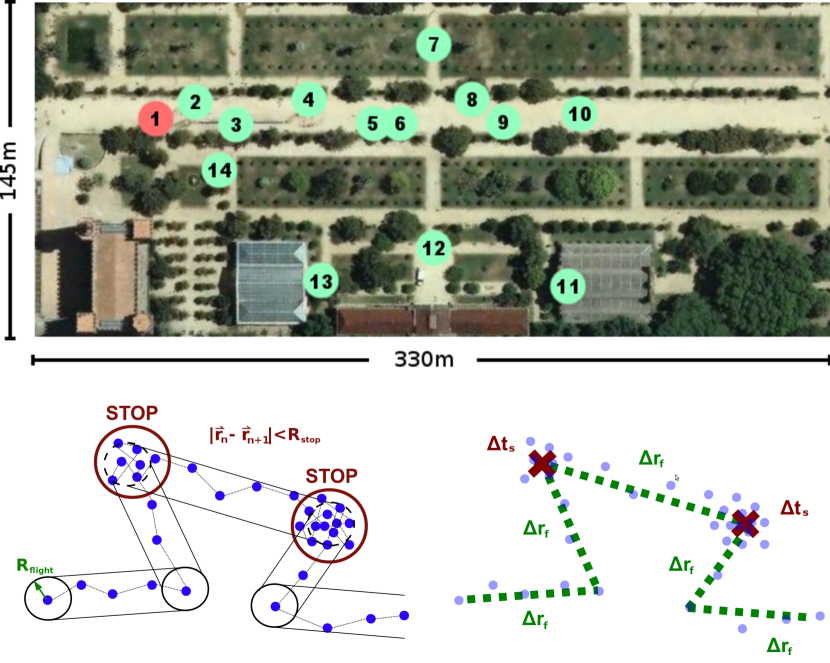
- バルセロナの公共フェアで大規模な市民科学実験を実施し、GPS搭載スマートフォンを用いて50名以上の参加者を追跡した。
- 平均位置誤差4.071メートル、15秒間隔のサンプリングで、現実のデータ収集を模倣した実世界のGPSデータを収集した。
- ランゲビン力学モデルを構築し、加法的成分として、ランダム運動のための確率的項、ボン・ミーゼス分布による持続性項、およびステージを表す誘導ポイント(ポテンシャル井戸)からの力場を含めた。
- 実際のフェアと同一のステージ配置を用い、330m × 145mの領域で20,000秒(5.5時間)分の移動をシミュレートした。
- dBBMM(動的ブラウン運動ブリッジ移動モデル)およびGISツール(ArcGIS、Geospatial Modelling Environment)を用いて、ホームレンジと軌道の分散を計算した。
- 軌道の分散を時間的に評価するため、11点のスライディングウインドウを用いて、移動の複雑さを分析した。
実験結果
リサーチクエスチョン
- RQ1可視の誘致ポイントからの反応的力は、都市的空間に類似したオープンな空間内での歩行者の移動パターンにどのように影響を与えるか?
- RQ2持続性や記憶といった内因的移動特性は、人間の移動軌道にどの程度寄与するか?
- RQ3能動的および反応的成分を統合した統一されたランゲビンベースのモデルは、現実の歩行者ダイナミクスを効果的に再現できるか?
- RQ4知覚的景観と個人の移動パターンの相互作用は、空間的分布およびホームレンジ推定にどのように影響を与えるか?
- RQ5公共イベントにおける集団的移動行動を形作る要因として、能動的行動と反応的行動の相対的寄与はどの程度か?
主な発見
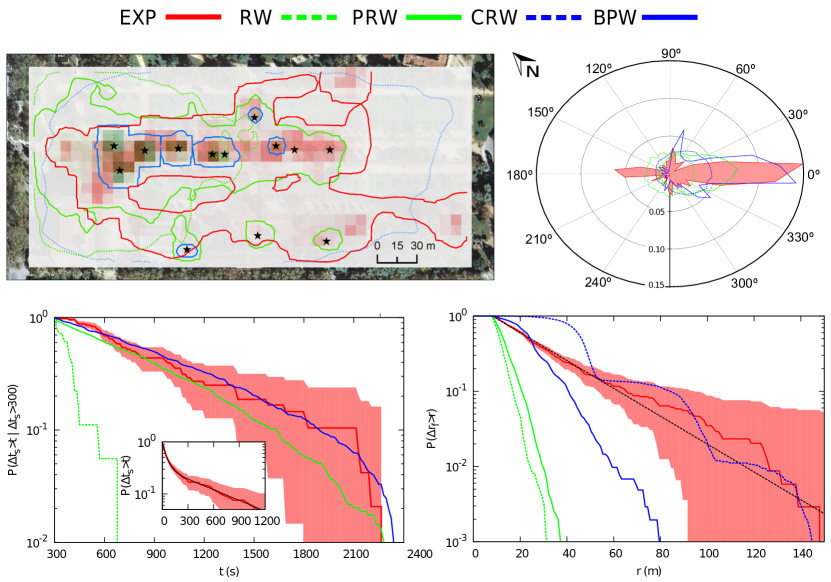
- ランゲビンモデルに誘導ポイント(ポテンシャル井戸)を組み込むことで、実際のGPS軌道との適合度が顕著に向上し、可視ステージからの強い反応的影響が示された。
- 軌道分散分析から、誘導ポイントに近づくと移動の複雑さが増加することが確認され、文脈依存の行動変化が裏付けられた。
- dBBMM分析から、反応的力が含まれるシミュレーションでは、純粋に能動的なモデルと比較して、参加者の95%ホームレンジが一貫して広がることが判明した。
- 持続性と記憶の両方の成分を含むモデルが、これらの特徴のうち1つまたはなしのモデルよりも、観察された移動パターンをよりよく再現した。
- シミュレートされた軌道は、空間的分布および移動強度の点で実データとよく一致し、モデルの予測力が妥当であることが裏付けられた。
- 本研究では、可視の誘導ポイントによって駆動される反応的行動が、特にステージ周辺の混雑領域において、歩行者フローを形作る主な要因であることが示された。
より良い研究を、今すぐ始めましょう
論文の読解から最終レビューまで、研究時間を劇的に削減しましょう。
クレジットカード登録不要
このレビューはAIが作成し、人間の編集者が確認しました。