
[論文レビュー] AI-driven materials design: a mini-review
本論文はAI対応の材料設計を概観し、深層生成モデル、RL/BO、そして自律ラボを用いた前方スクリーニングから逆設計への移行を強調し、課題と今後の方向性を論じる。
Materials design is an important component of modern science and technology, yet traditional approaches rely heavily on trial-and-error and can be inefficient. Computational techniques, enhanced by modern artificial intelligence (AI), have greatly accelerated the design of new materials. Among these approaches, inverse design has shown great promise in designing materials that meet specific property requirements. In this mini-review, we summarize key computational advancements for materials design over the past few decades. We follow the evolution of relevant materials design techniques, from high-throughput forward machine learning (ML) methods and evolutionary algorithms, to advanced AI strategies like reinforcement learning (RL) and deep generative models. We highlight the paradigm shift from conventional screening approaches to inverse generation driven by deep generative models. Finally, we discuss current challenges and future perspectives of materials inverse design. This review may serve as a brief guide to the approaches, progress, and outlook of designing future functional materials with technological relevance.
研究の動機と目的
- 試行錯誤法を超える、より迅速で効率的な材料探索の必要性を動機づける。
- 材料科学における前方スクリーニングから逆設計への進化を要約する。
- 逆設計を可能にする主要なAI手法(深層生成モデル、RL、BO、自律ラボ)を強調する。
- 現在の課題を議論し、AI主導の材料設計の今後のロードマップを提案する。
提案手法
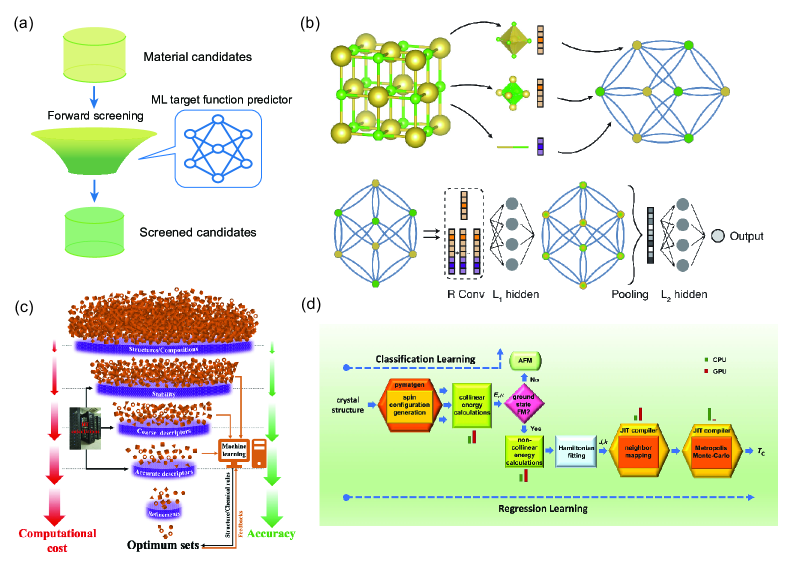
- 前方スクリーニングのワークフローと、性質予測におけるML代理モデルおよびグラフベース表現(例: CGCNN)の役割を説明する。
- 進化アルゴリズムファミリー(GA、PSO、MCTS)と、それらの結晶構造予測、材料最適化、ナノ粒子設計への適用を概説する。
- 適応的・対話的アプローチ(ベイズ最適化、強化学習、自律ラボ)と、それらの閉ループ設計評価サイクルを説明する。
- 逆設計のための深層生成モデル(VAE、GAN、拡散モデル、LLMs)と、ターゲット特性の条件付き生成を議論する。
- データの速度、データベース中心のワークフロー、インフラ要件を含む適応設計の現在の課題の総括を提供する。)
実験結果
リサーチクエスチョン
- RQ1材料科学において、前方スクリーニングから逆設計への移行を推進したAI手法は何か?
- RQ2前方スクリーニングと逆設計は、ターゲット特性を持つ材料を発見する上で、効率と能力の点でどう比較されるか?
- RQ3AI主導の逆設計を科学研究と技術開発に統合する際の主な課題と将来の方向性は何か?
主な発見
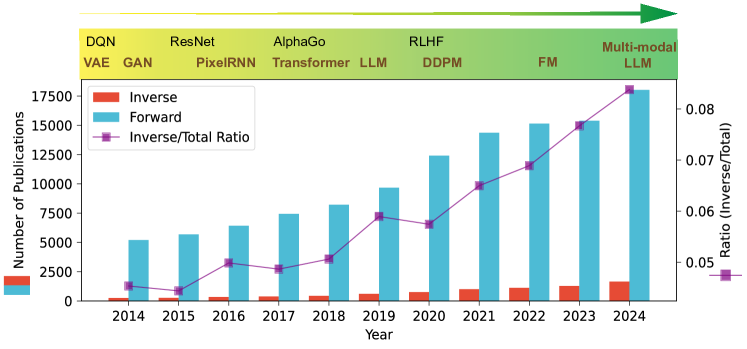
- 逆設計はますます顕著になっており、現在材料設計文献の約8%を占める。
- 深層生成モデルは潜在空間と条件付きサンプリングを通じて、直接的で特性をターゲットとした材料生成を可能にする。
- 適応的・対話的アプローチ(ベイズ最適化、強化学習、自律ラボ)は、データと実験の制約の下で設計を加速できる。
- 前方スクリーニングはML代理モデルで加速するが、広大な設計空間の外挿と高い偽陰性率に苦しむ。
- 進化アルゴリズム(GA、PSO、MCTS)は逆設計の下地を築いたが、計算コストとハイパーパラメータ感度の課題に直面している。
より良い研究を、今すぐ始めましょう
論文設計から論文執筆まで、研究時間を劇的に削減しましょう。
クレジットカード登録不要
このレビューはAIが作成し、人間の編集者が確認しました。