
[論文レビュー] AirPhyNet: Harnessing Physics-Guided Neural Networks for Air Quality Prediction
AirPhyNet は拡散-対流物理をニューラルネットワークに統合し、PM2.5を予測する精度を向上させ、特にデータが希薄な状況で現状の最先端ベースラインを上回る。
Air quality prediction and modelling plays a pivotal role in public health and environment management, for individuals and authorities to make informed decisions. Although traditional data-driven models have shown promise in this domain, their long-term prediction accuracy can be limited, especially in scenarios with sparse or incomplete data and they often rely on black-box deep learning structures that lack solid physical foundation leading to reduced transparency and interpretability in predictions. To address these limitations, this paper presents a novel approach named Physics guided Neural Network for Air Quality Prediction (AirPhyNet). Specifically, we leverage two well-established physics principles of air particle movement (diffusion and advection) by representing them as differential equation networks. Then, we utilize a graph structure to integrate physics knowledge into a neural network architecture and exploit latent representations to capture spatio-temporal relationships within the air quality data. Experiments on two real-world benchmark datasets demonstrate that AirPhyNet outperforms state-of-the-art models for different testing scenarios including different lead time (24h, 48h, 72h), sparse data and sudden change prediction, achieving reduction in prediction errors up to 10%. Moreover, a case study further validates that our model captures underlying physical processes of particle movement and generates accurate predictions with real physical meaning.
研究の動機と目的
- 精度の高い屋外PM2.5予測を、物理学とデータ駆動学習を組み合わせることによって動機づける。
- 基本的な大気輸送物理(拡散と対流)を深層学習フレームワークに組み込む。
- 希薄データや急変時において、予測精度と解釈性を向上させる。
提案手法
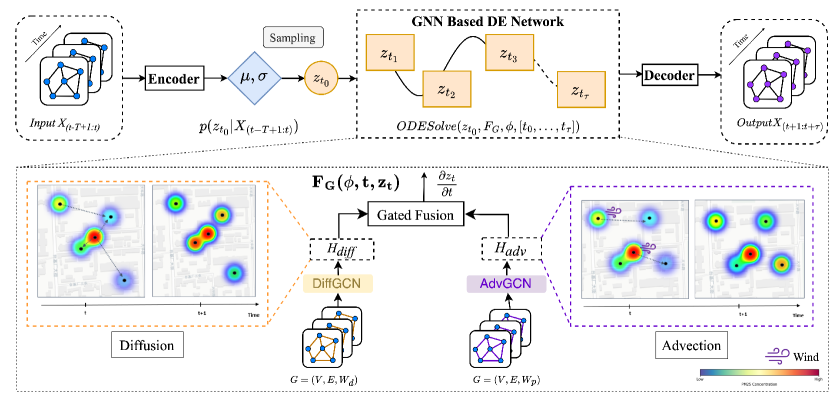
- 履歴の PM2.5 と天気データを RNN エンコーダ(GRU)でエンコードする。
- センサーネットワーク上の拡散と対流をグラフラプラス演算子を用いた微分方程式ネットワークとしてモデル化する。
- 拡散と対流のダイナミクスをゲート機構で融合し、拡散-対流微分方程式(DE)を形成する。
- DE ネットワークを GNN によるニューラルODEでパラメータ化し、潜在状態を時間とともに進化させる。
- 潜在予測を将来の時点(最大 72 時間 ahead)で PM2.5 濃度へデコードする。
- 予測濃度と真値濃度との MAE を最小化することで End-to-End に学習する。
実験結果
リサーチクエスチョン
- RQ1物理学に guid されたディープラーニング(拡散-対流)が、純粋なデータ駆動モデルよりも屋外 PM2.5 予測を改善できるか?
- RQ2物理情報を含むコンポーネントは、希薄データや急変シナリオで性能を高めるか?
- RQ3提案された GNN ベースの微分方程式ネットワークは、センサーネットワーク上の時空間輸送ダイナミクスを効果的に捉えるか?
- RQ4予測を基底となる拡散と対流プロセスと結びつけることの解釈可能性上の利点は何か?
主な発見
| モデル | 北京 24時間 MAE | 北京 24時間 RMSE | 北京 48時間 MAE | 北京 48時間 RMSE | 北京 72時間 MAE | 北京 72時間 RMSE | 深圳 24時間 MAE | 深圳 24時間 RMSE | 深圳 48時間 MAE | 深圳 48時間 RMSE | 深圳 72時間 MAE | 深圳 72時間 RMSE |
|---|---|---|---|---|---|---|---|---|---|---|---|---|
| HA | 38.37 | 83.91 | 45.80 | 95.56 | 50.58 | 101.51 | 8.35 | 12.52 | 9.72 | 14.34 | 10.54 | 15.39 |
| VAR | 60.10 | 102.92 | 60.44 | 103.02 | 60.64 | 103.07 | 21.50 | 26.09 | 21.84 | 26.50 | 22.17 | 26.92 |
| DCRNN | 35.99 | 52.55 | 49.66 | 67.50 | 57.01 | 74.67 | 7.76 | 11.54 | 9.99 | 14.11 | 10.98 | 15.14 |
| STGCN | 33.70 | 49.16 | 38.93 | 54.98 | 43.93 | 56.57 | 7.23 | 10.61 | 9.35 | 12.99 | 9.97 | 13.59 |
| GMAN | 50.62 | 66.05 | 50.73 | 66.07 | 50.69 | 65.87 | 9.76 | 12.70 | 10.08 | 13.22 | 10.07 | 12.99 |
| GTS | 34.99 | 51.45 | 54.18 | 71.87 | 73.50 | 89.59 | 6.58 | 9.55 | 8.70 | 12.15 | 10.54 | 13.94 |
| PM25GNN | 50.94 | 65.87 | 48.81 | 65.64 | 51.51 | 66.55 | 9.90 | 12.31 | 10.02 | 12.63 | 10.30 | 12.85 |
| AirFormer | 29.62 | 46.49 | 38.43 | 56.52 | 43.39 | 58.68 | 7.24 | 10.83 | 9.66 | 13.47 | 10.21 | 13.98 |
| LatentODE | 44.83 | 53.96 | 45.95 | 55.44 | 47.14 | 57.39 | 9.85 | 12.30 | 10.24 | 12.89 | 10.73 | 13.33 |
| ODE-LSTM | 46.19 | 57.56 | 49.18 | 62.39 | 51.45 | 63.66 | 10.55 | 13.24 | 11.36 | 14.18 | 12.03 | 14.81 |
| AirPhyNet | 29.11 | 42.16 | 36.69 | 48.66 | 42.23 | 53.07 | 6.38 | 9.48 | 8.18 | 11.38 | 9.51 | 12.51 |
- AirPhyNet は北京と深圳のデータセットの 24h、48h、72h 予測で一貫してベースラインを上回る。
- 全データ設定での2番手法に対する平均的な改善は MAE で 3.7%、RMSE で 6.1% 。
- 希薄データ設定で、AirPhyNet は競合他手より平均して MAE 8.3%、RMSE 8.1% 改善。
- 急変シナリオで最大 8% の予測誤差低減を達成。
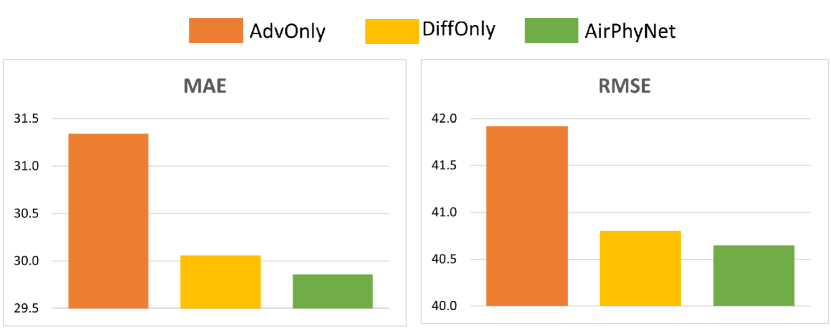
- アブレーション研究は、拡散と対流の組み合わせの有利性、および TCN ベースのエンコーダより GRU エンコーダを使用する利点を示す。
- ケーススタディの可視化は、予測における物理的に意味のある拡散と対流パターンを示す。
より良い研究を、今すぐ始めましょう
論文設計から論文執筆まで、研究時間を劇的に削減しましょう。
クレジットカード登録不要
このレビューはAIが作成し、人間の編集者が確認しました。