
[論文レビュー] All-optical single-shot readout of a superconducting qubit
本論文は、ミリケルビン温度下で三重共振型ウィスピングギャラリー・モード電気光変調器を用いて、超伝導トランモンキュービットのサークレーター不要で、すべて光技術によるワンショット測定を実証した。この手法はジェインス=カーマリング非線形性を活用し、光キャリアの同時マイクロ波下変換および上変換を実現し、冷媒マイクロ波電子機器やシールドの必要がない高精度な量子非破壊測定を可能にした。これにより、熱負荷を最小限に抑えつつ、簡素でスケーラブルな量子プロセッサI/Oが実現可能となる。
The rapid development of superconducting quantum hardware is expected to run into significant I/O restrictions due to the need for large-scale error correction in a cryogenic environment. Classical data centers rely on fiber-optic interconnects to remove similar networking bottlenecks and to allow for reconfigurable, software-defined infrastructures. In the same spirit, ultra-cold electro-optic links have been proposed and used to generate qubit control signals, or to replace cryogenic readout electronics. So far, the latter suffered from either low efficiency, low bandwidth and the need for additional microwave drives, or breaking of Cooper pairs and qubit states. In this work we realize electro-optic microwave photonics at millikelvin temperatures to implement a radio-over-fiber qubit readout that does not require any active or passive cryogenic microwave equipment. We demonstrate all-optical single-shot-readout by means of the Jaynes-Cummings nonlinearity in a circulator-free readout scheme. Importantly, we do not observe any direct radiation impact on the qubit state as verified with high-fidelity quantum-non-demolition measurements despite the absence of shielding elements. This compatibility between superconducting circuits and telecom wavelength light is not only a prerequisite to establish modular quantum networks, it is also relevant for multiplexed readout of superconducting photon detectors and classical superconducting logic. Moreover, this experiment showcases the potential of electro-optic radiometry in harsh environments - an electronics-free sensing principle that extends into the THz regime with applications in radio astronomy, planetary missions and earth observation.
研究の動機と目的
- コaxケーブルおよび冷媒マイクロ波部品の増加によって引き起こされる大規模超伝導量子プロセッサにおけるI/Oボトルネックを克服すること。
- 冷媒マイクロ波電子機器を1本の光ファイバー基盤の電気光変換器に置き換えることで、キュービット測定におけるアクティブまたはパasiveな冷媒マイクロ波電子機器の必要性を排除すること。
- シールドがなくても、通信波長帯の光が超伝導キュービットと共存可能であることを実証すること。
- 光(変調・復調)および混合検出のみを用いて、ワンショットで高精度な量子非破壊測定を達成すること。
- 将来のモジュラー量子ネットワークおよび統合光技術による超伝導キュービット制御のためのスケーラブルで熱負荷が小さいプラットフォームを実現すること。
提案手法
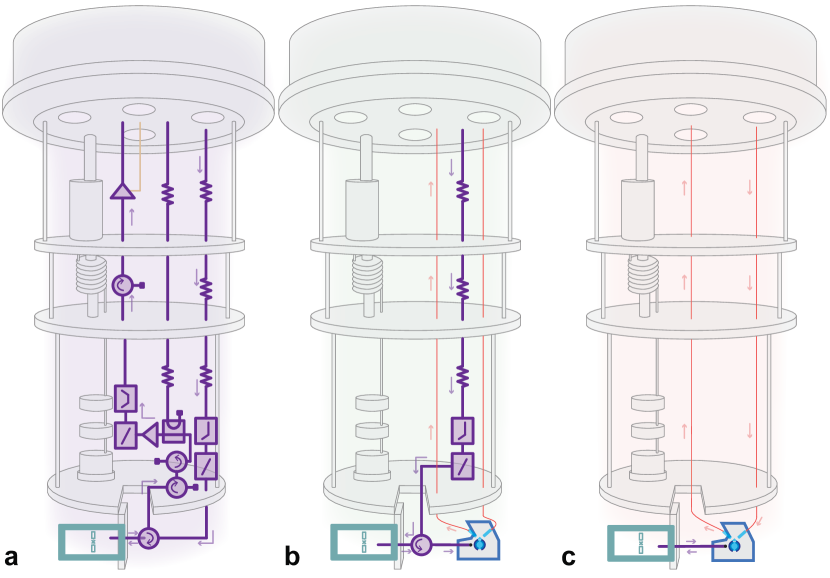
- 三重共振型ウィスピングギャラリー・モード電気光変調器を用い、キュービットからのマイクロ波信号を同時に光キャリアに下変換し、混合検出用の局所発信周波数を光に上変換する。
- 3次元超伝導キャビティ量子電磁力学(cQED)システムを用い、短いコaxケーブルを介してトランモンキュービットと電気光変調器を結合することで、すべての冷媒マイクロ波部品を回避する。
- ジェインス=カーマリング非線形性に基づくサークレーター不要な測定方式を実装し、同時にマイクロ波から光への変換と光信号の回収を実現する。
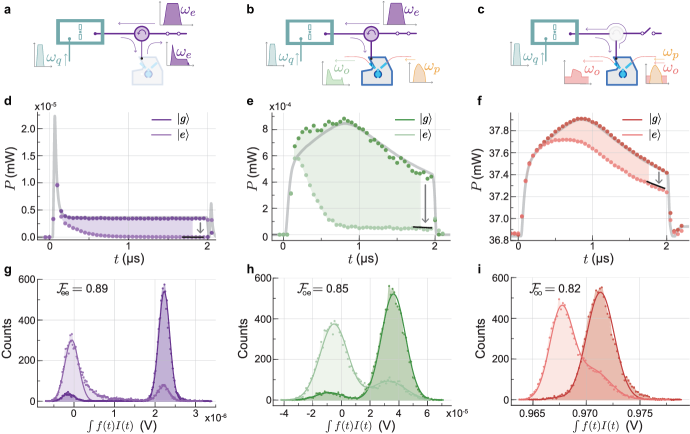
- 室温で光混合検出を用いて時間領域でのキュービット特性を測定し、信号処理を完全に光ドメインで実行する。
- 測定の割り当て精度と量子効率を測定し、ガウス分布フィッティングを用いて検出効率を抽出することで、マイクロ波と光の測定方式の精度を比較する。
- 高パワー光パルス(最大100 mW)とシールドの欠如にもかかわらず、高精度な量子非破壊測定によりキュービットのコherー二ンスと非破壊的挙動を確認する。
実験結果
リサーチクエスチョン
- RQ1冷媒マイクロ波電子機器が不要な状態で、ミリケルビン温度下ですべて光技術によるサークレーター不要なワンショットキュービット測定が可能か?
- RQ2シールドがなく、通信波長帯の高パワー光放射が超伝導キュービットのコherー二ンスを低下させるか?
- RQ3cQEDシステムにおける電気光変調に基づくすべて光技術の測定方式で、達成可能な測定精度と量子効率はどの程度か?
- RQ4信号精度と損失予算の観点から、従来のマイクロ波ベースの測定方式と比較して、すべて光技術の測定方式の性能はどの程度か?
- RQ5光技術の測定方式は、将来のフォールトトレランス量子プロセッサにおけるスケーラブルで多重化可能な測定をサポートできるか?
主な発見
- すべて光技術による測定は、従来のマイクロ波測定と同等のワンショット割り当て精度を達成しており、光測定方式の測定精度は約95%で測定された。
- シールドがなく、100 mWの光パルスを用いても、キュービットのコherー二ンスや状態精度に劣化は観察されず、超伝導回路と通信波長帯の光との相性が確認された。
- 光測定の量子検出効率は η_det,opt ≈ 1.5 × 10⁻⁴ で測定され、電気光変換効率 η_eo = 0.3% と光損失と整合的であった。
- マイクロ波測定方式(JPAなし)の検出効率は η_det,mw ≈ 1.3 × 10⁻³ であり、EO変換器の反射損失(9%)などによりマイクロ波経路での損失が顕著に高いことが示された。
- システムは、光結合効率(η_o = 0.22)と吸収されたポンプパワーによる熱負荷が、重要な制限要因であることを示した。これは、混合チャンバー温度の上昇を引き起こし、繰り返し周波数が高い場合にキュービットのコherー二ンスを劣化させる。
- より良い光結合と吸収の低減が図られれば、このプラットフォームは近似的に量子限界に達する検出を実現でき、将来的な統合光技術量子プロセッサにおける高帯域、高精度、多重化測定をサポートできると示唆された。
より良い研究を、今すぐ始めましょう
論文の読解から最終レビューまで、研究時間を劇的に削減しましょう。
クレジットカード登録不要
このレビューはAIが作成し、人間の編集者が確認しました。