
[論文レビュー] All the Little Things in Abell 2744: $>$1000 Gravitationally Lensed Dwarf Galaxies at $z=0-9$ from JWST NIRCam Grism Spectroscopy
この論文は All the Little Things (ALT) JWST Cycle 2 NIRCam grism survey of Abell 2744 を提示し、>1000 のレンズされた小型銀河 (z=0-9) のスペクトルと赤方偏移を提供し、新しい mosaic および線同定技術を導入、z=0.2-8.5 にわたって1630 の赤方偏移を測定。
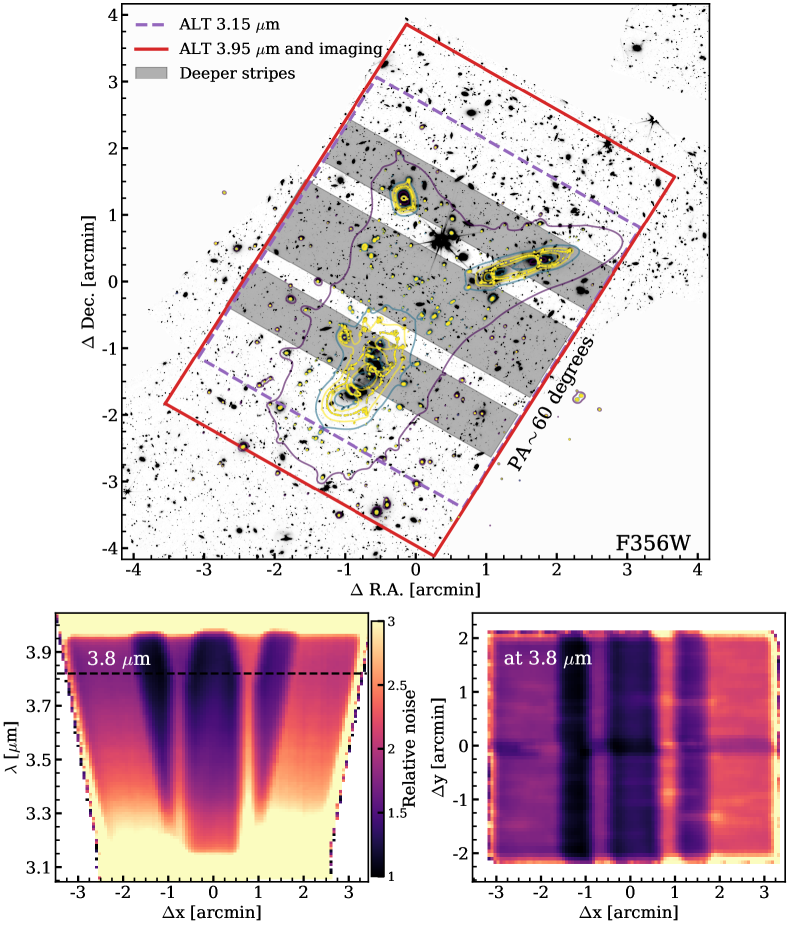
Dwarf galaxies hold the key to crucial frontiers of astrophysics, however, their faintness renders spectroscopy challenging. Here we present the JWST Cycle 2 survey, All the Little Things (ALT, PID 3516), which is designed to seek late-forming Pop III stars and the drivers of reionization at $z\sim6-7$. ALT has acquired the deepest NIRCam grism spectroscopy yet (7-27 hr), at JWST's most sensitive wavelengths (3-4 $μ$m), covering the powerful lensing cluster Abell 2744. Over the same 30 arcmin$^2$, ALT's ultra-deep F070W+F090W imaging ($\sim$30 mag) enables selection of very faint sources at $z>6$. We demonstrate the success of ALT's novel ``butterfly" mosaic to solve spectral confusion and contamination, and introduce the ``Allegro" method for emission line identification. By collecting spectra for every source in the field of view, ALT has measured precise ($R\sim1600$) redshifts for 1630 sources at $z=0.2-8.5$. This includes one of the largest samples of distant dwarf galaxies: [1015, 475, 50] sources less massive than the SMC, Fornax, and Sculptor with $\log(M_{*}/M_{\odot})<$[8.5, 7.5, 6.5]. We showcase ALT's discovery space with: (i) spatially resolved spectra of lensed clumps in galaxies as faint as $M_{ m{UV}}\sim-15$; (ii) large-scale clustering -- overdensities at $z$=[2.50, 2.58, 3.97, 4.30, 5.66, 5.77, 6.33] hosting massive galaxies with striking Balmer breaks; (iii) small-scale clustering -- a system of satellites around a Milky Way analog at $z\sim6$; (iv) spectroscopically confirmed multiple images that help constrain the lensing model underlying all science in this legacy field; (v) sensitive star-formation maps based on dust-insensitive tracers such as Pa$α$; (vi) direct spectroscopic discovery of rare sources such as AGN with ionized outflows. These results provide a powerful proof of concept for how grism surveys maximize the potential of strong lensing fields.
研究の動機と目的
- 極めて暗く、レンズされた銀河の深い分光カウントを動機づけ、金属欠乏ポケットと再電離時代の源を研究。
- Abell 2744 のレンズ効果を活用し、非常に小さな質量まで押し進み、クラムや伴星系の空間的に分解されたスペクトルを捉える。
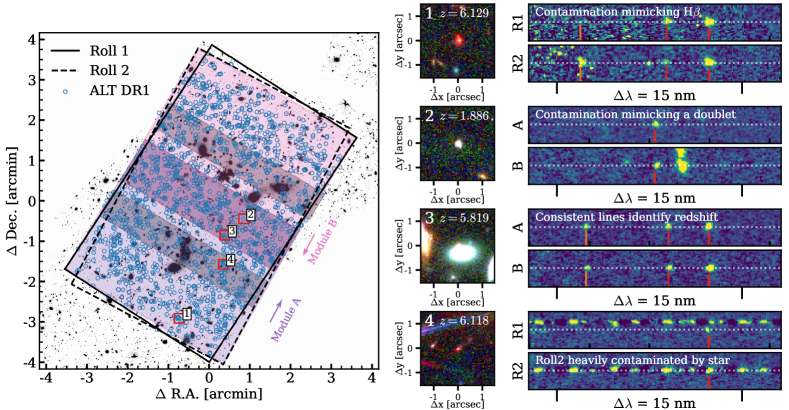
- WFSS データにおけるスペクトル混同を軽減するモザキングと分析手法を開発・検証。
- 多様な銀河環境の大規模で同質のスペクトroscopic赤方偏移と発光線測定のカタログを提供。
- 金属欠乏候補、吹き出しを持つAGN、巨大-小規模スケール双方のクラスタリング等の科学成果を示す。
提案手法
- JWST NIRCam WFSS (R~1600) を F356W 主要設定で用い、Abell 2744 全域にわたり深いグリズム分光を取得(フィールドごとに総露出 7–27 時間)。
- モジュール重複と分散方向のスペクトル混在を解決する、2つの近接ロール角を用いた新規 butterfly mosaic 戦略を実装。
- Allegro と grizli パイプラインを開発・適用し、発光線同定とスペクトログラフィック赤方偏移の測定を堅牢に。
- 多波長のNIRCam/HSTデータから写真計測カタログを構築し、前景の減算を丁寧に行い高い増倍率源を検出。
- 27-band のSEDフィッティングにより物理的性質を導出し、スペクトroscopic 赤方偏移を金属度感度線診断(例: [OIII]/Hβ)に固定。
- 研究質問の研究内での役割や、焦点を保つために存在しない場合や冗長な場合には省略される。
実験結果
リサーチクエスチョン
- RQ1Abell 2744 のような強いレンズクラスタの深い WFSS 調査において、赤方偏移分布と分光の網羅性はどの程度達成されるのか?
- RQ2蝶形モザイクと Allegro/grizli アプローチは、混雑したレンズ場でのスペクトル汚染をどれだけ軽減し、頑健な線同定を可能にするのか?
- RQ3Abell 2744 の背後で検出・特徴付けできる小型銀河の数(対応テンプレートの log(M*/Msun) < 8.5, 7.5, 6.5)を z~9 にまで拡大できるか?
- RQ4空間的に分解されたスペクトルは、非常に倍率の高いクラムや伴星における星形成、金属量、イオン化光子生成について何を明らかにするか?
- RQ5大規模・小規模スケールのクラスタリング分析は、レンズ場内の z~2–6 の大質量銀河の環境について何を示すか?
主な発見
| Band | Depth (0.16) [mag AB] | Depth (0.08) [mag AB] |
|---|---|---|
| F435W | 28.91 | 29.89 |
| F606W | 28.62 | 29.62 |
| F814W | 28.52 | 29.51 |
| F105W | 27.63 | 28.63 |
| F125W | 27.73 | 28.76 |
| F140W | 29.06 | 30.11 |
| F160W | 27.45 | 28.44 |
| JWST F070W | 28.91 | 29.89 |
| JWST F090W | 29.36 | 30.34 |
| JWST F115W | 29.02 | 30.05 |
| JWST F140M | 28.03 | 29.04 |
| JWST F150W | 29.12 | 30.14 |
| JWST F162M | 28.11 | 29.11 |
| JWST F182M | 28.48 | 29.50 |
| JWST F200W | 29.21 | 30.26 |
| JWST F210M | 28.37 | 29.37 |
| JWST F250M | 28.11 | 29.11 |
| JWST F277W | 29.64 | 30.66 |
| JWST F300M | 28.63 | 29.64 |
| JWST F335M | 28.65 | 29.70 |
| JWST F356W | 29.82 | 30.86 |
| JWST F360M | 28.72 | 29.72 |
| JWST F410M | 29.02 | 29.99 |
| JWST F430M | 27.98 | 28.98 |
| JWST F460M | 27.75 | 28.72 |
| JWST F480M | 27.91 | 28.87 |
| JWST F444W | 29.44 | 30.43 |
- field 内の 1630 該当源の正確な赤方偏移を測定し、z=0.2–8.5 に跨る。
- レンズ場内で log(M*/M⊙) < 8.5(およびそれ以下)の遠方の小型銀河の最大規模サンプルの1つを検出。
- Lensed clumps の空間的に分解されたスペクトルを、MUV ~ -15 の等級まで描出。
- 複数の赤方偏移(例: z=2.50, 2.58, 3.97, 4.30, 5.66, 5.77, 6.33 など)および z~6 の Milky Way 類似の衛星系の過密密度・クラスタリング信号を同定。
- Abell 2744 のレンズモデルを制約するスペクトroscopic 直接証拠を提供。
- 星形成の敏感な指標(例: Paα)や、 ionized outflows を伴う希少な源となるAGN の発見を含む。
より良い研究を、今すぐ始めましょう
論文設計から論文執筆まで、研究時間を劇的に削減しましょう。
クレジットカード登録不要
このレビューはAIが作成し、人間の編集者が確認しました。