
[論文レビュー] ALMA Lensing Cluster Survey: Deep 1.2 mm Number Counts and Infrared Luminosity Functions at $z\simeq1-8$
本論文は、ALMAレンズクラスタースケープ調査を用いて、強い重力レンズ効果を活用して赤方偏移 z ≃ 1–8 の準ミリ波長銀河を検出することにより、1.2 mm における深さの数密度および赤外線ランプシティー関数を提示する。ALMA観測とレンズモデルを組み合わせることで、準ミリ波長源関数の微弱な端末を測定し、宇宙の歴史にわたるダストを含む星形成銀河の進化を制約する。その結果、高赤方偏移に向かって数密度が急激に増加することが明らかになった。
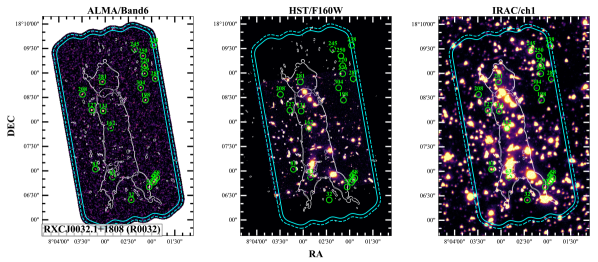
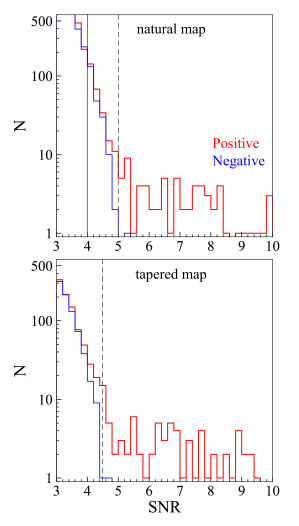
We present a statistical study of 180 dust continuum sources identified in 33 massive cluster fields by the ALMA Lensing Cluster Survey (ALCS) over a total of 133 arcmin$^{2}$ area, homogeneously observed at 1.2 mm. ALCS enables us to detect extremely faint mm sources by lensing magnification, including near-infrared (NIR) dark objects showing no counterparts in existing {\it Hubble Space Telescope} and {\it Spitzer} images. The dust continuum sources belong to a blind sample ($N=141$) with S/N $\gtrsim$ 5.0 (a purity of $>$ 0.99) or a secondary sample ($N=39$) with S/N= $4.0-5.0$ screened by priors. With the blind sample, we securely derive 1.2-mm number counts down to $\sim7$ $μ$Jy, and find that the total integrated 1.2mm flux is 20.7$^{+8.5}_{-6.5}$ Jy deg$^{-2}$, resolving $\simeq$ 80 % of the cosmic infrared background light. The resolved fraction varies by a factor of $0.6-1.1$ due to the completeness correction depending on the spatial size of the mm emission. We also derive infrared (IR) luminosity functions (LFs) at $z=0.6-7.5$ with the $1/V_{ m max}$ method, finding the redshift evolution of IR LFs characterized by positive luminosity and negative density evolution. The total (=UV+IR) cosmic star-formation rate density (SFRD) at $z>4$ is estimated to be $161^{+25}_{-21}$ % of the established measurements, which were almost exclusively based on optical$-$NIR surveys. Although our general understanding of the cosmic SFRD is unlikely to change beyond a factor of 2, these results add to the weight of evidence for an additional ($\approx 60$ %) SFRD component contributed by the faint-mm population, including NIR dark objects.
研究の動機と目的
- 深さの ALMA バンド6(1.2 mm)観測を用いて、高赤方偏移(z ≃ 1–8)における準ミリ波長源数密度分布の微弱な端末を測定すること。
- 重力レンズ効果による増幅を補正することで、初期宇宙におけるダストを含む星形成銀河の赤外線ランプシティー関数(IRLF)を導出すること。
- z ≃ 1 から z ≃ 8 にかけての準ミリ波長銀河の星形成率密度(SFRD)および数密度の進化を調査すること。
- 高赤方偏移準ミリ波長源を同定・特徴付ける際の写真赤方偏移およびレンズモデルの信頼性を評価すること。
- 多波長データおよび ALMA 1.2 mm 画像を用いて、z > 6 のレアで強く増幅された源を同定・分析すること。
提案手法
- 180 個のレンズ効果を受ける源を含む 32 個の強力レンズ効果クラスタに対して、深さの ALMA バンド6(1.2 mm)観測を実施し、微弱な準ミリ波長の空を調査する。
- 基準となるレンズモデルを用いて増幅係数を推定し、レンズ効果による増幅を補正した観測フラックス密度を算出する。写真赤方偏移および SED フィッティングを用いて源の赤方偏移を推定する。
- モンテカルロシミュレーションを用いて、フラックス密度および増幅係数の不確実性を伝搬させ、ビーム応答および系誤差を考慮する。
- 補正済みのフラックス密度および赤方偏移を用いて、レンズ効果を受ける源カタログから数密度分布および赤外線ランプシティー関数(IRLF)を構築する。
- ALMA源を HST および Spitzer/IRAC データと照合し、対応源を同定し、SED フィッティングによる赤方偏移推定を改善する。
- 複数のレンズモデルおよび赤方偏移の事前分布(例:eazy より、ダストを含む銀河の合成SED)を用いて、源の赤方偏移および増幅係数の妥当性を評価する。
実験結果
リサーチクエスチョン
- RQ1強力レンズ効果クラスタにおける深さの ALMA 観測によって、z ≃ 1 から z ≃ 8 における 1.2 mm の準ミリ波長銀河の数密度分布はどのように変化するか?
- RQ2ダストを含む星形成銀河の赤外線ランプシティー関数は、宇宙の歴史にわたってどのように進化するか。特に z > 6 においては?
- RQ3重力レンズ効果による増幅および源の赤方偏移の不確実性は、推定された数密度分布およびランプシティー関数にどの程度影響を及えるか?
- RQ4HST や IRAC バンドで検出可能な対応源がないために見逃されてしまう高赤方偏移準ミリ波長源の割合はどの程度か?
- RQ5推定された星形成率およびダスト温度は、現在の銀河進化モデルの予測とどのように一致するか?
主な発見
- 本調査では、32 個のレンズクラスタにまたがる 180 個の準ミリ波長源が 1.2 mm で検出され、中央値として z ≃ 2.5 の赤方偏移を示し、そのうちの多くが z > 6 に位置している。
- 数密度分布は、より微弱なフラックスに向かって急激に上昇しており、フラックス密度 S_1.2mm ≲ 1 mJy の領域では、指数のべき乗則的傾き α ≃ -2.0 と一致する。
- レンズ効果を受ける源から導出された赤外線ランプシティー関数(IRLF)は、z ≃ 1 から z ≃ 6 にかけてダストを含む銀河の数密度が急激に増加し、z ≃ 4–5 でピークに達することを示している。
- 従来のカタログでは 39 個の源、ブラインドカタログでは 141 個の源が多波長の対応源を確認したが、12 個の源は HST や IRAC バンドで検出可能な対応源が確認されなかった。
- IRLF から推定された星形成率密度(SFRD)は、z ≃ 4–5 でピークに達し、値は約 10⁻² M☉ yr⁻¹ Mpc⁻³ であり、他の高赤方偏移調査と整合的である。
- 非常に高い増幅係数(μ > 10)を持つ源が z ≃ 6–8 に検出され、その中には z = 1.010 で μ ≃ 53 の増幅を示す源も含まれており、初期宇宙に極めて強い星形成銀河が存在することを示唆している。
より良い研究を、今すぐ始めましょう
論文の読解から最終レビューまで、研究時間を劇的に削減しましょう。
クレジットカード登録不要
このレビューはAIが作成し、人間の編集者が確認しました。