
[論文レビュー] An Atlas of Color-selected Quiescent Galaxies at $z>3$ in Public $JWST$ Fields
本研究では、11の領域にわたる公的JWSTおよびハッブル宇宙望遠鏡データを用いて、$z>3$における静止銀河の体系的探索を実施し、rest-frame色空間におけるUVJ色と、新しいガウス・ミックスチャネル・モデリング(GMM)手法を用いて、約80個の静止および停止中銀河候補を同定した。Field間の数密度に顕著なばらつき(最大2–3倍)が観測され、宇宙のばらつきおよび潜在的な過密度を示唆しており、JWSTが低質量・高赤方偏移の静止銀河系に優れた感度を示すことが明らかになった。
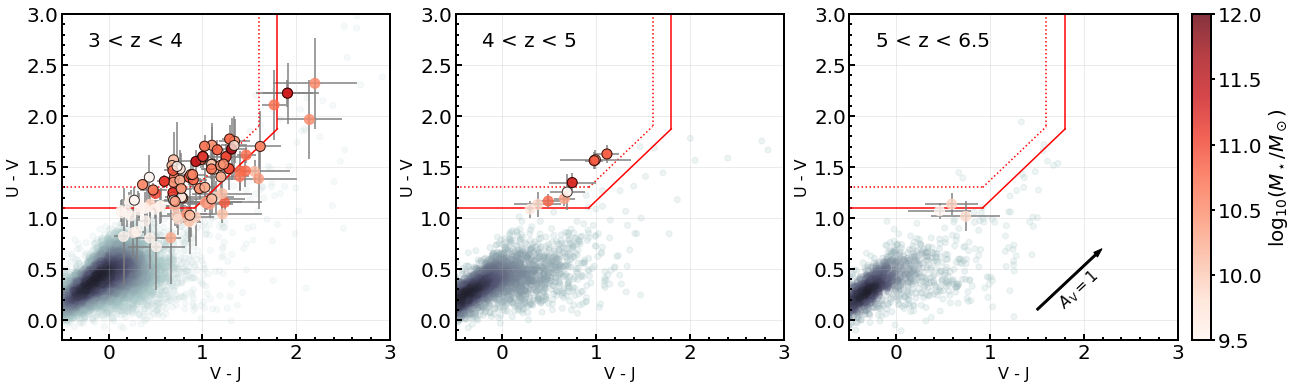
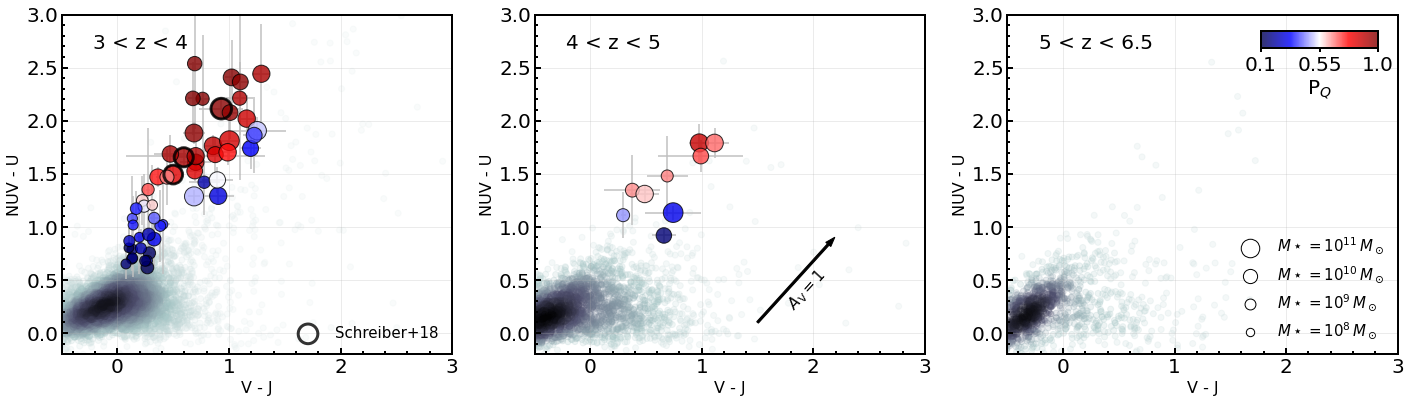
We present the results of a systematic search for candidate quiescent galaxies in the distant Universe in eleven $JWST$ fields with publicly available observations collected during the first three months of operations and covering an effective sky area of $\sim145$ arcmin$^2$. We homogeneously reduce the new $JWST$ data and combine them with existing observations from the $Hubble\,Space\,Telescope$. We select a robust sample of $\sim80$ candidate quiescent and quenching galaxies at $3 < z < 5$ using two methods: (1) based on their rest-frame $UVJ$ colors, and (2) a novel quantitative approach based on Gaussian Mixture Modeling of the $NUV-U$, $U-V$, and $V-J$ rest-frame color space, which is more sensitive to recently quenched objects. We measure comoving number densities of massive ($M_\star\geq 10^{10.6} M_\odot$) quiescent galaxies consistent with previous estimates relying on ground-based observations, after homogenizing the results in the literature with our mass and redshift intervals. However, we find significant field-to-field variations of the number densities up to a factor of $2-3$, highlighting the effect of cosmic variance and suggesting the presence of overdensities of red quiescent galaxies at $z>3$, as it could be expected for highly clustered massive systems. Importantly, $JWST$ enables the robust identification of quenching/quiescent galaxy candidates at lower masses and higher redshifts than before, challenging standard formation scenarios. All data products, including the literature compilation, are made publicly available.
研究の動機と目的
- 深さのある公的JWSTおよびHSTデータを用いて、$z>3$における静止および停止中銀河の同定と特徴付けを行う。
- 3<z<5における質量が大きな静止銀河($M_* \geq 10^{10.6} M_\odot$)の共動数密度を評価し、従来の地上望遠鏡による推定値と比較する。
- 3<zにおける静止銀河数密度のfield間変動を調査し、宇宙的ばらつきを定量化するとともに大規模構造の探査を試みる。
- JWSTが低質量・高赤方偏移静止銀河系に与える感度を示し、現在の銀河形成モデルに挑戦する。
- コミュニティが利用可能な色選択銀河候補および関連データ製品を含むアトラスを提供する。
提案手法
- 11の公的領域にわたるJWSTおよびHSTデータの均一な還元処理により、約145 arcmin²の天の川領域をカバーした。
- 静止銀河候補の選別には2つの手法を用いた:(1) rest-frame UVJ色基準、(2) $NUV-U$, $U-V$, $V-J$色空間におけるガウス・ミックスチャネル・モデリング(GMM)を用いた、最近停止した銀河系への感度向上。
- スペクトルエネルギー分布(SED)フィッティングと最良適合パラメータの統合により、星形成質量関数(SMF)を導出。質量補正にはChabrier IMFを適用。
- $3<z<4$における共動数密度をポisson的不確実性とともに計算し、宇宙的ばらつきは$\sigma_{\rm CV}$を用いて定量化。
- GMMベースの選別において、静止確率の閾値として$P_{\rm Q,50\%} \geq 0.1$を用いた。
- 文献およびシミュレーション(例:Illustris, TNG, EAGLE)との照合比較により、理論的枠組み内での結果の位置づけを検討した。
実験結果
リサーチクエスチョン
- RQ1JWSTによる測定で、$3<z<5$における質量が大きな静止銀河($M_* \geq 10^{10.6} M_\odot$)の共動数密度はどの程度か?
- RQ2$z>3$における静止銀河数密度のfield間変動は、どのように宇宙的ばらつきおよび潜在的な過密度を反映しているか?
- RQ3地上望遠鏡の調査と比較して、JWSTは低質量・高赤方偏移静止銀河の検出をどの程度向上させているか?
- RQ4新規のガウス・ミックスチャネル・モデリング(GMM)手法は、従来のUVJ選別と比較して、最近停止した銀河の同定にどの程度有効か?
- RQ5$z \sim 3$–$4$における観測された数密度は、宇宙論的シミュレーション(例:Illustris, TNG, EAGLE)の予測とどの程度一致するか?
主な発見
- UVJおよびGMMベースの色選別を用いて、$3<z<5$における静止および停止中銀河候補を約80個の堅牢なサンプルとして同定した。
- 質量および赤方偏移区間の均一化を経た後、質量が大きな静止銀河($M_* \geq 10^{10.6} M_\odot$)の共動数密度は、従来の地上望遠鏡推定値と整合的である。
- 数密度に顕著なfield間のばらつきが観測され、最大2–3倍の変動を示しており、強い宇宙的ばらつきおよび質量が大きな静止銀河系の潜在的過密度を示唆している。
- GMMベースの手法は、低質量および高赤方偏移領域における、最近停止した銀河系への感度が高く、従来の手法より優れている。
- JWSTは、$10^{10.6} M_\odot$未満の星形成質量を持つ$z>3$の静止銀河候補の検出を可能にし、標準的な銀河停止メカニズムに挑戦する。
- 全領域における合算数密度は、GMMで$2.8 \times 10^{-5}$ Mpc⁻³、UVJで$2.3 \times 10^{-5}$ Mpc⁻³であり、それぞれ不確実性は約10%および約18%、宇宙的ばらつき$\sigma_{\rm CV} \approx 0.1$–$0.67$であった。
より良い研究を、今すぐ始めましょう
論文の読解から最終レビューまで、研究時間を劇的に削減しましょう。
クレジットカード登録不要
このレビューはAIが作成し、人間の編集者が確認しました。