
[論文レビュー] An Overview of Diffusion Models: Applications, Guided Generation, Statistical Rates and Optimization
拡散モデルの適用、条件付きガイダンス機構、理論的特性、および最適化フレームワークを網羅した総合的な調査で、無条件拡散モデルと条件付き拡散モデルおよびそれらのサンプル複雑性とガイダンス設計に重点を置く。
Diffusion models, a powerful and universal generative AI technology, have achieved tremendous success in computer vision, audio, reinforcement learning, and computational biology. In these applications, diffusion models provide flexible high-dimensional data modeling, and act as a sampler for generating new samples under active guidance towards task-desired properties. Despite the significant empirical success, theory of diffusion models is very limited, potentially slowing down principled methodological innovations for further harnessing and improving diffusion models. In this paper, we review emerging applications of diffusion models, understanding their sample generation under various controls. Next, we overview the existing theories of diffusion models, covering their statistical properties and sampling capabilities. We adopt a progressive routine, beginning with unconditional diffusion models and connecting to conditional counterparts. Further, we review a new avenue in high-dimensional structured optimization through conditional diffusion models, where searching for solutions is reformulated as a conditional sampling problem and solved by diffusion models. Lastly, we discuss future directions about diffusion models. The purpose of this paper is to provide a well-rounded theoretical exposure for stimulating forward-looking theories and methods of diffusion models.
研究の動機と目的
- 拡散モデルの新興アプリケーションを、視覚、音声、ライフサイエンス、RL、最適化の分野で調査する。
- スコア学習、推定、およびサンプリングを含む無条件拡散モデルに関する理論的進展を要約する。
- 条件付き拡散モデルの理論的展開と、分布の形状を決定するガイダンスの役割を提示する。
- 拡散モデルとブラックボックス最適化および高次元構造最適化を結ぶ。
- 拡散モデルと確率的制御およびロバストネスとの接続における今後の方向性を論じる。
提案手法
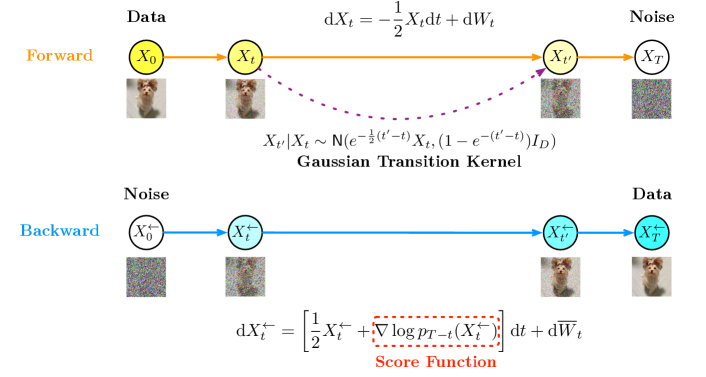
- 前向きSDEと後向きSDE、およびそれらの離散化を介して、連続時間拡散モデル形式を説明する。
- 条件付きスコアを通じたガイダンスの取り込みと実践的学習手法を説明する。
- スコアマッチングとノイズ除去スコアマッチングを中心的な学習目的として、要レビューする。
- 高次元データに対するスコア近似、推定、および分布学習に関する理論的成果を要約する。
- タスク固有の条件付き生成を可能にするガイダンス(分類器/分類器なし)の役割を論じる。
- 拡散モデルがブラックボックス最適化と構造化解探索にどのように用いられるかを概説する。
実験結果
リサーチクエスチョン
- RQ1拡散モデルはデータ分布を正確かつ効率的に学習できるのか、そして高次元または構造化設定におけるサンプル複雑性はどの程度か?
- RQ2条件付き拡散モデルはガイダンスと整合した分布をどのように生成できるか、ガイダンスはどのように設計・評価すべきか?
- RQ3スコア関数の学習および拡散モデルを用いたサンプリング/分布推定の理論的保証は何か?
- RQ4拡散モデルを高次元の最適化およびブラックボックス報酬指向タスクにどう活用できるか?
- RQ5拡散モデルと確率的制御やロバスト最適化などの広い領域との関連は何か?
主な発見
- 本論文は無条件および条件付き拡散モデルの両方を調査し、前向き・後向き過程の定式化と実用的なスコア推定を概説する。
- スコアマッチングとノイズ除去スコアマッチングを中心的な訓練目的として強調し、スコアの爆発や早期停止といった課題を含む。
- さまざまなネットワークアーキテクチャ(U-Net、トランスフォーマー)と、それらのスコア近似およびデータ効率における役割を論じる。
- 実用システムで用いられるサンプリング加速手法と潜在拡散アプローチを扱う。
- 拡散ガイド付き生成をブラックボックス最適化と結び付け、条件付き拡散モデルがターゲット報酬に条件付けられた高品質な解を生成できることを示す。
- 拡散モデルを確率的制御、ロバスト性、および離散拡散バリアントへ結ぶ将来の方向性を特定する。
![Figure 2: Conditional diffusion models generate images under various guidance [ 78 ] . The upper row demonstrates an alignment with text description consisting of multiple objects. The lower row demonstrates an abstract description of aesthetic quality.](https://ar5iv.labs.arxiv.org/html/2404.07771/assets/figure/vision_reward.png)
より良い研究を、今すぐ始めましょう
論文設計から論文執筆まで、研究時間を劇的に削減しましょう。
クレジットカード登録不要
このレビューはAIが作成し、人間の編集者が確認しました。