
[論文レビュー] Angle Basis: a Generative Model and Decomposition for Functional Connectivity
この論文は、機能的結合(FC)を正弦波ベース状態とジッター成分の組み合わせとして表現する、fMRIにおける新しい生成モデルおよび分解手法であるAngle Basisを導入する。わずか5〜10個のベース状態を用いることで、元のFCと同等の予測性能を達成し、再構成と残差の両方が予測に同等に寄与する。アンサンブル化すると、FCのAUCを最大5%上回り、残差は97.3%の正確度でほぼ完璧な被験者指紋識別を可能にする。
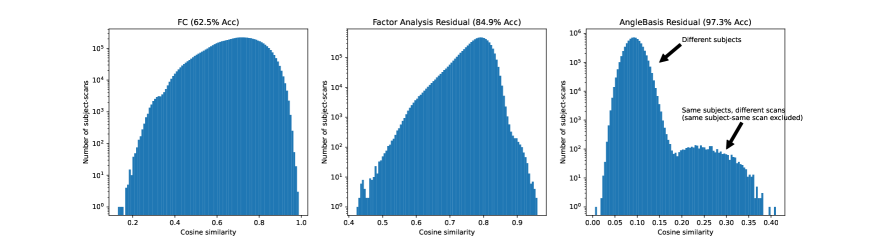
Functional connectivity (FC) is one of the most common inputs to fMRI-based predictive models, due to a combination of its simplicity and robustness. However, there may be a lack of theoretical models for the generation of FC. In this work, we present a straightforward decomposition of FC into a set of basis states of sine waves with an additional jitter component. We show that the decomposition matches the predictive ability of FC after including 5-10 bases. We also find that both the decomposition and its residual have approximately equal predictive value, and when combined into an ensemble, exceed the AUC of FC-based prediction by up to 5%. Additionally, we find the residual can be used for subject fingerprinting, with 97.3% same-subject, different-scan identifiability, compared to 62.5% for FC. Unlike PCA or Factor Analysis methods, our method does not require knowledge of a population to perform its decomposition; a single subject is enough. Our decomposition of FC into two equally-predictive components may lead to a novel appreciation of group differences in patient populations. Additionally, we generate synthetic patient FC based on user-specified characteristics such as age, sex, and disease diagnosis. By creating synthetic datasets or augmentations we may reduce the high financial burden associated with fMRI data acquisition.
研究の動機と目的
- 集団レベルの統計を必要とせず、理論的に根拠のある単一被験者対応の機能的結合(FC)の分解法の開発。
- FCが解釈可能で生成可能な成分に分解可能かどうかを検証すること。
- 分解の再構成成分と残差成分の両方が予測にどの程度有効であるかを評価すること。
- 年齢、性別、診断などの特徴に基づいて合成FCを生成し、fMRIデータ収集コストを削減すること。
- 残差成分が高精度な被験者識別(指紋識別)にどの程度有効であるかを検討すること。
提案手法
- BOLD信号を位相と振幅が異なる正弦波の和としてモデル化し、機能的結合をフーリエに類似した分解として表現する。
- 各領域(ROI)に位相と振幅を割り当て、元のFC行列を再構成するためのベース状態の集合を形成する。
- 各ROIにジッター項を追加して位相のばらつきを補正し、再構成精度を向上させる。
- 再構成誤差を最小化するための最小二乗法による最適化を実施する。
- 元のFCと再構成の差(残差)を保持し、補完的予測特徴として利用する。
- 訓練済みモデルを用いて年齢、性別、診断などの特徴パラメータを指定し、ベースパラメータを予測してFCを再構成することで、合成FCを生成する。
![Figure 1: Example of the angle basis reconstruction of one representative subject from the PNC dataset. The prominent block corresponds to the default mode network (DMN). The scan is probably of a female, due to the high within-DMN connectivity [ 11 ] . Here only one basis is used.](https://ar5iv.labs.arxiv.org/html/2305.10541/assets/x1.png)
実験結果
リサーチクエスチョン
- RQ1単一被験者のデータのみを用いて、機能的結合を解釈可能で生成可能なベース状態の集合に効果的に分解可能か?
- RQ2再構成FCとその残差成分の両方が、年齢、性別、人種、統合失調症診断などの特徴に対して有意な予測能力を保持しているか?
- RQ3再構成と残差のアンサンブルは、標準的なFCに基づく予測モデルを上回る性能を示すか?
- RQ4同じ被験者の異なるスキャン間で、残差成分が被験者指紋識別に非常に高い判別能力を示すか?
- RQ5特徴に基づいた合成FCは、実際のfMRIデータ収集に依存することなく信頼性高く生成可能か?
主な発見
- わずか5〜10個のアンプルベース成分を用いることで、再構成FCは年齢、性別、人種、統合失調症診断予測において元のFCと同等の予測性能を達成する。
- 残差成分単体でも再構成と同等の予測正確度を示し、PNCデータセットでは性別予測でAUC 0.744 ± 0.065、人種予測でAUC 0.812 ± 0.040を達成する。
- 再構成と残差のアンサンブルは、いくつかの予測タスクで元のFCのAUCを最大5%上回る。
- 残差は非常に高い正確度で被験者指紋識別を可能にし、同じ被験者で異なるスキャン間の識別正確度が97.3%に達する(FCは62.5%)。
- モデルは特徴に応じた合成FCを生成可能であり、例えば合成女性ではDMN内結合が強く、合成男性では勾配がなだらかになる傾向を示す。
- 計算効率が高く、中程度のGPUで1被験者あたり数秒で処理可能で、分解に集団レベルのデータを必要としない。
より良い研究を、今すぐ始めましょう
論文の読解から最終レビューまで、研究時間を劇的に削減しましょう。
クレジットカード登録不要
このレビューはAIが作成し、人間の編集者が確認しました。