
[論文レビュー] AntiFold: Improved antibody structure-based design using inverse folding
AntiFold は、ESM-IF1 から微調整された抗体特異的な inverse folding モデルで、CDR 配列回復とゼロショット抗体-抗原親和性予測を改善し、バックボーン構造を保持します。
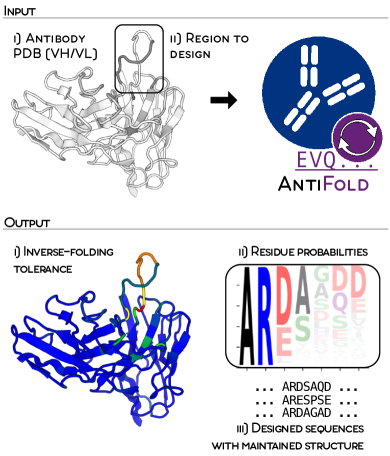
The design and optimization of antibodies requires an intricate balance across multiple properties. Protein inverse folding models, capable of generating diverse sequences folding into the same structure, are promising tools for maintaining structural integrity during antibody design. Here, we present AntiFold, an antibody-specific inverse folding model, fine-tuned from ESM-IF1 on solved and predicted antibody structures. AntiFold outperforms existing inverse folding tools on sequence recovery across complementarity-determining regions, with designed sequences showing high structural similarity to their solved counterpart. It additionally achieves stronger correlations when predicting antibody-antigen binding affinity in a zero-shot manner, while performance is augmented further when including antigen information. AntiFold assigns low probabilities to mutations that disrupt antigen binding, synergizing with protein language model residue probabilities, and demonstrates promise for guiding antibody optimization while retaining structure-related properties. AntiFold is freely available under the BSD 3-Clause as a web server at https://opig.stats.ox.ac.uk/webapps/antifold/ and and pip installable package at https://github.com/oxpig/AntiFold
研究の動機と目的
- 配列設計時にバックボーン構造を保持することによって、抗体設計を改善することを動機づける。
- 大規模な事前学習構造ベースモデルを微調整して作成した、抗体特異的な逆折り畳みモデルを開発する。
- CDR領域における配列回復とバックボーン保持の性能を評価する。
- ゼロショットおよび抗原情報を用いた結合親和性予測を評価する。
- 抗体最適化を支援するために研究者が利用できる実装を提供する。
提案手法
- 解決済みおよび予測された抗体構造に対してESM-IF1を微調整し、AntiFoldを作成する。
- 構造条件付き逆折り畳みを用いて、位置ごとの置換耐性とアミノ酸確率を出力する。
- 多様性のための制御可能な温度パラメータを用いて、指定領域の設計配列をサンプルする。
- ABodyBuilder2による再折り畳み後の設計CDRのアミノ酸回復率(AAR)とバックボーン RMSDを評価する。
- 抗体-抗原結合親和性予測を逆折り畳みの対数尤度で評価し、抗原コンテキストの有無で比較する。
- 広い利用可能性のためにウェブサーバーとpipインストール可能なパッケージを提供する。
実験結果
リサーチクエスチョン
- RQ1抗体特異的な逆折り畳みは、バックボーン構造を維持しつつCDR配列の回復を改善できるか?
- RQ2再折り畳み時にAntiFold設計配列は元の構造と似た折り畳みを示すか?
- RQ3逆折り畳みスコアは抗体-抗原結合親和性と相関するか、抗原情報を含めることでこの相関は改善されるか?
- RQ4抗体設計タスクにおける既存の逆折り畳みツールと比較してAntiFoldはどの程度の性能か?
- RQ5高適合性で構造的に制約されたバリアントを優先することにより、Affinity maturation戦略を支援できるか?
主な発見
- AntiFoldはAbMPNNおよびベースラインモデルと比較してCDRH3のアミノ酸回復と全体のAARを改善する。
- 設計配列はバックボーン構造を保持し、平均CDR RMSDが約0.95 Åで、幾何学的な保存を示している。
- 逆折り畳みスコアは結合親和性と相関し、ゼロショットテストではAntiFoldのスピアマン相関が競合他社より高くなる(0.418対0.334–0.322)。
- 結合部位近傍のCDR、特にCDR2とCDR3で抗原情報を含めることで性能が向上する。
- アフィニティ成熟実験で改善版と非改善版をより正確に分離し(中央値ランク80%対他は57–73%)、より優れた区分を示す。
- AntiFoldのスコアは入力構造タイプ(解決済み、予測、AlphaFold)に頑健で、予測構造にも適用しても高い性能を示す。
![Figure S1: Overview of the AntiFold training strategy. (A) AntiFold was trained and evaluated on solved antibody structures from SAbDab [Dunbar et al., 2014 , Schneider et al., 2021 ] and structures of antibody sequences from OAS [Kovaltsuk et al., 2018 , Olsen et al., 2022b ] modeled with ABodyBuil](https://ar5iv.labs.arxiv.org/html/2405.03370/assets/x2.png)
より良い研究を、今すぐ始めましょう
論文設計から論文執筆まで、研究時間を劇的に削減しましょう。
クレジットカード登録不要
このレビューはAIが作成し、人間の編集者が確認しました。