
[論文レビュー] Atmospheric Reconnaissance of TRAPPIST-1 b with JWST/NIRISS: Evidence for Strong Stellar Contamination in the Transmission Spectra
本研究は、TRAPPIST-1 bの最初のJWST/NIRISS透過スペクトルを報告し、信号を支配する未通過星 spots およびフレアの強い星間汚染を明らかにした。雲なし水素豊富の大気の不在は確認されたが、低重力および磁場効果に関する星間モデルの不正確さが、信頼性のある大気特徴の同定を制限しており、今後の冷却星周回系外惑星研究における重要な課題を示している。
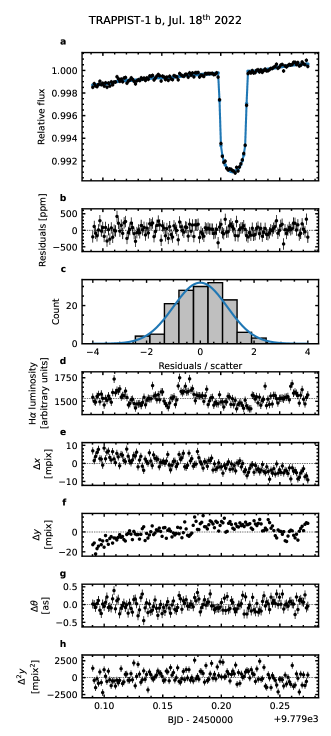
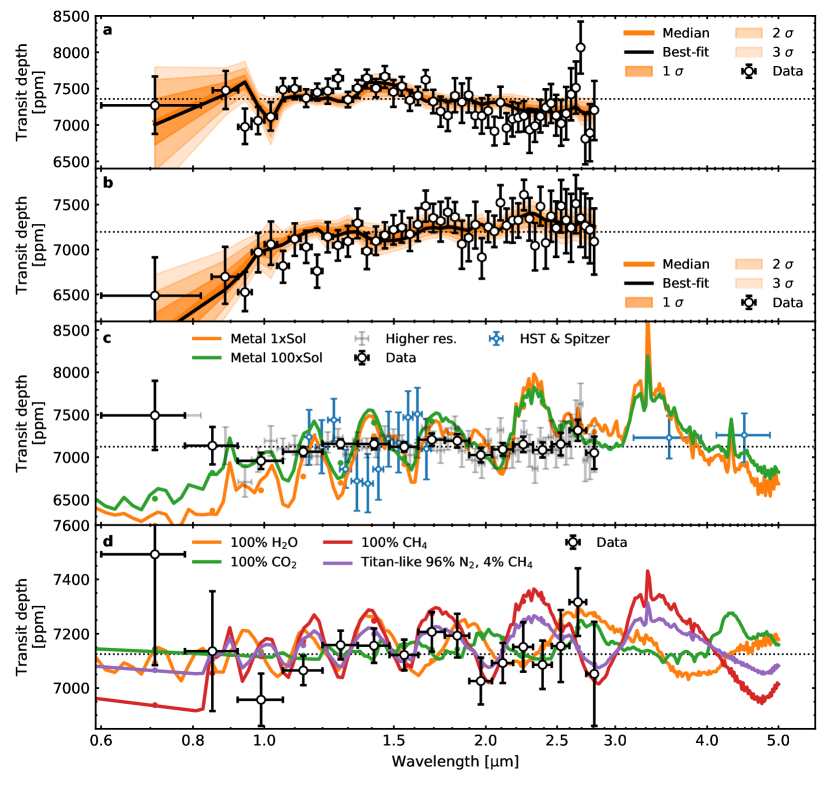
TRAPPIST-1 is a nearby system of seven Earth-sized, temperate, rocky exoplanets transiting a Jupiter-sized M8.5V star, ideally suited for in-depth atmospheric studies. Each TRAPPIST-1 planet has been observed in transmission both from space and from the ground, confidently rejecting cloud-free, hydrogen-rich atmospheres. Secondary eclipse observations of TRAPPIST-1 b with JWST/MIRI are consistent with little to no atmosphere given the lack of heat redistribution. Here we present the first transmission spectra of TRAPPIST-1 b obtained with JWST/NIRISS over two visits. The two transmission spectra show moderate to strong evidence of contamination from unocculted stellar heterogeneities, which dominates the signal in both visits. The transmission spectrum of the first visit is consistent with unocculted starspots and the second visit exhibits signatures of unocculted faculae. Fitting the stellar contamination and planetary atmosphere either sequentially or simultaneously, we confirm the absence of cloud-free hydrogen-rich atmospheres, but cannot assess the presence of secondary atmospheres. We find that the uncertainties associated with the lack of stellar model fidelity are one order of magnitude above the observation precision of 89 ppm (combining the two visits). Without affecting the conclusion regarding the atmosphere of TRAPPIST-1 b, this highlights an important caveat for future explorations, which calls for additional observations to characterize stellar heterogeneities empirically and/or theoretical works to improve model fidelity for such cool stars. This need is all the more justified as stellar contamination can affect the search for atmospheres around the outer, cooler TRAPPIST-1 planets for which transmission spectroscopy is currently the most efficient technique.
研究の動機と目的
- 2回の独立した transit の間における JWST/NIRISS データを用いて、TRAPPIST-1 b の大気透過スペクトルを特徴づけること。
- 特に未通過星 spots およびフレアを含む星間不均一性が透過スペクトル信号に与える影響を調査すること。
- 星間汚染およびモデルの正確性の制限がある状況下で、大気リトリーブ結果の信頼性を評価すること。
- 現在の星間大気モデル(PHOENIX および SPHINX)が、TRAPPIST-1 の観測スペクトルを NIRISS 波長範囲で十分に再現できるかを評価すること。
- 未解決の星間活動に起因する、M型矮星周回の温帯的岩石惑星における今後の透過スペクトル測定の主な注意点を特定すること。
提案手法
- 2回の別々の transit 中に、JWST/NIRISS を用いて高精度の透過スペクトルを取得した。
- 惑星大気と星間汚染の共同モデルを用いて観測スペクトルにフィットさせ、大気リトリーブには POSEIDON を、未通過不均一性の星間汚染モデルには別途定式化したモデルを用いた。
- 有効温度(2300–2800 K)および表面重力(2.5–5.5 dex)のグリッド上で、観測スペクトルと PHOENIX および SPHINX 星間大気モデルの間で比較を行った。
- Markov Chain Monte Carlo(MCMC)を用いて、emcee および PyMultiNest を用いて星間汚染および惑星大気パラメータを同時にフィッティングした。
- 観測スペクトルとモデルスペクトルの間の χ² を計算することで、モデルの正確性を定量化し、特に重要なスペクトル領域での系統的不一致を特定した。
- データ駆動的および理論的アプローチを用いて、特に低重力および磁場効果に関する不完全な星間モデルに起因する不確実性を評価した。
実験結果
リサーチクエスチョン
- RQ1未通過星 spots およびフレアは、JWST/NIRISS 観測における TRAPPIST-1 b の透過スペクトルにどの程度汚染を及えるか?
- RQ2現在の星間大気モデル(PHOENIX および SPHINX)は、NIRISS 波長範囲における TRAPPIST-1 の観測スペクトルを十分に再現できるか?
- RQ3星間モデルの正確性に関する不確実性は、TRAPPIST-1 b の大気リトリーブの信頼性にどのように影響するか?
- RQ4星間不均一性は、M型矮星周回の温帯的岩石惑星の透過スペクトル解釈にどのような影響を及えるか?
- RQ5観測されたスペクトル不一致は、磁場や非一様重力といった欠落した物理的要因に起因しているとみなせるか?
主な発見
- 最初の観測では未通過星 spots の強い証拠が得られたが、2回目の観測では未通過フレアの痕跡が確認された。
- 両観測で星間汚染が信号を支配しており、モデルの正確性に起因する不確実性が観測精度より1桁大きい(89 ppm)。
- 最良のフィットを得た PHOENIX モデルは、有効温度 2600 K、表面重力 3.5 dex であったが、0.7–0.8 μm の領域の特徴を再現できなかった。
- SPHINX モデルは 0.9–1.1 μm 範囲でより良いフィットを示したが、1.5–1.7 μm の水バンドの翅部では、スペクトル分解能が低く、重力カバレッジが限られているため困難を示した。
- テストされた星間モデル(PHOENIX や SPHINX)のいずれにも、SOSS スペクトル全体を十分な精度で再現できる能力がなく、磁場や非一様重力といった欠落した物理的要因が存在すると示唆された。
- 汚染が存在するにもかかわらず、分析により TRAPPIST-1 b に雲なし水素豊富大気が存在しないことは確認されたが、星間モデルの制限により二次的大気が制約できない状態であった。
より良い研究を、今すぐ始めましょう
論文の読解から最終レビューまで、研究時間を劇的に削減しましょう。
クレジットカード登録不要
このレビューはAIが作成し、人間の編集者が確認しました。