
[論文レビュー] Attack-Resilient Distributed Algorithms for Exponential Nash Equilibrium Seeking
本稿は、周期的でないDoS攻撃が発生する非周期的通信ネットワークにおいて、指数的収束を伴う非協力ゲームにおける指数的ナッシュ均衡(NE)探索の攻撃耐性を持つ分散アルゴリズムを提案する。攻撃の頻度と持続時間の境界を明示的に分析することで、攻撃的ネットワークの混乱に対しても正確なNE収束を保証する。これは、従来の研究が理想的な通信条件を仮定しているのに対し、顕著な進展を示している。
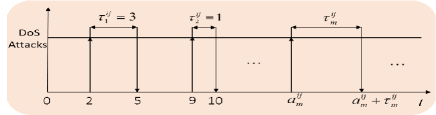
This paper investigates a resilient distributed Nash equilibrium (NE) seeking problem on a directed communication network subject to malicious cyber-attacks. The considered attacks, named as Denial-of-Service (DoS) attacks, are allowed to occur aperiodically, which refers to interruptions of communication channels carried out by intelligent adversaries. In such an insecure network environment, the existence of cyber-attacks may result in undesirable performance degradations or even the failures of distributed algorithm to seek the NE of noncooperative games. Hence, the aforementioned setting can improve the practical relevance of the problem to be addressed and meanwhile, it poses some technical challenges to the distributed algorithm design and exponential convergence analysis. In contrast to the existing distributed NE seeking results over a prefect communication network, an attack-resilient distributed algorithm is presented such that the NE can be exactly reached with an exponential convergence rate in the presence of DoS attacks. Inspired by the previous works in [21]-[26], an explicit analysis of the attack frequency and duration is investigated to enable exponential NE seeking with resilience against attacks.Examples and numerical simulation results are given to show the effectiveness of the proposed design.
研究の動機と目的
- 悪意あるサイバー攻撃、特にDoS攻撃の下で既存の分散NE探索アルゴリズムの耐性の欠如に対処すること。
- 通信の途切れを伴う状況下でも、ナッシュ均衡への指数的収束を維持する分散アルゴリズムを設計すること。
- 攻撃の頻度と持続時間の許容可能な境界を明示的に特定し、収束を保証すること。
- 通信ネットワークが完全でないという仮定を排除し、敵対的条件下でも正確なNE収束を可能にするために、先行研究を拡張すること。
- 変動するネットワークトポロジー、攻撃プロファイル、システムパラメータの下で、数値シミュレーションを通じてスケーラビリティとロバストネスを示すこと。
提案手法
- 各プレイヤーが局所的情報と隣接プレイヤーとの協調プロトコルを用いて戦略を更新する分散勾配ベースのアルゴリズムを設計し、有向グラフ上で実行する。
- 通信損失(DoS攻撃によるもの)を考慮した制御ゲインと動的更新則をアルゴリズムに統合する。
- 時間変動するネットワークトポロジーのモデルを用いて、攻撃の頻度と持続時間の明示的分析を実施し、攻撃が事前に定義されたしきい値を超えないように保証する。
- リャプノフに基づく安定性解析を用いて、導出された攻撃制約下でナッシュ均衡への指数的収束を証明する。
- 収束速度の定量的評価に、有向グラフのラプラシアン行列および最小非ゼロ固有値(λa)の性質を活用する。
- 一時スケール動的システムの手法を用いて、攻撃状態下における協調と勾配プレーの相互作用を扱う。
実験結果
リサーチクエスチョン
- RQ1有向通信ネットワークにおいて、周期的でないDoS攻撃が発生する状況下でも、分散ナッシュ均衡探索が指数的収束を達成できるか?
- RQ2指数的収束を保証するための、攻撃頻度と持続時間の明示的境界は何か?
- RQ3制御ゲインが攻撃下での収束速度とアルゴリズムのロバストネスに与える影響は何か?
- RQ4本アルゴリズムは、プレイヤー数の変動や異なるネットワークトポロジーにどの程度スケーラブルか?
- RQ5一般の非二次的コスト関数と現実的な攻撃パターン下で、アルゴリズムの性能はどの程度か?
主な発見
- 攻撃の頻度と持続時間が境界内に制限される限り、提案アルゴリズムは周期的でないDoS攻撃下でも指数的収束を達成する。
- シミュレーションにより、制御ゲインκを5に設定した場合、κ=1の場合よりも誤差の減少が速くなることが確認され、κの増加に伴い収束速度が向上することが示された。
- アルゴリズムはプレイヤー数の変動にスケーラブルであり、シミュレーションではプレイヤー数が少ない場合(N=3,5,10)でより良好な性能が観察された。
- ネットワークトポロジーは収束に顕著な影響を与える。ラプラシアン行列の非ゼロ固有値λaが大きいグラフでは収束が速く、対数スケールの誤差曲線で明確に示された。
- 理論的境界(14)および(15)を超える攻撃頻度と持続時間では収束が失敗する。これは、導出された条件の必要性を確認するものである。
- 一般の非二次的ゲームでは、DoS攻撃下でもすべてのプレイヤーの戦略がNE x* = col(-4.6589, 4.1589, 0, -2, 2.5) に指数的に収束し、相対誤差が指数的に減少した。
![Figure 2: Simulated results generated by the existing algorithm [ 11 ] in the absence of DoS attacks. Left: plot of players’ strategies and the NE $x^{*}_{i}$ ; Right: plot of an undirected graph in [ 11 ] and its associated Laplacian matrix.](https://ar5iv.labs.arxiv.org/html/2009.10666/assets/x2.png)
より良い研究を、今すぐ始めましょう
論文の読解から最終レビューまで、研究時間を劇的に削減しましょう。
クレジットカード登録不要
このレビューはAIが作成し、人間の編集者が確認しました。