
[論文レビュー] Bar formation and evolution in the cosmological context: Inputs from the Auriga simulations
本論文は Auriga の宇宙論的ズームインシミュレーションにおける棒銀河を分析し、棒の形成・成長・進化を宇宙時間を通じて特徴づけ、棒の性質を全体の銀河・ハローのパラメータと関連付けて検討する。
Galactic bars drive the internal evolution of spiral galaxies, while their formation is tightly coupled to the properties of their host galaxy and dark matter halo. To explore what drives bar formation in the cosmological context and how these structures evolve throughout cosmic history, we use the Auriga suite of magneto-hydrodynamical cosmological zoom-in simulations. We find that bars are robust and long-lived structures, and we recover a decreasing bar fraction with increasing redshift which plateaus around $\sim20\%$ at $z\sim3$. We find that bars which form at low and intermediate redshifts grow longer with time, while bars that form at high redshifts are born `saturated' in length, likely due to their merger-induced formation pathway. This leads to a larger bar-to-disc size ratio at high redshifts as compared to the local Universe. We subsequently examine the multi-dimensional parameter space thought to drive bar formation. We find that barred galaxies tend to have lower Toomre $Q$ values at the time of their formation, while we do not find a difference in the gas fraction of barred and unbarred populations when controlling for stellar mass. Barred galaxies tend to be more baryon-dominated at all redshifts, assembling their stellar mass earlier, while galaxies that are baryon-dominated but that do not host a bar, have a higher ex-situ bulge fraction. We explore the implications of the baryon-dominance of barred galaxies on the Tully-Fisher relation, finding an offset from the unbarred relation; confirming this in observations would serve as additional evidence for dark matter, as this behaviour is not readily explained in modified gravity scenarios.
研究の動機と目的
- Auriga シミュレーションにおける宇宙論的文脈とホスト銀川特性が、棒の形成にどう依存するかを調査する。
- 棒の性質(強さ、長さ)とそれらの高赤方偏移時代から現在までの進化を定量化する。
- 棒の形成とバリオン優勢、円盤の安定性、質量組み立て履歴との関連を評価する。
- 宇宙論的枠組みの中で、高赤方偏移におけるTully-Fisher関係と棒の関係について含意を探る。
提案手法
- Auriga の磁性流体宇宙論的ズームインシミュレーションを用い、ハロー質量を0.5〜2 × 10^12 Msunの範囲にわたって適用する。
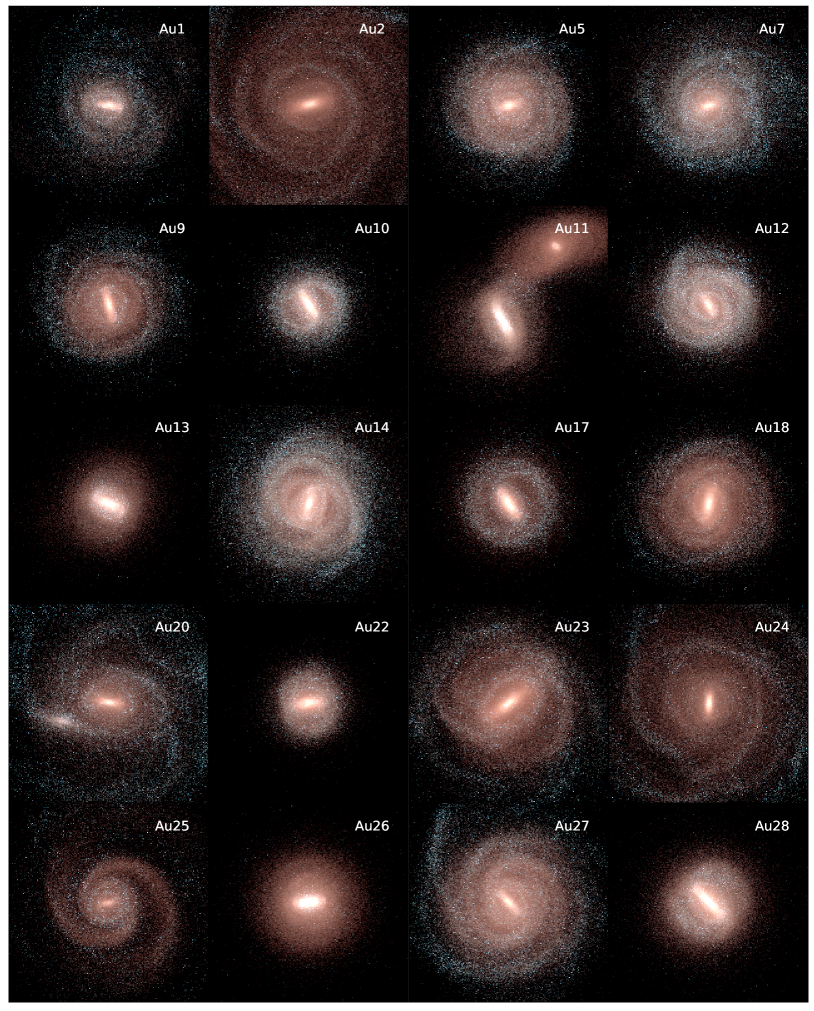
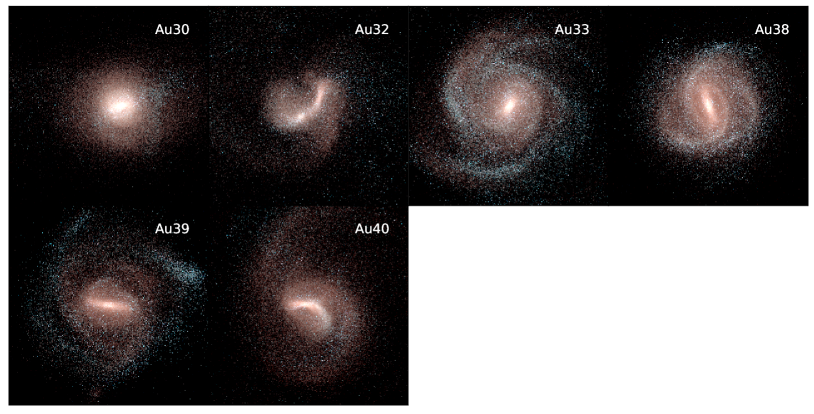
- z=0 で棒の強さ A2 (A2 >= 0.25) を星の表面密度の m=2 フーリエモードから計算して同定する。
- A2 が0.25を超え、かつそれを維持した最初のルックバック時間を棒形成時間 t_bf として算定する。
- R_bar を、A2 が最大値の70%に低下する半径として、約0–10 kpc の領域内で測定する。
- disc size R_d を、星の表面密度が1 Msun/pc^2を下回る半径として定義する。
- 5 kpc以内の質量のうち星が80%以上を占める時刻を、baryon-dominance time t_gal,bd として評価する。
実験結果
リサーチクエスチョン
- RQ1Auriga galaxies における棒の頻度は赤方偏移と恒星質量に関してどうなるのか?
- RQ2宇宙論的時間軸で、棒の強さ、長さ、形成時期はホスト銀河特性(バリオン優勢、discサイズ、 stellar mass)とどのように関連するか?
- RQ3恒星質量を制御した場合、棒あり銀河と棒なし銀河のガス分率はどう異なり、それが棒の形成にどう影響するか?
- RQ4宇宙論的文脈での棒の形成がTully-Fisher関係に与える影響、特に高赤方偏移での含意は何か?
主な発見
- Auriga の銀河では棒は頑健で長寿であり、赤方偏移が高くなるにつれて棒の頻度は減少するが z~3 付近で約20%程度の平坦化を示す。
- 低共動/中間の赤方偏移で形成された棒は時間とともに長くなる一方、早期に形成された棒は元から長く生まれ、長さの変化は小さい。
- 棒がある銀河はすべての赤方偏移でよりバリオン優勢になりやすく、棒形成は早期のバリオン優勢の開始と相関する。
- 現在の棒の強さと棒の年齢には穏やかな相関があり、棒形成時期と内側の恒星対ダークマター比には相関があるが、現在の恒星質量には強い依存はない。
より良い研究を、今すぐ始めましょう
論文設計から論文執筆まで、研究時間を劇的に削減しましょう。
クレジットカード登録不要
このレビューはAIが作成し、人間の編集者が確認しました。