
[論文レビュー] Bayesian analysis of a Unified Dark Matter model with transition: can it alleviate the $H_{0}$ tension?
この論文は、ハッブル定数の矛盾(Hubble tension)を軽減するために、高速遷移を伴う統一的暗黒物質(UDM)モデルをベイズ的手法を用いて検証している。SNIa(Pantheon)、CMBの事前分布(Planck)、およびSH0ESに基づく$M$-事前分布を用いた分析である。モデルは$H_0$の矛盾を約1.5σ軽減するが、AIC/BIC基準では$Λ$CDMモデルが強く支持され、標準モデルを凌駕する明確な改善は得られていない。理論的要件を満たしているものの、依然として標準モデルの優位性が示唆される。
We consider cosmological models in which Dark Matter (DM) and Dark Energy (DE) are described by a single component, dubbed Unified Dark Matter (UDM) models, in which the DE-like part can have an equation state $<-1$ at late times without violating the null energy condition. In this paper, we investigate whether this feature can relieve the Hubble tension. We perform a Bayesian analysis of the model using SNIa data from Pantheon, the CMB distance prior from Planck, and the prior on the absolute magnitude $M$ of SNIa from SH0ES. Using the prior, the data suggests a smooth transition taking place at redshifts $z_{ m t} \simeq 2.85$, which provides a value $H_0=69.64\pm 0.88$ for the Hubble constant, slightly alleviating the tension by $\sim 1.5 σ$. Without it, we obtain $H_0 = 67.6^{+1.3}_{-0.82}$ and a transition happening at $z_t=1.36$. We also discuss the importance of using the prior on $M$ for constraining this model.
研究の動機と目的
- 高速遷移を伴う統一的暗黒物質(UDM)モデルが$H_0$の矛盾を軽減できるかどうかを評価すること。
- SNIa(Pantheon)、CMB距離事前分布(Planck)、およびタイプIa超新星の絶対等級$M$に関するSH0ES事前分布を含む宇宙論的データを用いて、UDMモデルのベイズ解析を実施すること。
- $M$-事前分布がUDMモデルのパラメータ制約および得られる$H_0$値に与える影響を評価すること。
- 情報基準(AIC/BIC)を用いて、UDMモデルのデータ適合度を標準$Λ$CDMモデルと比較すること。
- UDMモデルが$w < -1$を通過しつつも、ゼロエネルギー条件を保つ能力が$H_0$の矛盾軽減に有効な解決策となるかどうかを検証すること。
提案手法
- CLASSボルツマンソルバおよびMontePythonを用いて、遷移パラメータ$\beta$および$a_t$でパrameter化されたUDMモデルのベイズ的パラメータ推定を実施する。
- Bertaccaら(2011)の圧力プロファイルを採用し、$\beta$および$a_t$に応じて物質的性質からダークエネルギー的性質への滑らかまたは高速な遷移を可能にする。
- SNIaの絶対等級$M$に関するSH0ES協会からの事前分布を適用し、$H_0$およびUDMパラメータの制約を強化する。
- CMB関連の距離事前分布(例:$R$、$l_A$)をPlanckから固定し、UDMモデルが$H_0$および$M$に与える影響を隔離する。
- モデルの性能を比較するため、アカイケ(AIC)およびベイズ的(BIC)情報基準を計算する。
- 理論的等級差と観測値を比較することで、UDMモデルがPantheon SNIaデータと整合するかを評価する。
実験結果
リサーチクエスチョン
- RQ1高速遷移を伴う統一的暗黒物質モデルは、$Λ$CDMモデルと比較して$H_0$の矛盾を軽減できるか?
- RQ2SH0ESによる$M$の事前分布の導入が、UDMモデルのパラメータ制約および推定された$H_0$にどのように影響を与えるか?
- RQ3UDMモデルが$w < -1$を通過しつつもゼロエネルギー条件を満たす能力が、$H_0$の矛盾軽減に有効なメカニズムを提供するか?
- RQ4情報基準によって測定した場合、UDMモデルは$Λ$CDMモデルと比較して、どの程度宇宙論的データの適合度を向上させるか?
- RQ5観測された$H_0$の矛盾の軽減は、$H_0$の真の増加によるものか、それとも$H_0$との相関によるパラメータ不確実性の増大によるものか?
主な発見
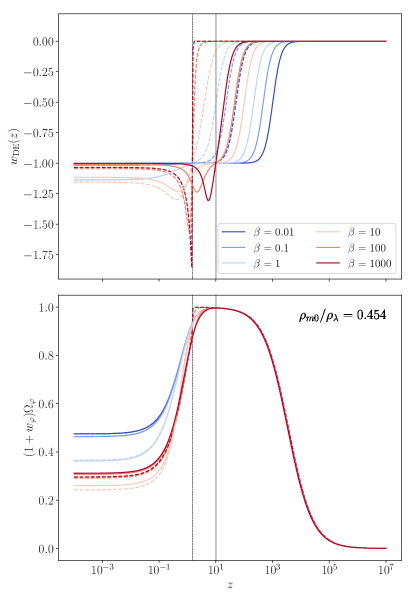
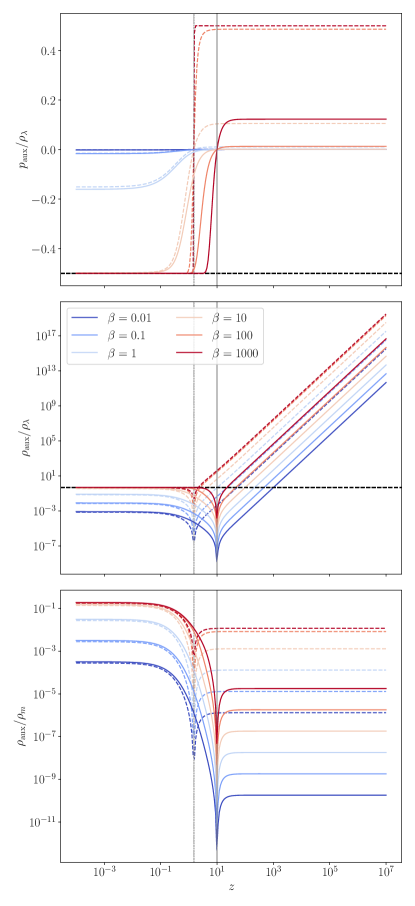
- データはUDMモデルにおいて滑らかな遷移を支持しており、$\beta(a^3 - a_t^3) < 1$である。これは遷移が高速ではなく、徐々に進行していることを示している。
- $M$-事前分布を含めた場合、遷移赤方偏移の事後分布は$z_t \simeq 2.85$である。これは比較的高い赤方偏移で遷移が発生していることを示唆している。
- モデルは$H_0 = 69.64 \pm 0.88 \, \text{km} \, \text{s}^{-1} \, \text{Mpc}^{-1}$を生成し、$Λ$CDM値と比較して$H_0$の矛盾を約1.5\sigma軽減している。
- 矛盾の軽減は、$H_0$の中央値に顕著なシフトがあるのではなく、$H_0$との相関によるパラメータ不確実性の増大に起因している。
- AICおよびBIC基準では、$M$-事前分布を用いた場合、$\Delta$AIC = 0.8および$\Delta$BIC = 10.8であり、$Λ$CDMモデルがUDMモデルを強く支持している。これは、標準モデルの経験的優位性を示している。
- 最も矛盾軽減の可能性が高い$\beta = 10$の場合、UDMモデルはPantheon SNIaデータと整合しない。理論的有用性にかかわらず、観測と矛盾している。
この論文を読む
Nubintのビューアで原文を開き、読みながら気になる箇所をすぐに質問できます。
Nubintでこの論文を読むこのレビューはAIが論文の原文をもとに作成しました。引用する前に原文をご確認ください。