
[論文レビュー] Birth of Rapidly Spinning, Overmassive Black Holes in the Early Universe
本論文は、赤方偏移 z ≈ 4–5 の初期宇宙における『小さな赤い点』(LRDs)と呼ばれる、ダストを多く含む活発銀河核が、密度の高い環境における長期間にわたる一貫した降着によって、急速に回転する過質量ブラックホール(BH)を有すると提案する。BHの成長率と質量密度の分析から、20%を超える放射効率が示唆され、これは最大限のスピンに近い96%相当のBHスピンに対応し、混沌とした降着を想定する標準的モデルに挑戦するものであり、初期BH成長において、整列したガス流入が支配的である可能性を示唆する。
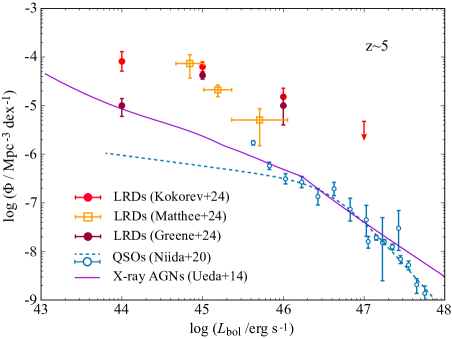
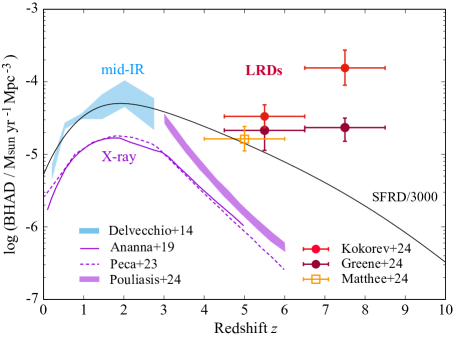
The James Webb Space Telescope (JWST) has unveiled numerous massive black holes (BHs) in faint, broad-line active galactic nuclei (AGNs). The discovery highlights the presence of dust-reddened AGN populations, referred to as "little red dots (LRDs)", more abundant than X-ray selected AGNs, which are less influenced by obscuration. This finding indicates that the cosmic growth rate of BHs within this population does not decrease but rather increases at higher redshifts beyond $z\sim 6$. The BH accretion rate density deduced from their luminosity function is remarkably higher than that from other AGN surveys in X-ray and infrared bands. To align the cumulative mass density accreted to BHs with the observed BH mass density at $z\simeq 4-5$, as derived from the integration of the BH mass function, the radiative efficiency must be doubled from the canonical 10% value, achieving significance beyond the $>3σ$ confidence level. This suggests the presence of rapid spins with 96% of the maximum limit among these BHs, maintained by prolonged mass accretion instead of chaotic accretion with randomly oriented inflows. Moreover, we derive an upper bound for the stellar mass of galaxies hosting these LRDs, ensuring consistency with galaxy formation in the standard cosmological model, where the host stellar mass is limited by the available baryonic reservoir. Our analysis gives a lower bound for the BH-to-galaxy mass ratio that exceeds the typical value known in the nearby universe and aligns with that for JWST-detected unobscured AGNs. Accordingly, we propose a hypothesis that the dense, dust-rich environments within LRDs facilitate the emergence of rapidly spinning and overmassive BH populations during the epoch of reionization. This scenario predicts a potential association between relativistic jets and other high-energy phenomena with overmassive BHs in the early universe.
研究の動機と目的
- 赤方偏移 z ≈ 4–5 における観測されたブラックホール質量密度を、高赤方偏移AGNの光度関数から推定される累積質量降着と一致させること。
- JWSTによって検出された新しく特定されたダスト赤化・幅広いラインを示すAGNの一種である「小さな赤い点」(LRDs)におけるブラックホールの放射効率を特定すること。
- 降着率と観測された質量関数を比較することで、初期宇宙のブラックホールのスピンを制約し、一貫した降着と混沌とした降着のどちらが支配的であるかを検証すること。
- 標準的宇宙論と整合性を持つように、ホスト銀河の星族質量の上限を確立し、LRDsにおけるBH/銀河質量比の下限を導出すること。
- ダストに富んだ環境が初期再電離期に急速に回転する過質量ブラックホールの形成に寄与する物理的メカニズムを提唱すること。
提案手法
- z ≈ 4–5 におけるSoltan-Paczyńskiの議論を適用し、観測されたブラックホール質量関数と、LRDsの全波長光度関数から導出された統合降着率を比較した。
- Hαおよび連続スペクトルのJWST観測を用いて、LRDsの全波長光度を推定し、降着率の計算を可能にした。
- 観測されたBH質量密度と降着質量を一致させるために必要な放射効率を、スピン依存効率の範囲を仮定して計算した。
- 標準的宇宙論モデルにおけるバリオン蓄えの制限と整合性を持つように、ホスト銀河の星族質量の最大値を制約した。
- 観測されたBH質量と導出されたホスト星族質量の上限を組み合わせて、BH/銀河質量比の下限を推定した。
- 密度が高くダストに富んだ環境が、整列した降着を促進し、高スピンで過質量BHを形成するとする物理的状況を提唱した。
実験結果
リサーチクエスチョン
- RQ1LRDsの光度関数から推定される降着率と、赤方偏移 z ≈ 4–5 における観測されたブラックホール質量密度を一致させるために、必要な放射効率は何か?
- RQ2推定された放射効率が示唆するスピンパラメータは何か? これは標準的値や理論的限界と比べてどう異なるか?
- RQ3観測されたBH質量を踏まえて、標準的宇宙論モデルがLRDsを宿す銀河の星族質量に課す制約は何か?
- RQ4LRDsにおけるBH/銀河質量比は、局所宇宙の値と比べてどう異なるか? これは初期ブラックホール成長メカニズムに何を示唆するか?
- RQ5観測されたLRDsの性質は、混沌とした降着ではなく、長期間にわたる一貫した降着によって説明可能か? そして、ジェット生成やマルチメッセージャー信号にどのような含意があるか?
主な発見
- 降着質量と観測されたBH質量密度の整合性を保つために必要な放射効率は20%を超え、標準的値の10%を著しく上回り、有意水準は2σ以上である。
- この高い放射効率は、最大ケル限界に近い96%に相当するブラックホールスピンを示唆し、次元なしのスピンパラメータ a₆ ≈ 0.96 に対応する。
- この分析は、LRDsにおけるブラックホール成長が、ランダムな向きを持つ混沌とした降着ではなく、整列した角運動量を有する長期間の一貫した降着によって支配されていることを示唆する。
- ホスト銀河の星族質量の上限は、標準的宇宙論モデルにおけるバリオン蓄えの制限と整合性を持つように制約された。
- LRDsにおけるBH/銀河質量比の下限は、通常の局所宇宙の値を上回っており、未遮へんJWST AGNで観測された値と一致しており、高赤方偏移においてBHがホスト銀河に対してより質量的に重いことを示唆する。
- 本研究は、LRDsにおけるダストに富んだ密度の高い環境が、急速に回転する過質量ブラックホールの形成を促進すると提唱し、相対論的ジェットや高エネルギー一時的現象と関連している可能性がある。
より良い研究を、今すぐ始めましょう
論文の読解から最終レビューまで、研究時間を劇的に削減しましょう。
クレジットカード登録不要
このレビューはAIが作成し、人間の編集者が確認しました。