
[論文レビュー] Boosting galactic outflows with enhanced resolution
論文は、局所的なガス冷却長を解像する解像度を上げると銀河系外流出の多相構造とエネルギー学が強化され、銀河からの質量・金属・エネルギーのローディング係数が向上することを示す。
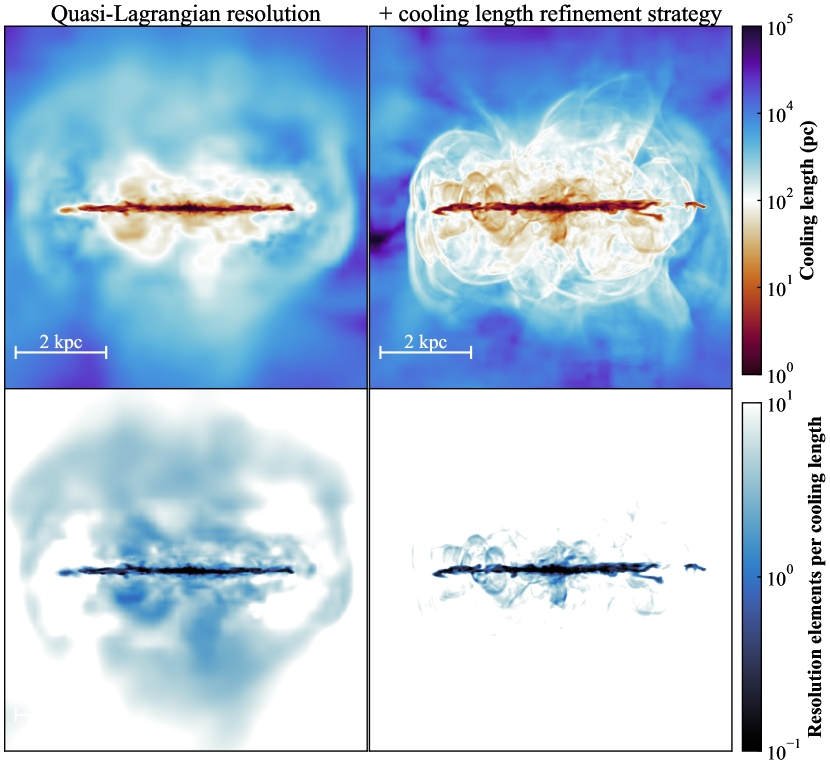
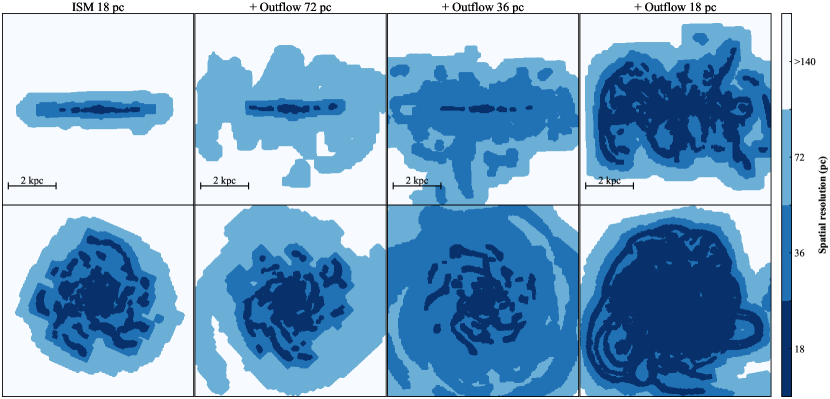
We study how better resolving the cooling length of galactic outflows affect their energetics. We perform radiative-hydrodynamical galaxy formation simulations of an isolated dwarf galaxy ($M_{\star}=10^{8}\, \mathrm{M}_\odot$) with the Ramses-RTZ code, accounting for non-equilibrium cooling and chemistry coupled to radiative transfer. Our simulations reach a spatial resolution of $18 \, \mathrm{pc}$ in the interstellar medium (ISM) using a traditional quasi-Lagrangian scheme. We further implement a new adaptive mesh refinement (AMR) strategy to resolve the local gas cooling length, allowing us to gradually increase the resolution in the stellar-feedback-powered outflows, from $\geq 200 \, \mathrm{pc}$ to $18 \, \mathrm{pc}$. The propagation of outflows into the inner circumgalactic medium (CGM) is significantly modified by this additional resolution, but the ISM, star formation and feedback remain by and large the same. With increasing resolution in the diffuse gas, the hot outflowing phase ($T > 8 imes 10^{4} \, \mathrm{K}$) systematically reaches overall higher temperatures and stays hotter for longer as it propagates outwards. This leads to two-fold increases in the time-averaged mass and metal outflow loading factors away from the galaxy ($r=5\, \mathrm{kpc}$), a five-fold increase in the average energy loading factor, and a $\approx$50 per cent increase in the number of sightlines with $N_{ ext{OVI}} \geq 10^{13}\, \mathrm{cm}^{-2}$. Such a significant boost to the energetics of outflows without new feedback mechanisms or channels strongly motivates future studies quantifying the efficiency with which better-resolved multiphase outflows regulate galactic star formation in a cosmological context.
研究の動機と目的
- 局所的なガス冷却長を解像することが銀河系外流出のエネルギー学に与える影響を理解する。
- 解像度の上昇に伴う出流の相構造(冷、温、熱)の変化を定量化する。
- キロパーセクスケールでの質量・金属・エネルギーのローディング係数への解像度の影響を決定する。
- より高解像の風でのO VIなどのイオン化トレーサを介した観測的含意を評価する。
提案手法
- ramses-rtzを用いた孤立系矮星系の放射流体力学シミュレーションを実施する。
- 実時間放射輸送と結合した非平衡冷却・化学を60種以上のイオン種に対して解く。
- 局所ガス冷却長を狙った新しいAMR細化を実装し、出流を>200 pcから18 pcまで細化する。
- 解像度間で星形成とフィードバック予算を一貫して維持し、解像度の影響を孤立させる。
- 複数の高度(例:r=5 kpc)で出流特性を比較し、PDFによる相分布を分析する。
- 初期緩和期間後約500 Myrにわたる時間平均診断を用いる。
実験結果
リサーチクエスチョン
- RQ1拡散出流ガスの局所冷却長を解像することは、出流のエネルギー学と相構造にどのような影響を与えるか。
- RQ2解像度の向上に伴い、質量・金属・エネルギーのローディング係数にどの程度定量的な変化が生じるか。
- RQ3より良い冷却長解像が、内CGMのO VIなどの観測可能なイオントレーサに影響を与えるか。
- RQ4矮星系で星形成とフィードバックの履歴を変更せずに、解像度を改善できるか。
主な発見
- 冷却長解像度の改善は、より多相の出流を生み、より冷たい密度の高い成分とより熱い拡散成分を含む。
- 5 kpcでの拡散ガスに対する時間平均質量ローディング係数は、高解像度でほぼ倍増する。
- 5 kpcでの時間平均金属ローディング係数は、質量ローディング係数と同程度の量で増加する。
- より良く解像された出流では平均エネルギー ローディング係数が約5倍に増加する。
- 視線のN(O VI) >= 1e13 cm^-2となる割合が約50%増加する。
- ISМの性質と global star formation rate は解像度間でほとんど変わらず、出流のエネルギー学への影響を特定している。
より良い研究を、今すぐ始めましょう
論文設計から論文執筆まで、研究時間を劇的に削減しましょう。
クレジットカード登録不要
このレビューはAIが作成し、人間の編集者が確認しました。