
[論文レビュー] Bridging Systems: Open Problems for Countering Destructive Divisiveness across Ranking, Recommenders, and Governance
The paper articulates Bridging Systems and an attention-allocation framework across ranking, collective response, and governance, outlining open problems to counter divisiveness.
Divisiveness appears to be increasing in much of the world, leading to concern about political violence and a decreasing capacity to collaboratively address large-scale societal challenges. In this working paper we aim to articulate an interdisciplinary research and practice area focused on what we call bridging systems: systems which increase mutual understanding and trust across divides, creating space for productive conflict, deliberation, or cooperation. We give examples of bridging systems across three domains: recommender systems on social media, collective response systems, and human-facilitated group deliberation. We argue that these examples can be more meaningfully understood as processes for attention-allocation (as opposed to "content distribution" or "amplification") and develop a corresponding framework to explore similarities - and opportunities for bridging - across these seemingly disparate domains. We focus particularly on the potential of bridging-based ranking to bring the benefits of offline bridging into spaces which are already governed by algorithms. Throughout, we suggest research directions that could improve our capacity to incorporate bridging into a world increasingly mediated by algorithms and artificial intelligence.
研究の動機と目的
- bridging を attention allocators の性質として定義し、分断を越えた相互理解を高めるという社会的目標を明確にする。
- Present an interdisciplinary framework linking recommender systems, collective response tools, and human facilitation.
- Propose signals, metrics, and data-modeling approaches to instantiate bridging in algorithmic and human systems.
- Identify evaluation challenges, risks, and implementation limits of bridging systems.
- Offer concrete open research questions to advance cross-domain collaboration and responsible deployment.
提案手法
- three domains: recommender systems, collective response systems, and human-facilitated deliberation に適用可能な attention-allocation framework を開発する。
- state と predictive models を含む allocation と learning のプロセスを形式化し、 allocations を導く価値モデルを明確化する。
- bridging を最適化するために使用できる signals と metrics を導入する。
- bridging の評価アプローチを検討し、実務的な評価考慮事項を概説する。
- 実務家と研究者向けの green box および blue box のガイダンスを強調し、実用的な例と具体的な研究方向の分類を提供する。)

実験結果
リサーチクエスチョン
- RQ1異なるドメイン(ランキング、集合的応答、熟議)にわたって bridging を報いるシステムはどのようなものか、どのように設計できるか。
- RQ2bridging を attention allocators の性質として運用化し、それらの最適化フレームワークに組み込むにはどうすればよいか。
- RQ3bridging の成果を確実に具現化し測定する信号、指標、データモデルは何か。
- RQ4bridging システムを実装する際の評価上の課題、制限、リスクは何で、それらをどう緩和するか。
- RQ5ドメイン横断の研究と Bridging Systems の安全な展開を加速させる未解決課題には何があるか。
主な発見
- アイデア: bridging 系は対立を排除したり均質化を強制したりするのではなく、分断を越えた相互理解と信頼を高めることを目指す。
- フレームワーク: 注意割り当てを統一的な視点として導入し、推奨システム、集合的応答、ファシリテーション系を比較する。
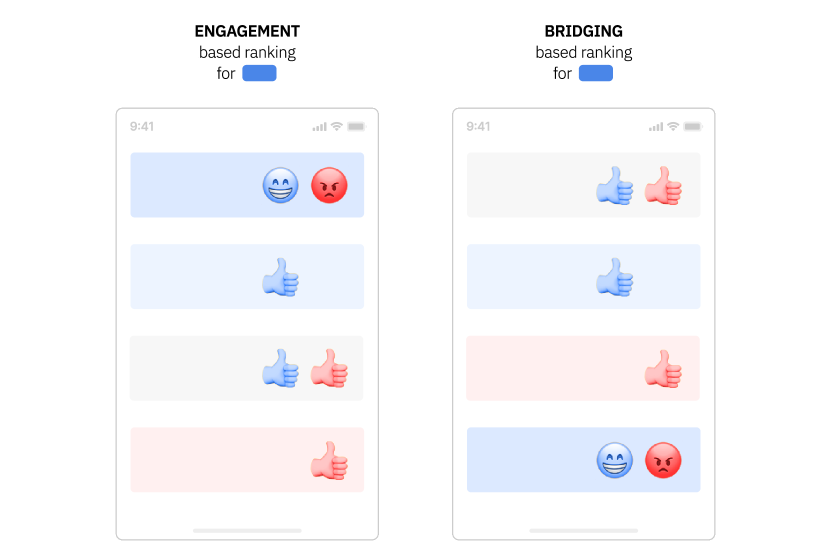
- 概念: 分断を跨ぐ整合を報いるようにランキングと割り当ての目的を再設計することで bridging を実現できる(例: 多様な承認モチーフ)。
- ツール: bridging の実データシステムでの開発と評価を導く信号、指標、最適化スタックを提案する。
- 範囲: 学際的な研究方向を強調し、bridging 実装の課題、制限、リスクを特定する。
より良い研究を、今すぐ始めましょう
論文設計から論文執筆まで、研究時間を劇的に削減しましょう。
クレジットカード登録不要
このレビューはAIが作成し、人間の編集者が確認しました。