
QUICK REVIEW
[論文レビュー] Building the First Galaxies -- Chapter 2. Starbursts Dominate The Star Formation Histories of 6 < z <12 Galaxies
Alan Dressler, Marcia Rieke|arXiv (Cornell University)|Jun 4, 2023
Astronomy and Astrophysical Research被引用数 9
ひとこと要約
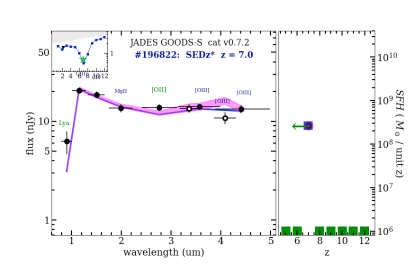
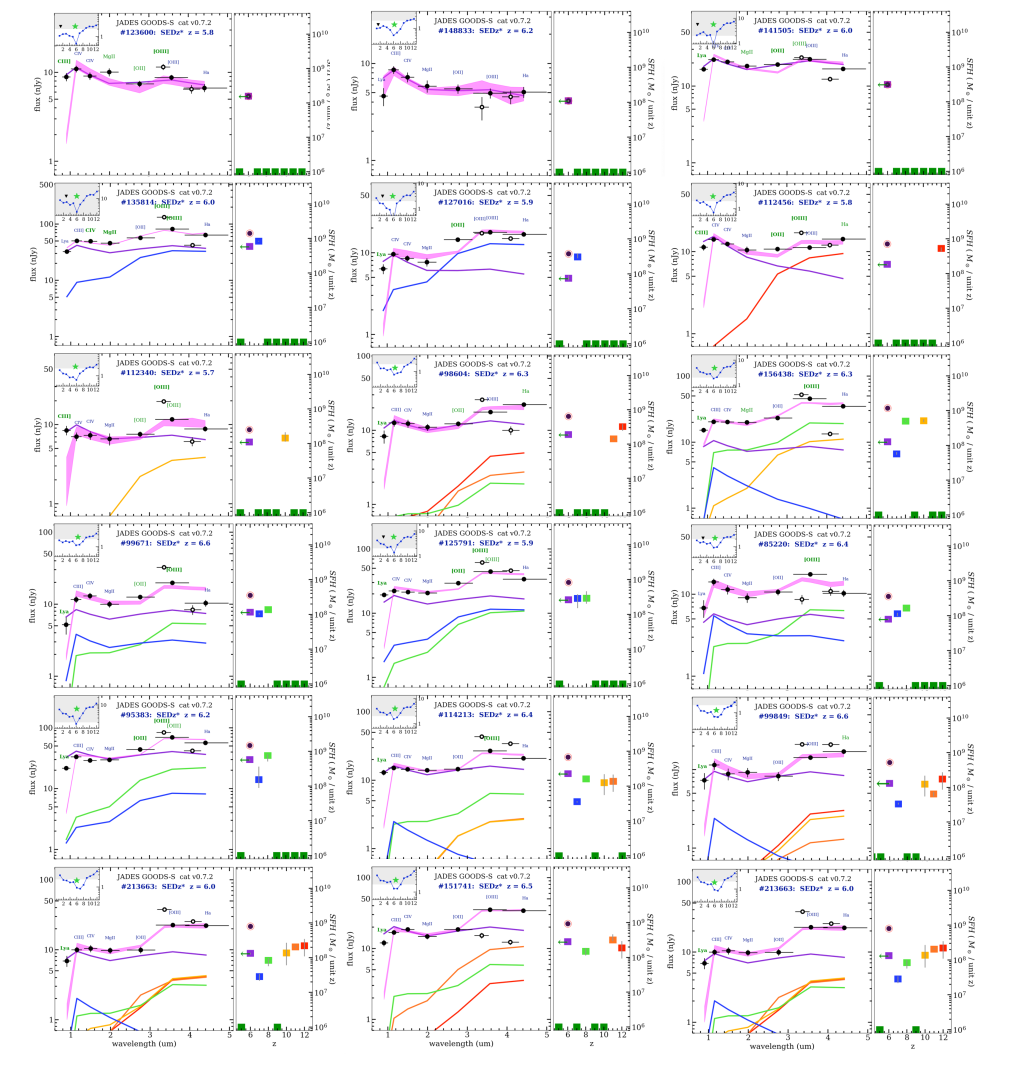
The study analyzes 894 galaxies at 6<z<12 from JWST/JADES GOODS-S with SEDz* to derive star formation histories, finding that starbursts dominate the histories (~70%) while longer SFHs contribute about one-third of stellar mass by z~6.
ABSTRACT
We use SEDz* -- a code designed to chart star formation histories (SFHs) of 6
研究の動機と目的
- Characterize the star formation histories of first galaxies in the 6<z<12 interval using JWST/NIRCam SEDs.
- Test and validate SEDz* as a tool to recover epoch-by-epoch stellar mass buildup from A-star dominated populations.
- Classify SFHs into distinct types and quantify their contributions to stellar mass over cosmic time.
提案手法
- Apply SEDz*, a NNLS-based tool, to fit 9-band NIRCam photometry with templates built from Bruzual & Charlot models including emission/continuum.
- Divide redshifts 6<z<12 into seven integer steps (z=12 to z=6) representing 42–186 Myr epochs and test two template sets (10 Myr bursts and constant star formation CSF).
- Reconstruct SFHs by adding template epochs from z=12 downward, selecting epoch of observation by minimum chi-squared, and summing mass contributions per epoch to form the SFH.
- Mitigate z<4/low-z interlopers using a multi-step validation: minima shallow/steepness of chi-squared, HST detections in visible bands, and EAZY photo-z comparisons to build a gold sample.
- Assess robustness of SFH types against dust extinction and confirm no strong extinction in the sample (AV ~0.1–0.4 ruled out).
実験結果
リサーチクエスチョン
- RQ1What are the dominant star formation histories of galaxies in the 6<z<12 epoch?
- RQ2Can SED-based templates using A-star dominated populations reliably recover epoch-by-epoch stellar mass buildup in the first galaxies?
- RQ3What is the distribution of SFH types (burst, stochastic, contiguous, continuous) in this redshift range?
- RQ4How do SFH types correlate with redshift, mass, and environment within the JADES GOODS-S field?
- RQ5What fraction of stellar mass by z~6 is assembled through short bursts versus longer star-formation histories?
主な発見
- SFH types are four: SFH1 (burst), SFH2 (stochastic), SFH3 (contiguous 3-epoch), SFH4 (continuous 4–6 epochs).
- Starbursts dominate the SFHs, comprising ~70% of the sample, while longer SFHs contribute about one-third of the accumulated stellar mass by z~6.
- The 894 SFHs imply integrated masses of 1.34e11, 1.09e11, 1.00e11, and 3.16e10 Msun for SFH1–SFH4 respectively, totaling ~4e11 Msun by z=6 in the field.
- No strong dependencies of SFH type on large-scale environment were found, though a compact group with early star formation at z=11–12 suggests long SFHs may dominate in rare dense environments.
- The sample is broadly dust-poor, with AV constraints ruling out significant extinction; yet a dust-enshrouded early burst is proposed as a possible precursor to measured SFHs.
より良い研究を、今すぐ始めましょう
論文設計から論文執筆まで、研究時間を劇的に削減しましょう。
クレジットカード登録不要
このレビューはAIが作成し、人間の編集者が確認しました。