
[論文レビュー] Calibrating baryonic feedback with weak lensing and fast radio bursts
本稿では、Euclidに類似した調査から得られる弱引力レンズ信号と分散測定値(DM)を相関させることで、大規模構造調査におけるバリオン核のフィードバックを校正するため、高速電波パulses(FRB)を宇宙論的プローブとして使用することを提案する。約10⁴個のFRBを用いることで、バリオン核フィードバックの制約が1桁向上し、ニュートリノ質量の制約が50–100 %向上し、宇宙論的パラメータとフィードバックパラメータのデゲネラシーを解消する。
One of the key limitations of large-scale structure surveys of the current and future generation, such as Euclid, LSST-Rubin or Roman, is the influence of feedback processes on the distribution of matter in the Universe. This effect, called baryonic feedback, modifies the matter power spectrum on non-linear scales much stronger than any cosmological parameter of interest. Constraining these modifications is therefore key to unlocking the full potential of the upcoming surveys, and we propose to do so with the help of Fast Radio Bursts (FRBs). FRBs are short, astrophysical radio transients of extragalactic origin. Their burst signal is dispersed by the free electrons in the large-scale structure, leading to delayed arrival times at different frequencies characterised by the dispersion measure (DM). Since the dispersion measure is sensitive to the integrated line-of-sight electron density, it is a direct probe of the baryonic content of the Universe. We investigate how FRBs can break the degeneracies between cosmological and feedback parameters by correlating the observed Dispersion Measure with the weak gravitational lensing signal of a Euclid-like survey. In particular, we use a simple one-parameter model controlling baryonic feedback, but we expect similar findings for more complex models. Within this model, we find that $\sim 5 imes 10^4$ FRBs are sufficient to constrain the baryonic feedback significantly better than cosmic shear alone, tightening the constraints considerably (roughly by a factor of five). We also expect a 1.5-fold improvement in the sum of neutrino masses.
研究の動機と目的
- 将来の弱レンズ調査における宇宙論的制約の主な不確実性要因である、非線形物質パワー スペクトルに及ぼすバリオン核フィードバック効果を解消すること。
- 現在、大規模構造調査の精度を制限している、宇宙論的パラメータとフィードバックモデルパラメータのデゲネラシーを解消すること。
- FRBが分散測定値(DM)との相関を通じて、大規模構造内の電子密度分布を新たな独立したプローブとして提供できることを示すこと。
- 特にフィードバック強度とニュートリノ質量のパラメータ制約の向上を定量的に評価し、宇宙のせん断とFRBのDMデータを組み合わせた場合の利点を明らかにすること。
- CMBの事前分布に依存せず、異なる系制度を持つ低赤方偏移プローブとしてFRBが、宇宙論的推論の堅牢性を高めることを示すこと。
提案手法
- 本研究では、物質パワー スペクトル、電子密度、および弱レンズとの交差相関に及ぼすバリオン核フィードバックの影響をシミュレートするために、1パラメータのフィードバックモデルを用いる。
- FRBの分散測定値(DM)を、自由電子密度の線積分的プローブとしてモデル化し、大規模構造内のバリオン内容に敏感であることを示す。
- FRBのDMの角度パワー スペクトルと、Euclidに類似した調査から得られる宇宙のせん断パワー スペクトルを相関させ、パラメータ空間におけるデゲネラシーを解消する。
- ノイズのないデータベクトルを用いたフィッシャー行列予測と、emceeを用いたMCMCサンプリングを組み合わせ、宇宙論的およびフィードバックパラメータの事後分布を推定する。
- シミュレーションのキャリブレーション範囲を超えた外挿を避けるために、宇宙論的パラメータに事前分布を課し、パラメータ推定の堅牢性を確保する。
- 宇宙のせん断のみによる制約と、宇宙のせん断に加えてFRBのDM相関データを組み合わせた場合の制約を比較し、特にフィードバック強度、ハッブル定数、バリオン密度、ニュートリノ質量に注目する。
実験結果
リサーチクエスチョン
- RQ1FRBの分散測定値は、弱レンズ調査における宇宙論的パラメータとバリオン核フィードバックパラメータのデゲネラシーを解消できるか?
- RQ2宇宙のせん断のみと比較して、FRBのDMデータを追加することで、フィードバック強度の制約はどの程度改善されるか?
- RQ3FRBに基づくDM相関は、ニュートリノ質量和の制約をどの程度向上させられるか?
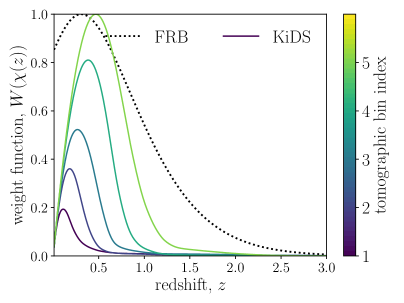
- RQ4FRBのDM相関の赤方偏移重み関数は、tSZ効果とどのように異なり、これにより系制度と補完性にどのような意味があるか?
- RQ5CMBの事前分布に依存せず、FRBがバリオン構造の独立した低赤方偏移プローブとして機能できるか?
主な発見
- 約10⁴個のFRBを用いることで、宇宙のせん断のみの場合と比較して、バリオン核フィードバック強度の制約が1桁向上する。
- FRBデータの追加により、ニュートリノ質量和の不確実性が50–100 %低減され、この重要な宇宙論的パラメータの制約が顕著に厳しくなる。
- FRBのDM相関は、ハッブル定数やバリオン密度といった宇宙論的パラメータとフィードバックパラメータの間のデゲネラシーを解消する。
- tSZ効果とは異なる赤方偏移感度と系制度を持つため、補完的プローブとしての役割を果たし、宇宙論的推論の堅牢性を高める。
- 保守的な事前分布と単純なフィードバックモデルのもとでも、FRBデータの導入により、特にフィードバックおよびニュートリノ質量パラメータにおいて顕著な改善が得られる。
- 予測で用いられたSN比は、現在および計画中のFRB調査(CHIME、ASKAP、SKAなど)を踏まえると、今世紀中頃までに達成可能である。
より良い研究を、今すぐ始めましょう
論文の読解から最終レビューまで、研究時間を劇的に削減しましょう。
クレジットカード登録不要
このレビューはAIが作成し、人間の編集者が確認しました。