
[論文レビュー] CANOS: A Fast and Scalable Neural AC-OPF Solver Robust To N-1 Perturbations
CANOS は、AC最適潮流(AC-OPF)のためのグラフニューラルネットワーク(GNN)ベースのニューラルソルバーであり、1%以内の真のAC-OPFコストに近い解を得るとともに、65ms未満で実行可能であり、N-1トポロジー摂動に対しても同様に有効である。10,000バスまでのグリッドにスケーラブルであり、トポロジー変更に対しても実行可能性と正確性を維持し、リアルタイムおよびセキュリティ制約付き電力系統運用における強固な展開を可能にする。
Optimal Power Flow (OPF) refers to a wide range of related optimization problems with the goal of operating power systems efficiently and securely. In the simplest setting, OPF determines how much power to generate in order to minimize costs while meeting demand for power and satisfying physical and operational constraints. In even the simplest case, power grid operators use approximations of the AC-OPF problem because solving the exact problem is prohibitively slow with state-of-the-art solvers. These approximations sacrifice accuracy and operational feasibility in favor of speed. This trade-off leads to costly "uplift payments" and increased carbon emissions, especially for large power grids. In the present work, we train a deep learning system (CANOS) to predict near-optimal solutions (within 1% of the true AC-OPF cost) without compromising speed (running in as little as 33--65 ms). Importantly, CANOS scales to realistic grid sizes with promising empirical results on grids containing as many as 10,000 buses. Finally, because CANOS is a Graph Neural Network, it is robust to changes in topology. We show that CANOS is accurate across N-1 topological perturbations of a base grid typically used in security-constrained analysis. This paves the way for more efficient optimization of more complex OPF problems which alter grid connectivity such as unit commitment, topology optimization and security-constrained OPF.
研究の動機と目的
- 大規模電力グリッドにおいて、正確なAC-OPFをリアルタイムで解く計算の非現実性に対処すること。
- DC-OPFのような従来の近似手法がもたらす、速度と正確性のトレードオフを克服し、高コストの補償支払いと排出量の増加を回避すること。
- 線路の故障(N-1事故)を含むトポロジー摂動下でも、実行可能性と正確性を維持する機械学習モデルの開発。
- 制約の満たし方を保ちながら、実際のグリッドサイズ(最大10,000バス)にスケーラブルに展開可能なニューラルソルバーの実装。
- セキュリティ制約付きOPF、ユニットコミットメント、最適トランスミッションスイッチングといったより複雑なOPF変種を解く基盤を提供すること。
提案手法
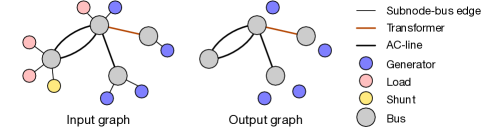
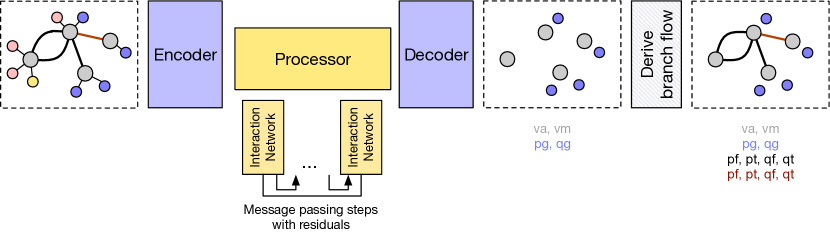
- CANOS は、36〜60ステップのメッセージパッシングを用いた、エンコード・プロセス・デコードアーキテクチャを持つ深層グラフニューラルネットワーク(GNN)を採用し、電力グリッドのトポロジーと潮流をモデル化する。
- モデルは、N-1線路故障シナリオを含む、さまざまなグリッド構成における負荷値の摂動によって生成された合成データ上で、エンドツーエンドに訓練される。
- 反復的最適化を回避するため、グリッドパラメータから直接最適発電ディスpatchと電圧プロファイルを予測する。
- 制約の満たし方は、予測値の検証と精錬に電力潮流方程式を適用する微分可能後処理ステップによって強制される。
- 損失関数には制約違反に対するペナルティ項が含まれており、ラグランジュ法やゼロ勾配技術による改善が可能である。
- GNNがグラフ構造に自然に一般化するため、再トレーニングなしに変更されたグリッドでも推論が可能であり、トポロジー変更に対して強固である。
実験結果
リサーチクエスチョン
- RQ1深層学習モデルは、大規模電力グリッドにおいて65ms未満の推論時間で、近似的に最適なAC-OPF解を得られるか?
- RQ2GNNベースのソルバーは、線路故障などのN-1トポロジー摂動下でも、実行可能性と正確性をどれほど維持できるか?
- RQ3ニューラルAC-OPFソルバーは、実際のグリッドサイズ(例:10,000バス)にどれほどスケーラブルに拡張可能であり、同時に解の品質を保てるか?
- RQ4ニューラルソルバーは、運用の実行可能性を損なわず、リアルタイムおよびセキュリティ制約付きOPFアプリケーションで従来のソルバーに置き換え可能か?
- RQ5再トレーニングなしに、新しい線路や事故などの未観測のトポロジー変更に対し、モデルはどの程度一般化できるか?
主な発見
- CANOS はテストケースにおいて真のAC-OPFコストの1%以内の解を得ており、ニューラルソルバーとしては高い最適性を示している。
- 1回の推論に33〜65msで実行可能であり、動的電力系統運用におけるリアルタイム展開を可能にしている。
- 10,000バスのシステムにおいて、N-1摂動下でも平均99.8%の制約満たし率を維持しており、トポロジー変更に対する強い耐性を示している。
- 未観測のN-1事故に対しても、性能の著しい低下なしに良好な一般化性能を示しており、トレーニング時の摂動を超えた一般化が可能である。
- メッセージパッシングステップ数を増やすことで性能が向上する傾向にあり、より深いGNNが解の品質を向上させることを示唆している。
- トポロジー耐性に優れるため、SC-OPF、ユニットコミットメント、最適トランスミッションスイッチングといった複雑なOPF変種への実用的展開が可能である。
より良い研究を、今すぐ始めましょう
論文の読解から最終レビューまで、研究時間を劇的に削減しましょう。
クレジットカード登録不要
このレビューはAIが作成し、人間の編集者が確認しました。