
[論文レビュー] Causal Inference in Recommender Systems: A Survey of Strategies for Bias Mitigation, Explanation, and Generalization
この調査は、因果推論を推薦システムに組み込むことで、予測の偏りを減らし、説明性を向上させ、一般化を高める方法を、Rubin の潜在アウトカムと Pearl の構造因果モデルを用いてレビューします。
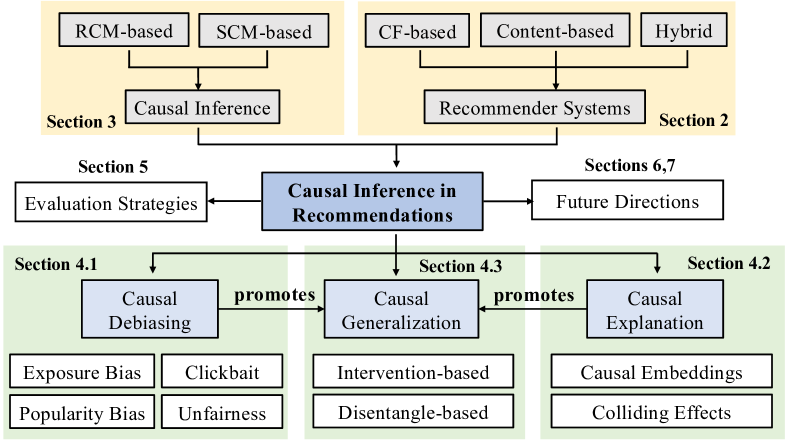
In the era of information overload, recommender systems (RSs) have become an indispensable part of online service platforms. Traditional RSs estimate user interests and predict their future behaviors by utilizing correlations in the observational historical activities, their profiles, and the content of interacted items. However, since the inherent causal reasons that lead to the observed users' behaviors are not considered, multiple types of biases could exist in the generated recommendations. In addition, the causal motives that drive user activities are usually entangled in these RSs, where the explainability and generalization abilities of recommendations cannot be guaranteed. To address these drawbacks, recent years have witnessed an upsurge of interest in enhancing traditional RSs with causal inference techniques. In this survey, we provide a systematic overview of causal RSs and help readers gain a comprehensive understanding of this promising area. We start with the basic concepts of traditional RSs and their limitations due to the lack of causal reasoning ability. We then discuss how different causal inference techniques can be introduced to address these challenges, with an emphasis on debiasing, explainability promotion, and generalization improvement. Furthermore, we thoroughly analyze various evaluation strategies for causal RSs, focusing especially on how to reliably estimate their performance with biased data if the causal effects of interests are unavailable. Finally, we provide insights into potential directions for future causal RS research.
研究の動機と目的
- 従来の相関ベースの推薦システムが因果推論のギャップのために抱える限界を説明する。
- 2 つの主要な因果推論フレームワーク(Rubin の潜在アウトカムと Pearl の構造因果モデル)とそれらと RS との関連を要約する。
- 因果推論技術が RS におけるデバイアス除去、説明性、一般化の向上にどのように寄与するかを論じる。
- biased データや因果効果が利用できない場合の因果 RS の評価戦略を分析する。
- 将来の因果 RS 研究の方向性を提示する。)
提案手法
- 従来の RS とその相関ベースの限界の基本を示す。
- RS コンテキストにおける Rubin の潜在アウトカムフレームワークと Pearl の構造因果モデルを紹介する。
- 露出バイアスに対処するなど、因果推論技術が RS をデバイス化し、説明性を促進し、一般化を改善する方法を説明する。
- RS における因果グラフ構造と介入概念(do 演算子)を論じる。
- RS データで因果効果を特定するためのバックドア調整と共変量ベースの戦略(IPW)を説明する。
実験結果
リサーチクエスチョン
- RQ1従来の RS でどのように露出バイアスが生じ、それを因果的方法でどのように緩和できるか?
- RQ2Rubin’s と Pearl’s の因果フレームワークの利益とトレードオフは RS にとってどのようなものか?
- RQ3因果推論技術は RS の説明性と一般化をどのように改善できるか?
- RQ4因果効果が得られない場合、因果 RS の性能を信頼性高く評価する戦略は何か?
- RQ5因果 RS の研究を進める上で将来的に有望な方向は何か?
主な発見
- 因果 RS は、観測された評価における非ランダムな露出と混同行為から生じるバイアスに対処する妥当な方法を提供する。
- Rubin’s と Pearl’s のフレームワークは補完的な視点を提供する:RCM は潜在アウトカムに焦点を当て、SCM は因果グラフと介入を重視する。
- ハイブリッドアプローチ(例:サイド情報の組み込み)は因果関係の形成と虚偽の相関の緩和に役立つ。
- SCM は介入や反事実を考えることを可能にし、説明性と設定を横断したターゲット一般化を支援する。
- 本調査は因果効果が直接観測できない場合の因果 RS の評価戦略を概説する。
- 因果 RS 研究の未解決の問題と将来の方向性を特定する。

より良い研究を、今すぐ始めましょう
論文設計から論文執筆まで、研究時間を劇的に削減しましょう。
クレジットカード登録不要
このレビューはAIが作成し、人間の編集者が確認しました。