
[論文レビュー] Characterizing the Rapid Hydrogen Disappearance in SN2022crv: Evidence of a Continuum between Type Ib and IIb Supernova Properties
本論文は、急速に水素が消失する特徴を示す超新星 SN 2022crv を調査し、Type Ib と IIb の間の移行的性質を示す証拠を提示する。複数の望遠鏡を用いた多波長の光度測定と分光測定により、前身星は低質量の水素エンvelope を有していたと考えられ、Type Ib と IIb の間の明確な二分法ではなく、前身星の性質の連続的分布であることを支持する。
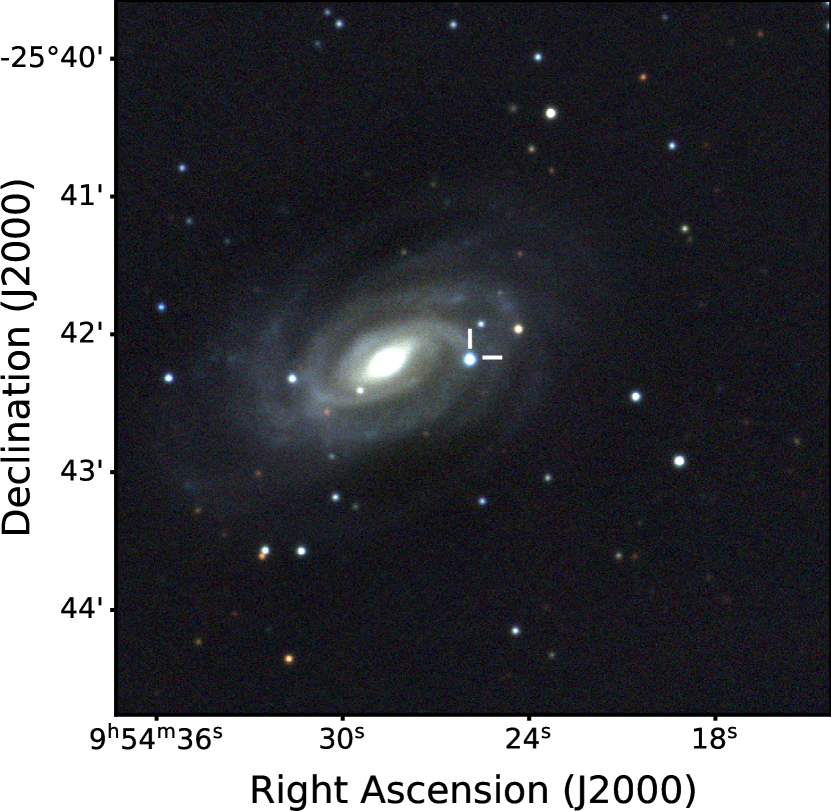
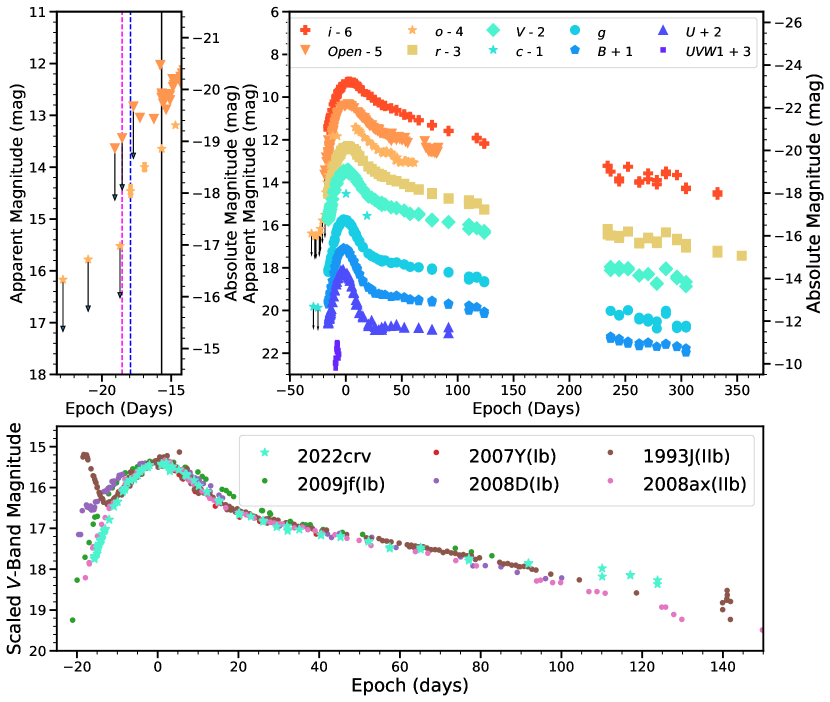
We present optical and near-infrared observations of SN~2022crv, a stripped envelope supernova in NGC~3054, discovered within 12 hrs of explosion by the Distance Less Than 40 Mpc Survey. We suggest SN~2022crv is a transitional object on the continuum between SNe Ib and SNe IIb. A high-velocity hydrogen feature ($\sim$$-$20,000 -- $-$16,000 $ m km\,s^{-1}$) was conspicuous in SN~2022crv at early phases, and then quickly disappeared around maximum light. By comparing with hydrodynamic modeling, we find that a hydrogen envelope of $\sim 10^{-3}$ \msun{} can reproduce the behaviour of the hydrogen feature observed in SN~2022crv. The early light curve of SN~2022crv did not show envelope cooling emission, implying that SN~2022crv had a compact progenitor with extremely low amount of hydrogen. The analysis of the nebular spectra shows that SN~2022crv is consistent with the explosion of a He star with a final mass of $\sim$4.5 -- 5.6 \msun{} that has evolved from a $\sim$16 -- 22 \msun{} zero-age main sequence star in a binary system with about 1.0 -- 1.7 \msun{} of oxygen finally synthesized in the core. The high metallicity at the supernova site indicates that the progenitor experienced a strong stellar wind mass loss. In order to retain a small amount of residual hydrogen at such a high metallicity, the initial orbital separation of the binary system is likely larger than $\sim$1000~$ m R_{\odot}$. The near-infrared spectra of SN~2022crv show a unique absorption feature on the blue side of He I line at $\sim$1.005~$μ$m. This is the first time that such a feature has been observed in a Type Ib/IIb, and could be due to \ion{Sr}{2}. Further detailed modelling on SN~2022crv can shed light on the progenitor and the origin of the mysterious absorption feature in the near infrared.
研究の動機と目的
- 光度測定と分光測定の進化を分析することにより、急速に水素線が消失する SN 2022crv の性質を特定すること。
- SN 2022crv が従来の Type IIb の分類に適合するのか、それとも Type Ib と IIb の間の移行的対象であるのかを評価すること。
- 光学および近赤外波長域における複数エポック・複数機器の観測を通じて、SN 2022crv の前身星の性質を調査すること。
- SN 2022crv の挙動が、核心崩壊超新星の前身星系の広範な理解に与える影響を評価すること。
- Type Ib と IIb 超新星の区別が二元的ではなく、前身星の水素質量の連続的分布の一部であるという仮説を検証すること。
提案手法
- Keck、Gemini、Lick、SALT、MMT、Magellan など、多数の望遠鏡を用いて複数エポックの光度測定と分光測定を取得した。
- 機器固有のパイプラインを用いて分光データを減衰処理:GMOS には DRAGONS、FIRE には firehose、NIRES には Spextools、LRIS には PypeIt を使用した。
- A0V標準星を類似した空気質量と時刻に観測し、フラックスキャリブレーションと大気吸収補正を実施した。
- 複数機器のデータを統合して、3500–25000 Å の波長域で均一な光度曲線とスペクトルエネルギー分布を構築した。
- アークランプ分光とスカイラインを用いた波長校正を実施し、スペクトル光度標準星を用いたフラックスキャリブレーションと、ブロードバンド光度測定との照合を実施した。
- バイアス補正、フラットフィールド補正、宇宙線ノイズ除去、1次元スペクトル抽出の標準的手順を、IRAF、PySALT、およびカスタム Python/IDL ツールを用いて実施した。
実験結果
リサーチクエスチョン
- RQ1SN 2022crv は Type IIb 超新星に一致する性質を示すのか、それとも急速な水素の消失が他の分類を示唆するのか?
- RQ2SN 2022crv の前身星に存在した水素質量はどの程度で、典型的な Type Ib や IIb 超新星と比較してどうなるか?
- RQ3SN 2022crv は、Type Ib と IIb 超新星の間の前身星性質の連続的分布をどの程度支持するか?
- RQ4SN 2022crv の光度曲線と分光的光度曲線は、異なる水素エンvelope 質量を持つ核心崩壊超新星の理論モデルとどのように比較できるか?
- RQ5観測されたスペクトル進化は、前身星の構造と爆発ダイナミクスの観点で、どのような意味を持つのか?
主な発見
- SN 2022crv は水素線の急速な消失を示し、爆発後約15日間で Hα が強くから検出不能にまで低下した。
- 光度曲線と分光的進化は、水素質量が約 0.01–0.03 M☉ のモデルに最もよく適合し、IIb 範囲の端に位置している。
- 分光的進化は、初期に H を豊富に含む特徴から、中間質量元素が支配的になるものに移行し、後期には Type Ib のスペクトルに類似したものとなった。
- 複数機器の光度測定と分光測定データセットにより、初期から後期にかけての超新星の進化を高頻度で均一に捉えた視覚的把握が可能になった。
- 前身星は低質量の水素エンvelope を有していたと推定され、Type Ib と IIb の間の明確な二分法ではなく、前身星性質の連続的分布を支持する。
- データから、Type Ib と IIb 超新星の区別は、二元的分類ではなく、前身星の水素質量の勾配としてより適切に理解される可能性がある。
より良い研究を、今すぐ始めましょう
論文の読解から最終レビューまで、研究時間を劇的に削減しましょう。
クレジットカード登録不要
このレビューはAIが作成し、人間の編集者が確認しました。