
[論文レビュー] Chemical Reactions regulated by Phase-Separated Condensates
本論文は、足場の相分離を希釈されたクライアントから切り離して研究し、凝縮体が化学反応の収率と初期組み立て速度をどのように調節するかを示す理論的枠組みを提示し、最大の効果を得るための最適な凝縮体体積を示す。
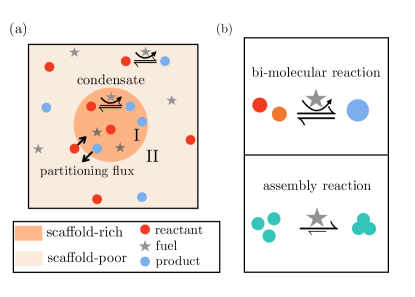
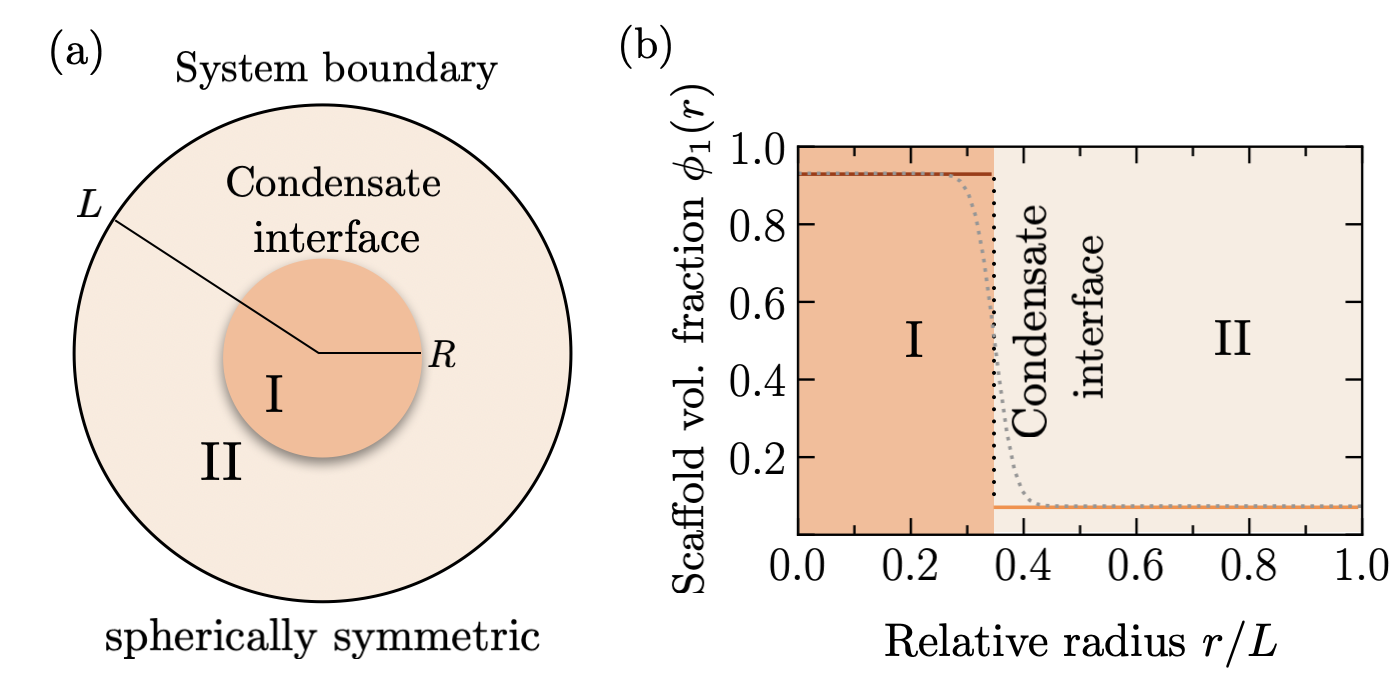
Phase-separated liquid condensates can spatially organize and thereby regulate chemical processes. However, the physicochemical mechanisms underlying such regulation remain elusive as the intramolecular interactions responsible for phase separation give rise to a coupling between diffusion and chemical reactions at non-dilute conditions. Here, we derive a theoretical framework that decouples the phase separation of scaffold molecules from the reaction kinetics of diluted clients. As a result, phase volume and client partitioning coefficients become control parameters, which enables us to dissect the impact of phase-separated condensates on chemical reactions. We apply this framework to two chemical processes and show how condensates affect the yield of reversible chemical reactions and the initial rate of a simple assembly process. In both cases, we find an optimal condensate volume at which the respective chemical reaction property is maximal. Our work can be applied to experimentally quantify how condensed phases alter chemical processes in systems biology and unravel the mechanisms of how biomolecular condensates regulate biochemistry in living cells.
研究の動機と目的
- 位相分離した生体分子凝縮体が細胞内の反応成分を空間的にどのように整理するかを動機づける。
- 足場主導の相分離を希釈された反応クライアントから分離して扱う枠組みを開発する。
- 凝縮体の特性が単純な反応の収率と開始速度をどのように支配するかを定量化する。
提案手法
- 非希釈の足場と希釈クライアントを含む不可压縮混合物の連続体理論を導出する。
- 成分間の拡散とクロスカップリングを記述するためにOnsager reciprocityを用いた可動性行列を採用する。
- 足場–クライアント相互作用を捉えるために交換化学ポテンシャルと相依存的活性係数を導入する。
- 共存する凝縮体相と周囲相における希釈クライアントの反応拡散方程式を定式化する。
- 分割係数を介してプログラム可能なパラメータへと反応動力学を単純化するための薄い境界面近似と相平衡近似を提供する。
- 凝縮体の存在下で可逆反応と初期速度が制限された組み立て過程へこの枠組みを適用する。
実験結果
リサーチクエスチョン
- RQ1希釈クライアントを含む可逆反応の定常収率を、相分離凝縮体はどのように変えるか?
- RQ2凝縮体は不可逆的な組み立て過程の初期速度にどのように影響するか?
- RQ3凝縮体体積、分配係数、相特異的反応速度がクライアントの動力学の調節においてどのような役割を果たすか?
- RQ4この枠組みは反応関連特性を最大化する最適な凝縮体サイズを予測できるか?
主な発見
- 凝縮体は凝縮体体積を調整することにより、可逆反応の定常収率を最大化できる。
- 凝縮体は相特異的な拡散と反応速度に依存して、組み立て過程の初期速度や収率を最大化することもできる。
- この枠組みは、標的とする反応特性が最大となる最適な凝縮体体積 (V^I,*) が存在することを特定する。
- 相依存的な交換活性係数と分配は、共存する相間で希釈クライアントの分布を制御し、したがって動力学を調節する。
- 燃料エネルギーによって平衡から逸脱すると、非一様な空間プロファイルが現れ、平衡条件と比較して反応収率を高めたり形成を形作ったりする。
より良い研究を、今すぐ始めましょう
論文設計から論文執筆まで、研究時間を劇的に削減しましょう。
クレジットカード登録不要
このレビューはAIが作成し、人間の編集者が確認しました。