
[論文レビュー] Chemically Transferable Generative Backmapping of Coarse-Grained Proteins
この論文は GenZProt を紹介します。転写可能で化学知識を持つバックマッピングモデルで、内部座標系の SE(3)-等変 VAE を用い、物理情報を取り入れた損失でアルファ炭素粗視化表現から全原子タンパク質構造を再構成します。
Coarse-graining (CG) accelerates molecular simulations of protein dynamics by simulating sets of atoms as singular beads. Backmapping is the opposite operation of bringing lost atomistic details back from the CG representation. While machine learning (ML) has produced accurate and efficient CG simulations of proteins, fast and reliable backmapping remains a challenge. Rule-based methods produce poor all-atom geometries, needing computationally costly refinement through additional simulations. Recently proposed ML approaches outperform traditional baselines but are not transferable between proteins and sometimes generate unphysical atom placements with steric clashes and implausible torsion angles. This work addresses both issues to build a fast, transferable, and reliable generative backmapping tool for CG protein representations. We achieve generalization and reliability through a combined set of innovations: representation based on internal coordinates; an equivariant encoder/prior; a custom loss function that helps ensure local structure, global structure, and physical constraints; and expert curation of high-quality out-of-equilibrium protein data for training. Our results pave the way for out-of-the-box backmapping of coarse-grained simulations for arbitrary proteins.
研究の動機と目的
- 粗粒化タンパク質シミュレーションを迅速かつ信頼性高くバックマッピングして原子分解能を回復する動機づけ。
- PED からの多様な実験系統で学習させ、化学的転送性を実現する。
- 内部座標生成と物理-informed 損失によってトポロジーと物理的妥当性を保持する。
- 任意のタンパク質や複雑なタンパク質–IDP 系に対してそのまま適用可能であることを実証する。
提案手法
- VAE フレームワークを用いて p(x|X) をモデル化する。ここで X は CG 構造、x は全原子構造。
- 内部座標系(Z-matrix)で構造を表現し、トポロジーを保持しカルテシアン再構成をルールベースで可能にする。
- 多層グラフメッセージパッシングを用いた SE(3)-等変エンコーダ/事前分布を採用する(原子-原子、原子-残基、残基-残基)。
- Z-matrix に基づく不変デコーダで局所ジオメトリを拘束(結合長/結合角)しねじれ自由度を許容する。
- 物理に着想を得た損失項を組み込む:L_bond、L_angle、L_torsion、L_xyz、L_steric を含み、L_recon = γL_local + δL_torsion + ηL_xyz + ζL_steric として組み合わせ;ELBO 最適化で学習する。
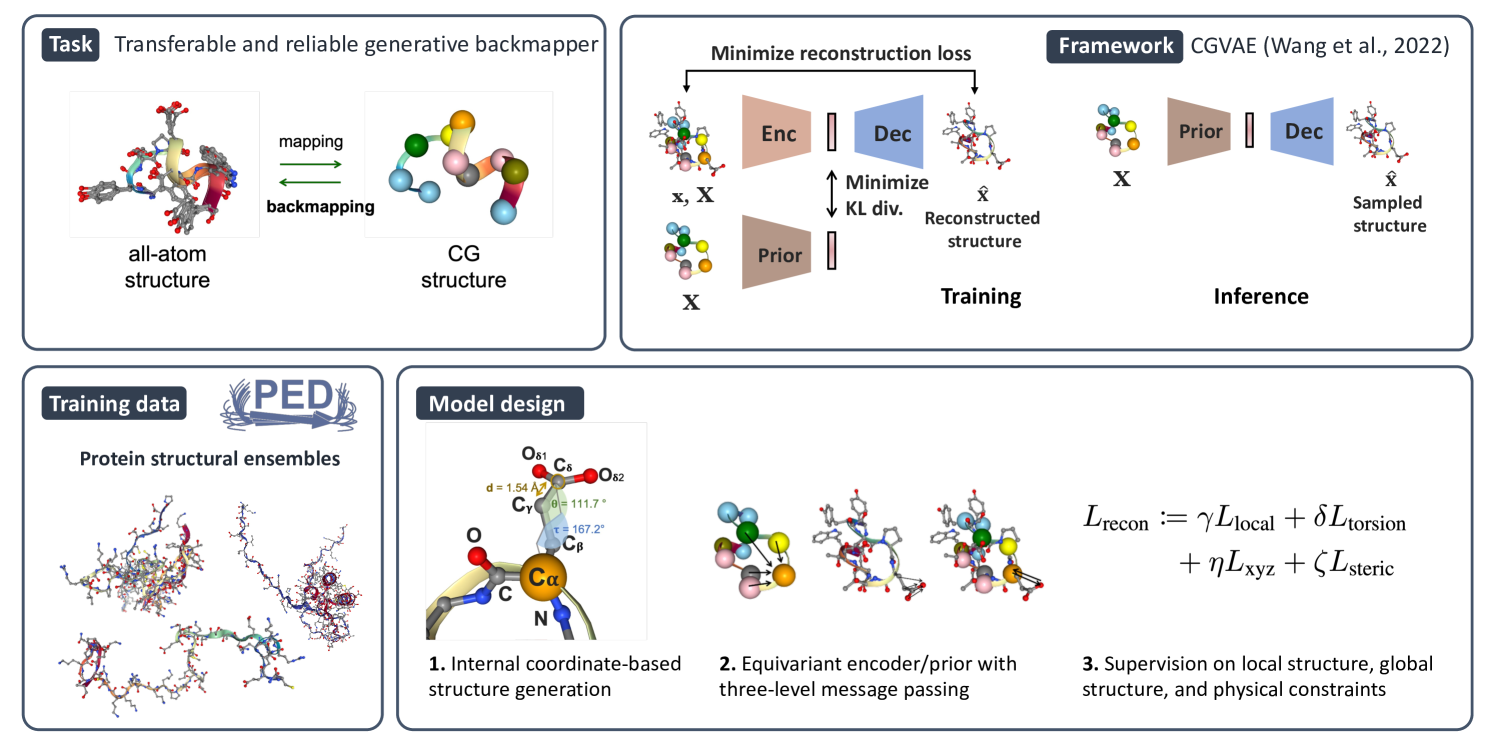
実験結果
リサーチクエスチョン
- RQ1生成バックマッピングモデルは多様なタンパク質化学に一般化できる原子分解構成を学習できるか。
- RQ2等変エンコーダを用いた内部座標デコーディングは、トポロジー保持と立体衝突の低減に Cartesian デコーダより寄与するか。
- RQ3物理情報を含む損失項が再構成品質と妥当性(立体衝突、結合、角度、ねじれ)に与える影響は何か。
- RQ4PED 系列で学習した転送可能なモデルは、未知のタンパク質およびタンパク質–IDP 複合体に対して正確なバックマッピングを提供できるか。
主な発見
- GenZProt (m1) は、テストタンパク質に対する RMSD、GED、立体衝突指標で ablated 変種を上回る最良の成績を一貫して達成する。
- 内部座標 Z-matrix デコーダを持つ等変エンコーダ/事前分布は、大規模なタンパク質に対して不変対策や Cartesian デコーダより優れている。
- 多様な PED 系列で学習することで、PED00151 のみの学習データ以上に一般化できる転送可能モデルが得られる。
- 特に xyz および steric 項の物理情報を伴う損失は高品質な再構成と立体衝突の低減に不可欠である。
- 定性的分析では、再構成された構造とサンプル構造がトポロジーと長距離相互作用を維持し、立体的問題が限定的であることが示される。水素結合接触も合理的に回復される。

より良い研究を、今すぐ始めましょう
論文の読解から最終レビューまで、研究時間を劇的に削減しましょう。
クレジットカード登録不要
このレビューはAIが作成し、人間の編集者が確認しました。