
[論文レビュー] Classical benchmarking of zero noise extrapolation beyond the exactly-verifiable regime
この論文はゼロノイズ外挿法(ZNE)を kicked Ising 回路の様々な古典的シミュレーションと比較し、ZNEが検証可能な範囲を超えても高精度を維持することを示し、複数の古典的手法を比較します。
In a recent work a quantum error mitigation protocol was applied to the expectation values obtained from circuits on the IBM Eagle quantum processor with up $127$ - qubits with up to $60 \; - \; \mbox{CNOT}$ layers. To benchmark the efficacy of this quantum protocol a physically motivated quantum circuit family was considered that allowed access to exact solutions in different regimes. The family interpolated between Clifford circuits and was additionally evaluated at low depth where exact validation is practical. It was observed that for highly entangling parameter regimes the circuits are beyond the validation of matrix product state and isometric tensor network state approximation methods. Here we compare the experimental results to matrix product operator simulations of the Heisenberg evolution, find they provide a closer approximation than these pure-state methods by exploiting the closeness to Clifford circuits and limited operator growth. Recently other approximation methods have been used to simulate the full circuit up to its largest extent. We observe a discrepancy of up to $20\%$ among the different classical approaches so far, an uncertainty comparable to the bootstrapped error bars of the experiment. Based on the different approximation schemes we propose modifications to the original circuit family that challenge the particular classical methods discussed here.
研究の動機と目的
- 正確な古典的検証レジームを超える回路に対して、ゼロノイズ外挿法(ZNE)などの量子誤り緩和技術(QEM)の評価を動機づける。
- 実験的なZNEの結果を、ハイゼンベルグ進化または状態ダイナミクスを近似する幅広い古典的シミュレーション手法と比較する。
- 検証可能な領域とそれを超える領域の双方で、ZNE補正観測量を最もよく再現する古典的手法を評価する。
- 古典的方法に挑戦し、その限界を浮き彫りにする回路およびモデリングの拡張を提案する。
提案手法
- 観測量のハイゼンベルグ進化を、マトリックス積分子演算子(MPO)表現を用いて近似し、O(D) = (U†)D O U^D ダイナミクスを模擬する。
- 2D ヘビーヘックス格子を蛇行順序で1D鎖へ写像し、層間で変分MPO圧縮を挟みながら、入れ子状のユニタリ共役変換を実行する。
- 固定結合次元 χ を用いて切り捨て誤差を制御し、与えられた初期生成状態に対してDステップ後の期待値を計算する。
- MPO-ハイゼンベルグの結果を、厳密計算、純状態MPSダイナミクス、等尺性テンソルネットワーク(isoTNS)、BP-TNS、CPT、そして小規模デバイスのシミュレーションと比較する。
- 演算子エンタングルメントエントロピー(OEE)およびOTOCを用いて演算子の成長を分析し、MPOの有効性とライトコーン動態を理解する。
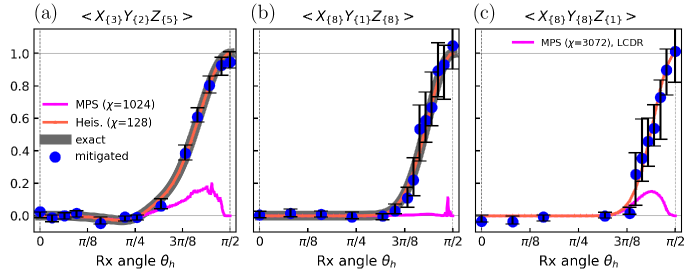
![Figure 1: Comparison of classical approximations for $\langle Z_{62}\rangle$ at Trotter depth $D=20$ against experimental ZNE results: (1) matrix-product-state (MPS) representation of the pure state within a lightcone-reduced volume [ 3 ] ; (2) extrapolation of the MPS results with respect to the es](https://ar5iv.labs.arxiv.org/html/2306.17839/assets/x1.png)
実験結果
リサーチクエスチョン
- RQ1古典的検証が可能な領域で、ZNEは厳密な結果をどれほど再現できるか。
- RQ2代替の古典的手法(MPS、MPO、BP-TNS、CPT)は検証可能な領域を超えて正確さを拡張できるか、そしてそれらはZNEとどう比較されるか。
- RQ3heavy-hex格子上の大深さ・高エンタングルメント回路に対するMPOベースのハイゼンベルグ進化の限界とスケーリングは何か。
- RQ4回路変種(非Cliffordゲート、非可換ゲート層)は、ZNEと古典的シミュレーションの性能と比較可能性にどう影響するか。
- RQ5演算子ベースの古典的シミュレーションは、近短期デバイス上のZNE結果を予測する信頼できるベンチマークや改善を提供できるか。
主な発見
- ZNEは、古典的手段で検証可能な領域でブートストラップ誤差範囲内の厳密な結果を再現する。
- MPSおよび2D isoTNS純粋状態法は、パラメータの全範囲で観測量を再現するのに苦戦する。特にClifford点から離れた領域で。
- ハイゼンベルグ MPO進化は、厳密検証を超えたパラメータ領域でZNE結果と一致し、20 トロッター手順(60 CNOT層)まで。
- 特定の領域近傍で、さまざまな古典的アプローチは約20%の範囲で一致し、ZNEの誤差棒と同程度のばらつきとなり、残る古典的不確実性を示している。
- 演算子の成長は最悪ケースの予想より遅く、OEEは深さに二次的、OTOCsはライトコーン制限された広がりを示し、MPOの効率性を高める。BP-TNSは大深さとループ状エンタングルメントで限界を示す。
より良い研究を、今すぐ始めましょう
論文設計から論文執筆まで、研究時間を劇的に削減しましょう。
クレジットカード登録不要
このレビューはAIが作成し、人間の編集者が確認しました。