
[論文レビュー] CO2 storage in deep saline aquifers: evaluation of geomechanical risks using integrated modeling workflow
この論文はMUFITSとFLAC3Dを結合した逐次結合型の水理地盤力学モデリングワークフローを開発し、深部塩水層を地震断層が横断するCO2注入時の地盤力学リスク(断層活性化、透過性変化、潜在的なCO2漏出)を評価する。
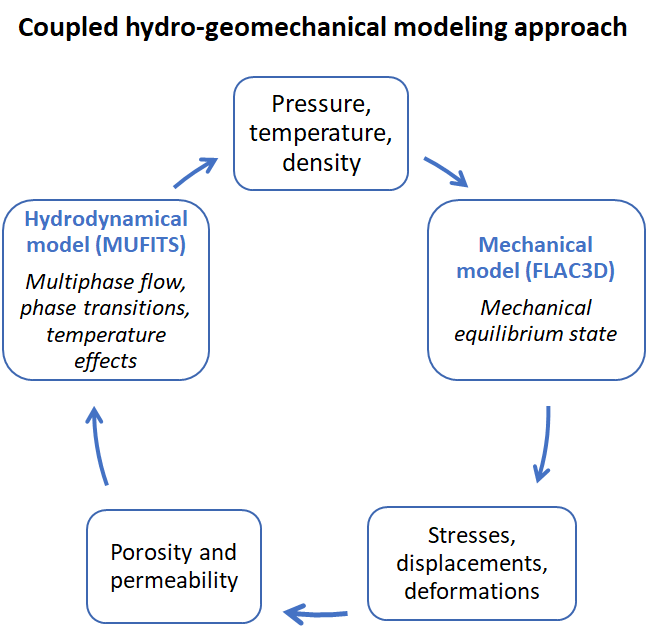
CO2 injection into a saline aquifer crossed by a tectonic fault is studied with coupled fluid mechanics - geomechanics modeling. The simulation approach is based on coupling of the MUFITS reservoir simulator and the FLAC3D mechanical simulator via an in-house API (i.e., an algorithm for data transfer between simulators). MUFITS simulates the non-isothermal multiphase flow of CO2 and brine in rock formation accounting for phase transitions and thermal effects. The modeling workflow is sequential, so that hydrodynamical simulations are carried out at a certain time interval, after which pressure, temperature, and density distributions are passed to FLAC3D, which calculates the equilibrium mechanical state. Computed deformations and stresses are utilized to update the porosity and permeability fields for the subsequent hydrodynamic modeling. In particular, we focus on the tectonic fault and its behavior during CO2 injection. We distinguish the damage zone and core inside the fault and derive the closure relations for their permeability alteration analytically. The coupled approach developed here is applied to simulate CO2 injection into synthetic and realistic reservoir models. For the former one, we study the effect of formation depth and presence of the tectonic stresses at the initial mechanical state, while for the latter, we consider different injection modes (bottomhole pressure). In each numerical experiment, we describe the evolution of the fault permeability due to the slip along its plane and the development of plastic deformations leading to the loss of reservoir integrity and CO2 leakage. Sensitivity analysis of the coupled model to realistic values of input parameters to assess the fault stability is carried out.
研究の動機と目的
- 深部塩水層におけるCO2貯蔵時の地盤力学リスクを動機付け、対処する。
- 流体フローと力学を統合した逐次結合型の水理地盤力学モデリングワークフローを開発する。
- CO2注入下での断層帯における透過性の進化を特徴づける。
- 合成および現実的な貯留層を通じて、断層活性化、塑性変形、およびCO2漏出シナリオを評価する。
提案手法
- 非等温多相CO2–塩水フローのためのMUFITSによる結合水理地盤力学モデリングと、機械的平衡のためのFLAC3D。
- MUFITSとFLAC3D間のデータ転送を社内APIを介して行う逐次結合。
- 全体体積ひずみから体積率透過率とべき法則透過率関係を用いて、孔隙率と透過率を更新。
- 透過性の進化を断層破壊帯と断層核部の解析閉包関係として導出。
- ワークフローに断層帯透過性変化を記述する解析モデルを組み込む。
- 断層安定性に影響を与えるパラメータ値を探索する感度分析を実施。
実験結果
リサーチクエスチョン
- RQ1深部塩水層へのCO2注入は、貯留層に交差する地質断層の機械状態にどのように影響するか?
- RQ2孔圧と温度の変化は弾性および塑性変形を介して断層の透過性をどう変えるか?
- RQ3どの注入モードと貯留層構成が、断層すべり、破壊帯透過性の変化、またはCO2漏出経路へとつながるのか?
- RQ4統合された水理地盤力学モデルは、注入中の断層帯の孔隙と透過性の進化を予測できるか?
主な発見
- 結合したMUFITS–FLAC3Dワークフローは、圧力・温度・密度分布とそれが孔隙率および透過率に与える影響をシミュレートできる。
- 断層帯の透過性は断層面に沿った滑りや塑性変形により進化し、漏出導管を形成する可能性がある。
- 破壊帯と断層核部の透過性変化を解析的に記述するモデルをワークフローに組み込み、導管形成を定量化。
- 感度分析は、入力パラメータが断層安定性とCO2漏出リスクへ与える影響を示す。
- 本研究は合成モデルと現実的な貯留層モデルの両方を評価し、異なる注入モードが地盤力学リスクに及ぼす影響を示す。
より良い研究を、今すぐ始めましょう
論文の読解から最終レビューまで、研究時間を劇的に削減しましょう。
クレジットカード登録不要
このレビューはAIが作成し、人間の編集者が確認しました。