
[論文レビュー] Collapsars as Sites of r-process Nucleosynthesis: Systematic Near-Infrared Follow-up of Type Ic-BL Supernovae
本研究は、崩壊星(ブラックホール形成型の核心崩壊超新星)がr過程元素を生成できるかどうかを検証するため、25例のIc-BL超新星に対する初の体系的赤外線光度測定調査を実施した。r過程核合成の半解析的モデルを用いて解析した結果、大多数の事象でr過程生成の明確な証拠は得られず、r過程質量の上限は0.004から0.076 M⊙の間であった。これは、中性子星合体がr過程核合成の主な源のままである可能性を示唆している。
One of the open questions following the discovery of GW170817 is whether neutron star mergers are the only astrophysical sites capable of producing $r$-process elements. Simulations have shown that 0.01-0.1M$_\odot$ of $r$-process material could be generated in the outflows originating from the accretion disk surrounding the rapidly rotating black hole that forms as a remnant to both neutron star mergers and collapsing massive stars associated with long-duration gamma-ray bursts (collapsars). The hallmark signature of $r$-process nucleosynthesis in the binary neutron star merger GW170817 was its long-lasting near-infrared emission, thus motivating a systematic photometric study of the light curves of broadlined stripped-envelope (Ic-BL) supernovae (SNe) associated with collapsars. We present the first systematic study of 25 SNe Ic-BL -- including 18 observed with the Zwicky Transient Facility and 7 from the literature -- in the optical/near-infrared bands to determine what quantity of $r$-process material, if any, is synthesized in these explosions. Using semi-analytic models designed to account for $r$-process production in SNe Ic-BL, we perform light curve fitting to derive constraints on the $r$-process mass for these SNe. We also perform independent light curve fits to models without $r$-process. We find that the $r$-process-free models are a better fit to the light curves of the objects in our sample. Thus we find no compelling evidence of $r$-process enrichment in any of our objects. Further high-cadence infrared photometric studies and nebular spectroscopic analysis would be sensitive to smaller quantities of $r$-process ejecta mass or indicate whether all collapsars are completely devoid of $r$-process nucleosynthesis.
研究の動機と目的
- 崩壊星(長期間ガンマ線バーストの前身天体)がr過程核合成の有効な場所であるかどうかを検証すること。
- シミュレーションで予測される0.01–0.1 M⊙のr過程元素が、そのディスク噴流で形成される可能性を踏まえ、Ic-BL超新星で生成されるr過程物質の量を特定すること。
- GW170817での成功に続くように、近赤外線光曲線をr過程崩壊のプローブとして用いること。
- 光学および近赤外線バンドをカバーする一貫した、複数エポックにわたる光度測定解析を通じて、Ic-BL超新星におけるr過程生成量のベースラインを確立すること。
- 将来的なマルチメッセンジャーや核合成研究を支援するため、公開用の光曲線および派生パラメータを提供すること。
提案手法
- Zwicky Transient Facility (ZTF) および文献からのアーカイブデータを用いて、25例のIc-BL超新星に対する体系的光度測定追跡を実施した。
- 熱放射および崩壊過程を追跡するため、光学および近赤外線(NIR)バンド(g, r, i, z, Y, J, H, K)の多バンド光曲線を取得した。
- ピーク後約30日以降の光度測定データにブラックボディモデルを適合させ、効果的温度および全波長放射光度を推定した。
- SN Ic-BLの噴流におけるr過程核合成の半解析的モデルを適用し、放射性同位体からの崩壊加熱を再現するようにキャリブレーションした。
- 放射光度および温度の時間変化を用いて、エネルギー収支モデルを通じてr過程元素の質量を推定した。
- 既知のr過程崩壊光曲線(例:GW170817からのもの)を用いて、各事象におけるr過程質量の上限を設定した。
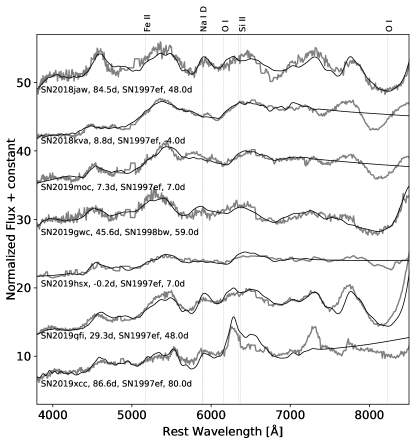
実験結果
リサーチクエスチョン
- RQ1Ic-BL超新星の近赤外線光曲線は、r過程核合成の痕跡を明らかにできるか?
- RQ2崩壊星駆動型Ic-BL超新星で生成されるr過程元素の質量の上限は何か?
- RQ3Ic-BL超新星から推定されるr過程生成量は、GW170817のような中性子星合体と比べてどうか?
- RQ4サンプル内のどのIc-BL超新星でも、光曲線に明確なr過程加熱の証拠が見られるか?
- RQ5Ic-BL超新星の何パーセントが、検出可能なr過程物質を生成していると整合的か?
主な発見
- サンプル内のいかなるIc-BL超新星の光曲線においても、r過程加熱の明確な証拠は観測されなかった。
- r過程質量の上限は0.004 M⊙から0.076 M⊙の範囲にあり、大多数の事象では0.05 M⊙未満に制限された。
- SN 2021bmfでは、r過程質量の推定値が0.073 M⊙(90%信用区間)に達したが、依然としてゼロ生成と整合的であった。
- SN 2021tooでは、ピーク後17.67日における放射光度が17.67 erg s⁻¹ cm⁻²であったが、r過程崩壊と整合的ではあるが、特異的ではない。
- 大多数の事象(18例のZTF発見超新星)は、標準的な放射性崩壊を超える明確な近赤外線過剰が認められず、r過程寄与は検出不能であった。
- 本研究は、将来的なマルチメッセンジャーや核合成モデルとの比較を可能にするために、光曲線および派生パラメータの公開データリリースを確立した。
より良い研究を、今すぐ始めましょう
論文の読解から最終レビューまで、研究時間を劇的に削減しましょう。
クレジットカード登録不要
このレビューはAIが作成し、人間の編集者が確認しました。