
[論文レビュー] Compact realization of all-attosecond pump-probe spectroscopy
本稿では、後処理圧縮された数フェムト秒の近赤外パルスと一時的ブルーシフト強化型高調波生成(HHG)幾何学を用いた、1 kHzのコンactなレーザー駆動型全アト秒ポンププローブ分光法の実装を提示する。ピーク強度が最大1×10¹³ W/cm²に達する近い孤立型アト秒XUVパルスを実現し、原子および分子内の電子励起状態の要素特異的かつ高時間分解能での研究が可能となる。
The ability to perform attosecond-pump attosecond-probe spectroscopy (APAPS) is a longstanding goal in ultrafast science. While first pioneering experiments demonstrated the feasibility of APAPS, the low repetition rates (10-120 Hz) and the large footprints of existing setups have so far hindered the widespread exploitation of APAPS. Here we demonstrate two-color APAPS using a commercial laser system at 1 kHz, straightforward post-compression in a hollow-core fiber and a compact high-harmonic generation (HHG) setup. The latter enables the generation of intense extreme-ultraviolet (XUV) pulses by using an out-of-focus HHG geometry and by exploiting a transient blueshift of the driving laser in the HHG medium. Near-isolated attosecond pulses are generated, as demonstrated by one-color and two-color XUV-pump XUV-probe experiments. Our concept allows selective pumping and probing on extremely short timescales and permits investigations of fundamental processes that are not accessible by other pump-probe techniques.
研究の動機と目的
- アト秒ポンプアト秒プローブ分光法(APAPS)の広範な導入を妨げてきた低繰り返し周波数・大型装置型の制限を克服すること。
- コンパクトで商業用のレーザーシステムを用いて、強度が高く、ほぼ孤立したアト秒XUVパルスを生成することで、高時間分解能での電子励起状態の研究を可能にすること。
- XUVパルスは近赤外(NIR)パルスよりも局所的かつ要素特異的であるため、コア電子および内殻バリエンス電子励起状態の選択的ポンプおよびプローブを実現すること。
- XUVポンプとXUVプローブを用いたAPAPSが、XUV-NIR実験で見られる10⁻⁴の変化と比較して10–100%の信号変化を達成できることを示し、より安定した測定が可能になること。
- 日常的なラボ利用および将来的な複雑系への応用に適した、スケーラブルで安定的かつコンパクトなアト秒科学のプラットフォームを構築すること。
提案手法
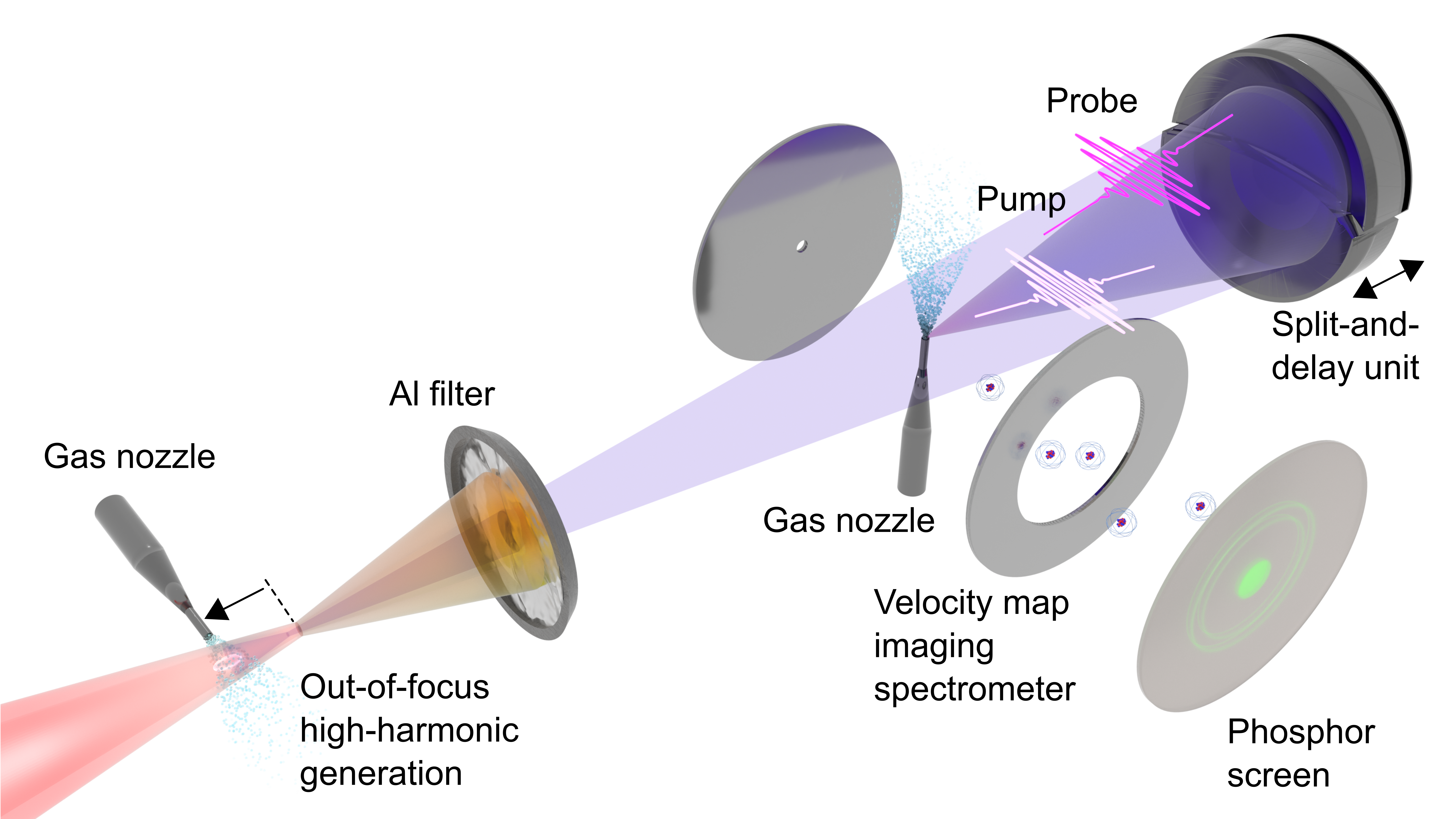
- 高調波生成(HHG)の駆動源として、商業用1 kHz、36-fs、13 mJ、800 nmのレーザーシステムを用いる。
- ヘリウムを3.5 barで充填した1 mの長さ、400 µmコアのホロウコアファイバーを用いて、レーザーパルスの後処理圧縮を実施し、圧縮後パルス幅を3.8 fsに達成した。
- 焦点外の幾何配置を用いることで、HHG媒体内に一時的ブルーシフト効果を発生させ、強度が高く短いXUVパルスの生成を強化する。
- キryptonまたはキセノンを4 barのバック圧力で供給するパルスガスジェットと1 mmのアイリスを用いて、HHG効率を最適化する。
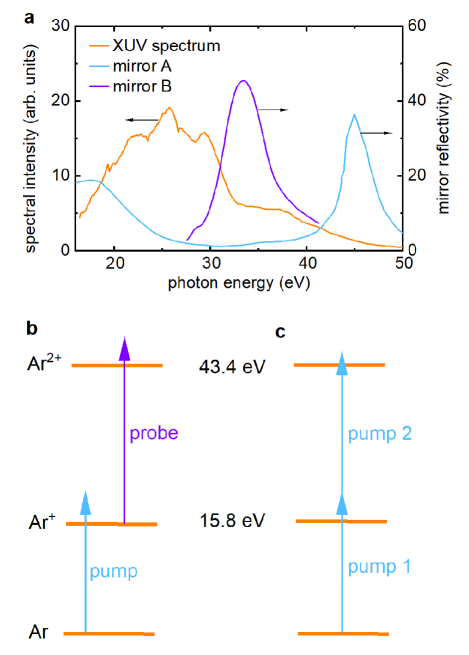
- 分光器に回折格子とマイクロチャネルプレート/蛍光スクリーンを組み合わせ、アルミフィルター(100 nmおよび200 nm)を用いて残留NIR光を抑制することで、XUVパルスを同定する。
- 球面 multilayer ミラー(反射率ピークが<25 eVおよび33.5 eV付近)を備えたスプリット・ディレイユニットを用い、ポンププローブ遅延を制御し、XUVパルスの空間的重畳を実現する。
実験結果
リサーチクエスチョン
- RQ1コンパクトで高繰り返し周波数(1 kHz)のレーザーシステムが、ポンププローブ実験に適した強度が高く、ほぼ孤立したアト秒XUVパルスを生成できるか?
- RQ2焦点外のHHG幾何配置における一時的ブルーシフト効果が、XUVパルス生成の効率および強度を顕著に向上させられるか?
- RQ3XUVパルスをポンプおよびプローブとして用いた全アト秒ポンププローブ分光法が、XUV-NIR方式と比較して信号対雑音比を著しく向上させられるか?
- RQ4コンパクトで安定的かつ商業的に実現可能な装置で、達成可能なXUVパルスの持続時間およびピーク強度はどの程度か?
- RQ5この装置は、アト秒〜数フェムト秒スケールの電子励起状態の動的挙動を、要素特異的感度をもって解明できるか?
主な発見
- 100アト秒程度の測定持続時間が確認された近い孤立型アト秒XUVパルスが生成された。これは、ワンカラーパルスおよびツーカラーパルスXUVポンプXUVプローブ実験によって裏付けられた。
- XUVピーク強度は最大1×10¹³ W/cm²に達し、鏡B(33.5 eV)での標的へのパルスエネルギーは0.15 nJに達した。これにより、強場相互作用が可能となった。
- XUVパルスエネルギーはソースで10 nJと推定され、透過および反射損失を経て、最終的に標的でのパルスエネルギーは0.12–0.15 nJに減少した。
- XUVポンプXUVプローブ実験では10–100%の信号変化が達成され、XUV-NIRポンププローブ実験で一般的に観察される10⁻⁴の変化と比較して顕著に高い値となった。
- 1 kHzのレーザーシステムの使用により、高い信号対雑音比と安定した動作が実現され、従来のAPAPS実験で用いられた低繰り返し周波数システムの制限を克服した。
- 焦点外のHHG幾何配置における一時的ブルーシフト効果により、中程度のレーザーパルスエネルギー(1 mJ)でも強力なXUVパルスの効率的生成が可能となった。
より良い研究を、今すぐ始めましょう
論文の読解から最終レビューまで、研究時間を劇的に削減しましょう。
クレジットカード登録不要
このレビューはAIが作成し、人間の編集者が確認しました。