
[論文レビュー] Constraining cosmology with the Gaia-unWISE Quasar Catalog and CMB lensing: structure growth
本研究では、Gaia–unWISEクェザー・カタログ(Quaia)とPlanck CMBレンズィングマップとのクロス相関を用いて、宇宙論的パラメータを制約し、σ₈ = 0.766 ± 0.034およびΩₘ = 0.343⁺⁰.⁰¹⁷₋₀.⁰¹⁹を測定した。結果は約1.4σのずれでPlanckと整合的であり、高赤方偏移クェザーに起因するやや低いσ₈が、CMBレンズィングマップにおけるCIBフォアグラウンド汚染の可能性によって引き起こされていると考えられる。
We study the angular clustering of Quaia, a Gaia- and unWISE-based catalog of over a million quasars with an exceptionally well-defined selection function. With it, we derive cosmology constraints from the amplitude and growth of structure across cosmic time. We divide the sample into two redshift bins, centered at $z=1.0$ and $z=2.1$, and measure both overdensity auto-correlations and cross-correlations with maps of the Cosmic Microwave Background convergence measured by Planck. From these data, and including a prior from measurements of the baryon acoustic oscillations scale, we place constraints on the amplitude of the matter power spectrum $σ_8=0.766\pm 0.034$, and on the matter density parameter $Ω_m=0.343^{+0.017}_{-0.019}$. These measurements are in reasonable agreement with \planck at the $\sim$ 1.4$σ$ level, and are found to be robust with respect to observational and theoretical uncertainties. We find that our slightly lower value of $σ_8$ is driven by the higher-redshift sample, which favours a low amplitude of matter fluctuations. We present plausible arguments showing that this could be driven by contamination of the CMB lensing map by high-redshift extragalactic foregrounds, which should also affect other cross-correlations with tracers of large-scale structure beyond $z\sim1.5$. Our constraints are competitive with those from state-of-the-art 3$ imes$2-point analyses, but arise from a range of scales and redshifts that is highly complementary to those covered by cosmic shear data and most galaxy clustering samples. This, coupled with the unprecedented combination of volume and redshift precision achieved by Quaia allows us to break the usual degeneracy between $Ω_m$ and $σ_8$.
研究の動機と目的
- 宇宙時間にわたるQuaiaカタログのクェザーの角度クラスタリングを用いて、宇宙論的パラメータを制約すること。
- クェザーとCMBレンズィングマップのクロス相関から得られる宇宙論的制約の妥当性を検証すること。
- 特にCMBレンズィングマップにおけるフォアグラウンド汚染が高赤方偏移クェザーのクロス相関に与える影響を含む、潜在的な系外要因を調査すること。
- 赤方偏移が高く、赤方偏移の精度が高く、大規模なクェザー標本を用いて、Ωₘとσ₈のデゲネラシーを解消すること。
提案手法
- Quaiaカタログは、100万個を超えるクェザーを含み、明確な選択関数を持つ。これは赤方偏移z = 1.0とz = 2.1を中心とする2つの赤方偏移ビンに分割される。
- 複数の角度スケールにわたる、過密度自己相関およびPlanck CMBレンズィング収束マップ(κ)とのクロス相関が測定される。
- バリオンアコースティックオシレーション(BAO)スケールの事前分布を含む、統合尤度解析を用いて宇宙論的制約が導かれる。
- 観測系外要因のバイアスをテストするために、データ駆動型のノルムモデルと、PR3およびPR4 CMBレンズィング再構成マップ(MV、Pol、TT)を用いたモンテカルロシミュレーションが用いられる。
- 異なるレンズィング再構成手法(例:MV対Pol)間のバンドパワーのずれは、χ²検定により統計的フラクチュエーションとの整合性を評価される。
- レンズィング正規化補正を考慮し、クェザー過密度マップの制約付きガウス実現を用いて、信号とノイズ成分をモデル化する。
実験結果
リサーチクエスチョン
- RQ1高赤方偏移クェザーとCMBレンズィングのクロス相関は、σ₈およびΩₘの制約を安定して得られるか?
- RQ2得られたσ₈とPlanckの値との間に観測された不一致は、CMBレンズィングマップの系外要因に起因しているか?
- RQ3Quaiaカタログは、高赤方偏移の精度と大規模な体積のおかげで、Ωₘとσ₈のデゲネラシーを解消できるか?
- RQ4銀河間フォアグラウンド、特に宇宙赤外背景(CIB)は、z > 1.5におけるクェザー–CMBレンズィングクロス相関にどの程度影響を及ぼすか?
- RQ5CMBレンズィング再構成(例:MV対Pol)間の観測されたバンドパワーの違いは、統計的フラクチュエーションと整合的か、それとも残存する系外要因の兆候か?
主な発見
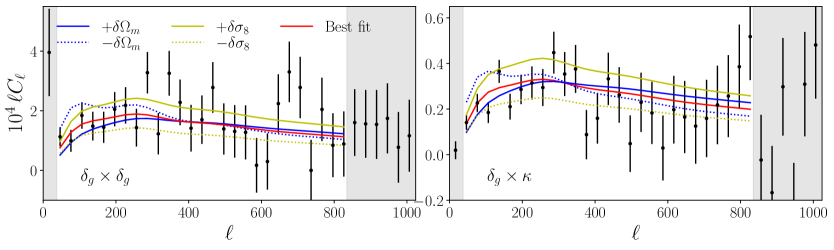
- 分析からσ₈ = 0.766 ± 0.034およびΩₘ = 0.343⁺⁰.⁰¹⁷₋₀.⁰¹⁹が得られ、約1.4σのずれでPlanckと合理的に整合している。
- わずかに低いσ₈の値は、主にz ≈ 2.1の高赤方偏移クェザー標本に起因し、物質フラクチュエーションの振幅が低くなる傾向を示している。
- PR3およびPR4 CMBレンズィングマップを用いた整合性テストでは、全χ²検定のPTEが6%であり、やや緊張しているが、統計的フラクチュエーションの反例とは見なされない。
- ℓ ≈ 100およびℓ ≈ 370のビンではPTEが約2%であり、残留系外要因を示唆する可能性のある不一致を示している。
- MVおよびPolレンズィング再構成間の観測されたバンドパワーのずれは、統計的フラクチュエーションと整合的であるが、CIBが高赤方偏移クェザー–CMBレンズィングクロス相関に影響を与える最も可能性の高いフォアグラウンド汚染物質であると特定された。
- 結果は観測的および理論的不確実性に対して頑健であり、Quaia標本は3×2-point解析における宇宙線ひずみと銀河クラスタリングとは非常に補完的である。
より良い研究を、今すぐ始めましょう
論文の読解から最終レビューまで、研究時間を劇的に削減しましょう。
クレジットカード登録不要
このレビューはAIが作成し、人間の編集者が確認しました。